

266
Digital Electronics
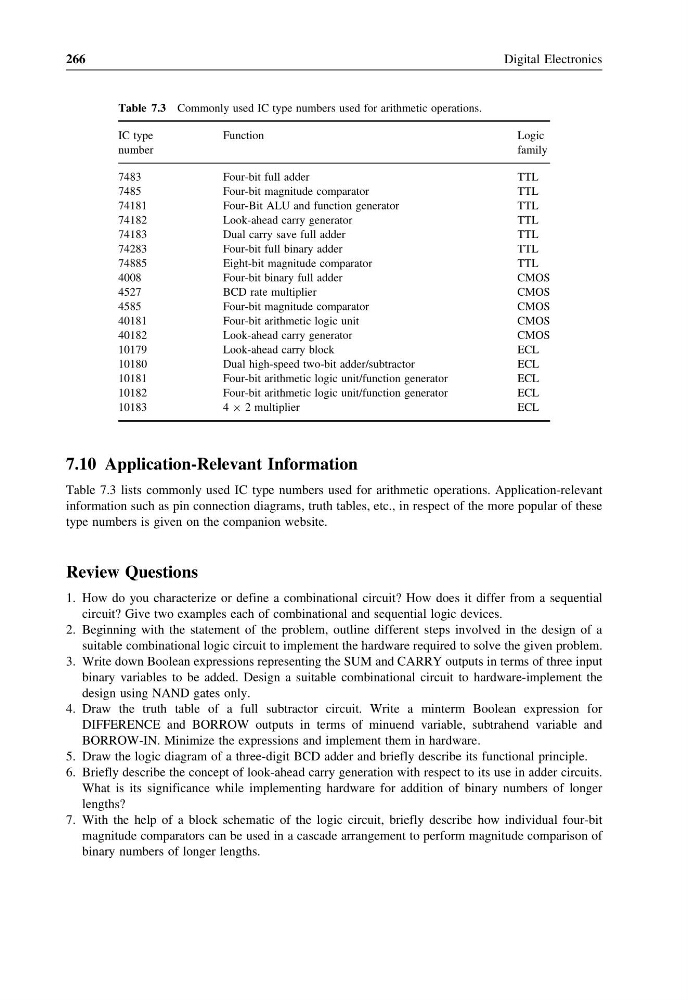
Table 7.3 Commonly used IC type numbers used for arithmetic operations.
IC type
Function
Logic
number
family
7483
Four-bit full adder
TTL
7485
Four-bit magnitude comparator
TTL
74181
Four-Bit ALU and function generator
TTL
74182
Look-ahead carry generator
TTL
74183
Dual carry save full adder
TTL
74283
Four-bit full binary adder
TTL
74885
Eight-bit magnitude comparator
TTL
4008
Four-bit binary full adder
CMOS
4527
BCD rate multiplier
CMOS
4585
Four-bit magnitude comparator
CMOS
40181
Four-bit arithmetic logic unit
CMOS
40182
Look-ahead carry generator
CMOS
10179
Look-ahead carry block
ECL
10180
Dual high-speed two-bit adder/subtractor
ECL
10181
Four-bit arithmetic logic unit/function generator
ECL
10182
Four-bit arithmetic logic unit/function generator
ECL
10183
4 × 2 multiplier
ECL
7.10 Application-Relevant Information
Table 7.3 lists commonly used IC type numbers used for arithmetic operations. Application-relevant
information such as pin connection diagrams, truth tables, etc., in respect of the more popular of these
type numbers is given on the companion website.
Review Questions
1. How do you characterize or define a combinational circuit? How does it differ from a sequential
circuit? Give two examples each of combinational and sequential logic devices.
2. Beginning with the statement of the problem, outline different steps involved in the design of a
suitable combinational logic circuit to implement the hardware required to solve the given problem.
3. Write down Boolean expressions representing the SUM and CARRY outputs in terms of three input
binary variables to be added. Design a suitable combinational circuit to hardware-implement the
design using NAND gates only.
4. Draw the truth table of a full subtractor circuit. Write a minterm Boolean expression for
DIFFERENCE and BORROW outputs in terms of minuend variable, subtrahend variable and
BORROW-IN. Minimize the expressions and implement them in hardware.
5. Draw the logic diagram of a three-digit BCD adder and briefly describe its functional principle.
6. Briefly describe the concept of look-ahead carry generation with respect to its use in adder circuits.
What is its significance while implementing hardware for addition of binary numbers of longer
lengths?
7. With the help of a block schematic of the logic circuit, briefly describe how individual four-bit
magnitude comparators can be used in a cascade arrangement to perform magnitude comparison of
binary numbers of longer lengths.
Digital Electronics
Table 7.3 Commonly used IC type numbers used for arithmetic operations.
IC type
Function
Logic
number
family
7483
Four-bit full adder
TTL
7485
Four-bit magnitude comparator
TTL
74181
Four-Bit ALU and function generator
TTL
74182
Look-ahead carry generator
TTL
74183
Dual carry save full adder
TTL
74283
Four-bit full binary adder
TTL
74885
Eight-bit magnitude comparator
TTL
4008
Four-bit binary full adder
CMOS
4527
BCD rate multiplier
CMOS
4585
Four-bit magnitude comparator
CMOS
40181
Four-bit arithmetic logic unit
CMOS
40182
Look-ahead carry generator
CMOS
10179
Look-ahead carry block
ECL
10180
Dual high-speed two-bit adder/subtractor
ECL
10181
Four-bit arithmetic logic unit/function generator
ECL
10182
Four-bit arithmetic logic unit/function generator
ECL
10183
4 × 2 multiplier
ECL
7.10 Application-Relevant Information
Table 7.3 lists commonly used IC type numbers used for arithmetic operations. Application-relevant
information such as pin connection diagrams, truth tables, etc., in respect of the more popular of these
type numbers is given on the companion website.
Review Questions
1. How do you characterize or define a combinational circuit? How does it differ from a sequential
circuit? Give two examples each of combinational and sequential logic devices.
2. Beginning with the statement of the problem, outline different steps involved in the design of a
suitable combinational logic circuit to implement the hardware required to solve the given problem.
3. Write down Boolean expressions representing the SUM and CARRY outputs in terms of three input
binary variables to be added. Design a suitable combinational circuit to hardware-implement the
design using NAND gates only.
4. Draw the truth table of a full subtractor circuit. Write a minterm Boolean expression for
DIFFERENCE and BORROW outputs in terms of minuend variable, subtrahend variable and
BORROW-IN. Minimize the expressions and implement them in hardware.
5. Draw the logic diagram of a three-digit BCD adder and briefly describe its functional principle.
6. Briefly describe the concept of look-ahead carry generation with respect to its use in adder circuits.
What is its significance while implementing hardware for addition of binary numbers of longer
lengths?
7. With the help of a block schematic of the logic circuit, briefly describe how individual four-bit
magnitude comparators can be used in a cascade arrangement to perform magnitude comparison of
binary numbers of longer lengths.