

260
Digital Electronics
7.7 Arithmetic Logic Unit (ALU)
The arithmetic logic unit (ALU) is a digital building block capable of performing both arithmetic as
well as logic operations. Arithmetic logic units that can perform a variety of arithmetic operations
such as addition, subtraction, etc., and logic functions such as ANDing, ORing, EX-ORing, etc., on
two four-bit numbers are usually available in IC form. The function to be performed is selectable from
function select pins. Some of the popular type numbers of ALU include 74181, 74381, 74382, 74582
(all from the TTL logic family) and 40181 (from the CMOS logic family). Functional details of these
ICs are given in the latter part of the chapter under the heading of Application-Relevant Information.
More than one such IC can always be connected in cascade to perform arithmetic and logic operations
on larger bit numbers.
7.8 Multipliers
Multiplication of binary numbers is usually implemented in microprocessors and microcomputers by
using repeated addition and shift operations. Since the binary adders are designed to add only two
binary numbers at a time, instead of adding all the partial products at the end, they are added two
at a time and their sum is accumulated in a register called the accumulator register. Also, when the
multiplier bit is ‘0’, that very partial product is ignored, as an all ‘0’ line does not affect the final result.
The basic hardware arrangement of such a binary multiplier would comprise shift registers for the
multiplicand and multiplier bits, an accumulator register for storing partial products, a binary parallel
adder and a clock pulse generator to time various operations.
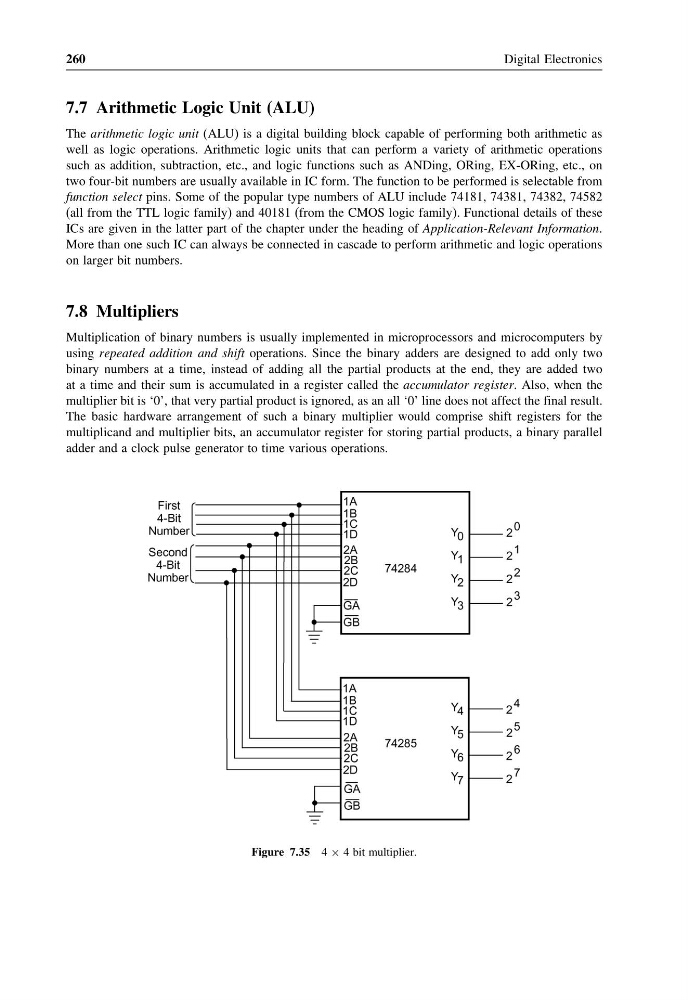
Figure 7.35 4 × 4 bit multiplier.
Digital Electronics
7.7 Arithmetic Logic Unit (ALU)
The arithmetic logic unit (ALU) is a digital building block capable of performing both arithmetic as
well as logic operations. Arithmetic logic units that can perform a variety of arithmetic operations
such as addition, subtraction, etc., and logic functions such as ANDing, ORing, EX-ORing, etc., on
two four-bit numbers are usually available in IC form. The function to be performed is selectable from
function select pins. Some of the popular type numbers of ALU include 74181, 74381, 74382, 74582
(all from the TTL logic family) and 40181 (from the CMOS logic family). Functional details of these
ICs are given in the latter part of the chapter under the heading of Application-Relevant Information.
More than one such IC can always be connected in cascade to perform arithmetic and logic operations
on larger bit numbers.
7.8 Multipliers
Multiplication of binary numbers is usually implemented in microprocessors and microcomputers by
using repeated addition and shift operations. Since the binary adders are designed to add only two
binary numbers at a time, instead of adding all the partial products at the end, they are added two
at a time and their sum is accumulated in a register called the accumulator register. Also, when the
multiplier bit is ‘0’, that very partial product is ignored, as an all ‘0’ line does not affect the final result.
The basic hardware arrangement of such a binary multiplier would comprise shift registers for the
multiplicand and multiplier bits, an accumulator register for storing partial products, a binary parallel
adder and a clock pulse generator to time various operations.
Figure 7.35 4 × 4 bit multiplier.