

226
Digital Electronics
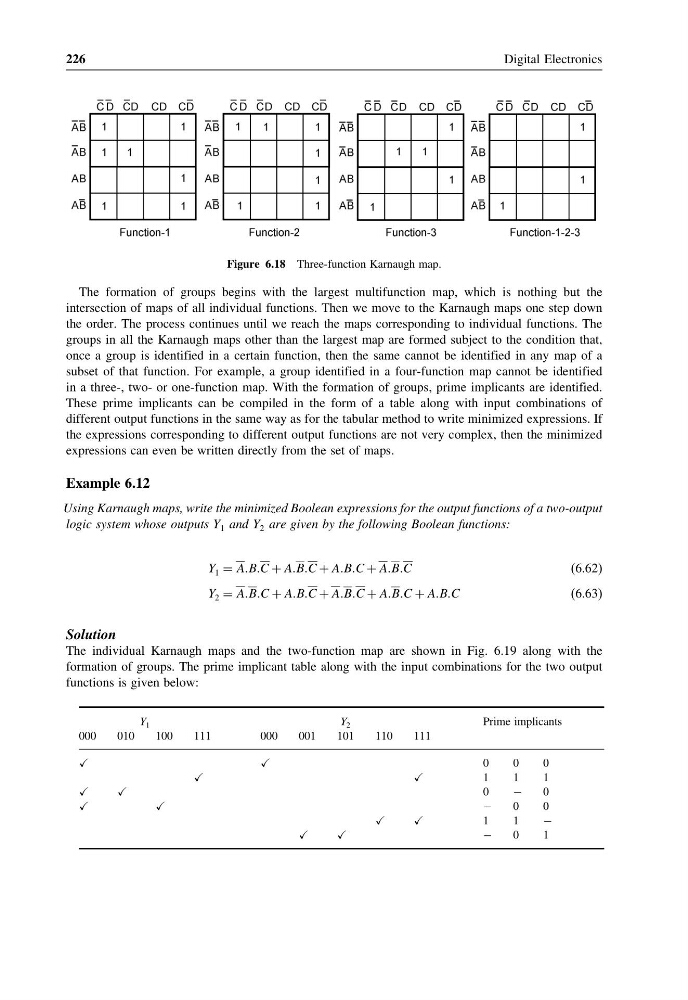
Figure 6.18 Three-function Karnaugh map.
The formation of groups begins with the largest multifunction map, which is nothing but the
intersection of maps of all individual functions. Then we move to the Karnaugh maps one step down
the order. The process continues until we reach the maps corresponding to individual functions. The
groups in all the Karnaugh maps other than the largest map are formed subject to the condition that,
once a group is identified in a certain function, then the same cannot be identified in any map of a
subset of that function. For example, a group identified in a four-function map cannot be identified
in a three-, two- or one-function map. With the formation of groups, prime implicants are identified.
These prime implicants can be compiled in the form of a table along with input combinations of
different output functions in the same way as for the tabular method to write minimized expressions. If
the expressions corresponding to different output functions are not very complex, then the minimized
expressions can even be written directly from the set of maps.
Example 6.12
Using Karnaugh maps, write the minimized Boolean expressions for the output functions of a two-output
logic system whose outputs Y 1 and Y 2 are given by the following Boolean functions:
Y 1 = AABBC + AABBC + AABBC + AABBC
(6.62)
Y 2 = AABBC + AABBC + AABBC + AABBC + AABBC
(6.63)
Solution
The individual Karnaugh maps and the two-function map are shown in Fig. 6.19 along with the
formation of groups. The prime implicant table along with the input combinations for the two output
functions is given below:
Y 1
Y 2
Prime implicants
000
010
100
111
000
001
101
110
111
0
0
0
1
1
1
0
−
0
−
0
0
1
1
−
−
0
1
Digital Electronics
Figure 6.18 Three-function Karnaugh map.
The formation of groups begins with the largest multifunction map, which is nothing but the
intersection of maps of all individual functions. Then we move to the Karnaugh maps one step down
the order. The process continues until we reach the maps corresponding to individual functions. The
groups in all the Karnaugh maps other than the largest map are formed subject to the condition that,
once a group is identified in a certain function, then the same cannot be identified in any map of a
subset of that function. For example, a group identified in a four-function map cannot be identified
in a three-, two- or one-function map. With the formation of groups, prime implicants are identified.
These prime implicants can be compiled in the form of a table along with input combinations of
different output functions in the same way as for the tabular method to write minimized expressions. If
the expressions corresponding to different output functions are not very complex, then the minimized
expressions can even be written directly from the set of maps.
Example 6.12
Using Karnaugh maps, write the minimized Boolean expressions for the output functions of a two-output
logic system whose outputs Y 1 and Y 2 are given by the following Boolean functions:
Y 1 = AABBC + AABBC + AABBC + AABBC
(6.62)
Y 2 = AABBC + AABBC + AABBC + AABBC + AABBC
(6.63)
Solution
The individual Karnaugh maps and the two-function map are shown in Fig. 6.19 along with the
formation of groups. The prime implicant table along with the input combinations for the two output
functions is given below:
Y 1
Y 2
Prime implicants
000
010
100
111
000
001
101
110
111
0
0
0
1
1
1
0
−
0
−
0
0
1
1
−
−
0
1