

Boolean Algebra and Simplification Techniques
225
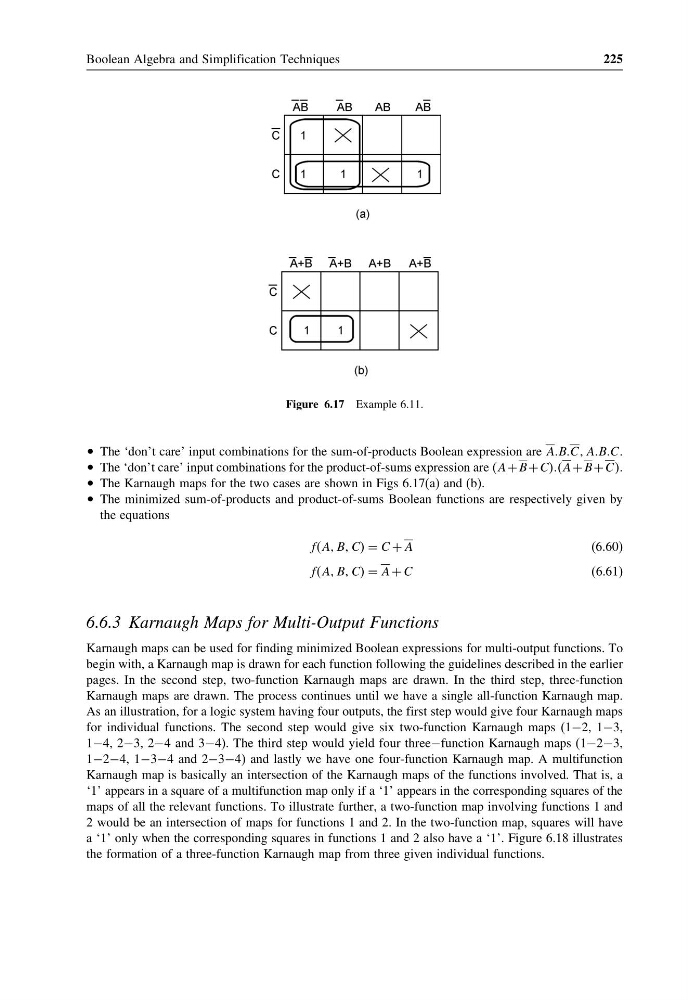
Figure 6.17 Example 6.11.
• The ‘don’t care’ input combinations for the sum-of-products Boolean expression are AABBCC AABBC.
• The ‘don’t care’ input combinations for the product-of-sums expression are A+B +CCCCA+B +CC.
• The Karnaugh maps for the two cases are shown in Figs 6.17(a) and (b).
• The minimized sum-of-products and product-of-sums Boolean functions are respectively given by
the equations
ffAA BB CC = C + A
(6.60)
ffAA BB CC = A + C
(6.61)
6.6.3 Karnaugh Maps for Multi-Output Functions
Karnaugh maps can be used for finding minimized Boolean expressions for multi-output functions. To
begin with, a Karnaugh map is drawn for each function following the guidelines described in the earlier
pages. In the second step, two-function Karnaugh maps are drawn. In the third step, three-function
Karnaugh maps are drawn. The process continues until we have a single all-function Karnaugh map.
As an illustration, for a logic system having four outputs, the first step would give four Karnaugh maps
for individual functions. The second step would give six two-function Karnaugh maps (1−2, 1−3,
1−4, 2−3, 2−4 and 3−4). The third step would yield four three−function Karnaugh maps (1−2−3,
1−2−4, 1−3−4 and 2−3−4) and lastly we have one four-function Karnaugh map. A multifunction
Karnaugh map is basically an intersection of the Karnaugh maps of the functions involved. That is, a
‘1’ appears in a square of a multifunction map only if a ‘1’ appears in the corresponding squares of the
maps of all the relevant functions. To illustrate further, a two-function map involving functions 1 and
2 would be an intersection of maps for functions 1 and 2. In the two-function map, squares will have
a ‘1’ only when the corresponding squares in functions 1 and 2 also have a ‘1’. Figure 6.18 illustrates
the formation of a three-function Karnaugh map from three given individual functions.
225
Figure 6.17 Example 6.11.
• The ‘don’t care’ input combinations for the sum-of-products Boolean expression are AABBCC AABBC.
• The ‘don’t care’ input combinations for the product-of-sums expression are A+B +CCCCA+B +CC.
• The Karnaugh maps for the two cases are shown in Figs 6.17(a) and (b).
• The minimized sum-of-products and product-of-sums Boolean functions are respectively given by
the equations
ffAA BB CC = C + A
(6.60)
ffAA BB CC = A + C
(6.61)
6.6.3 Karnaugh Maps for Multi-Output Functions
Karnaugh maps can be used for finding minimized Boolean expressions for multi-output functions. To
begin with, a Karnaugh map is drawn for each function following the guidelines described in the earlier
pages. In the second step, two-function Karnaugh maps are drawn. In the third step, three-function
Karnaugh maps are drawn. The process continues until we have a single all-function Karnaugh map.
As an illustration, for a logic system having four outputs, the first step would give four Karnaugh maps
for individual functions. The second step would give six two-function Karnaugh maps (1−2, 1−3,
1−4, 2−3, 2−4 and 3−4). The third step would yield four three−function Karnaugh maps (1−2−3,
1−2−4, 1−3−4 and 2−3−4) and lastly we have one four-function Karnaugh map. A multifunction
Karnaugh map is basically an intersection of the Karnaugh maps of the functions involved. That is, a
‘1’ appears in a square of a multifunction map only if a ‘1’ appears in the corresponding squares of the
maps of all the relevant functions. To illustrate further, a two-function map involving functions 1 and
2 would be an intersection of maps for functions 1 and 2. In the two-function map, squares will have
a ‘1’ only when the corresponding squares in functions 1 and 2 also have a ‘1’. Figure 6.18 illustrates
the formation of a three-function Karnaugh map from three given individual functions.