

Boolean Algebra and Simplification Techniques
217
is placed in all those squares for which the output is ‘0’. 0s are omitted for simplicity. An ‘X’ is
placed in squares corresponding to ‘don’t care’ conditions. In the case of a maxterm Karnaugh map,
a ‘1’ is placed in all those squares for which the output is ‘0’, and a ‘0’ is placed for input entries
corresponding to a ‘1’ output. Again, 0s are omitted for simplicity, and an ‘X’ is placed in squares
corresponding to ‘don’t care’ conditions.
The choice of terms identifying different rows and columns of a Karnaugh map is not unique for a
given number of variables. The only condition to be satisfied is that the designation of adjacent rows
and adjacent columns should be the same except for one of the literals being complemented. Also, the
extreme rows and extreme columns are considered adjacent. Some of the possible designation styles for
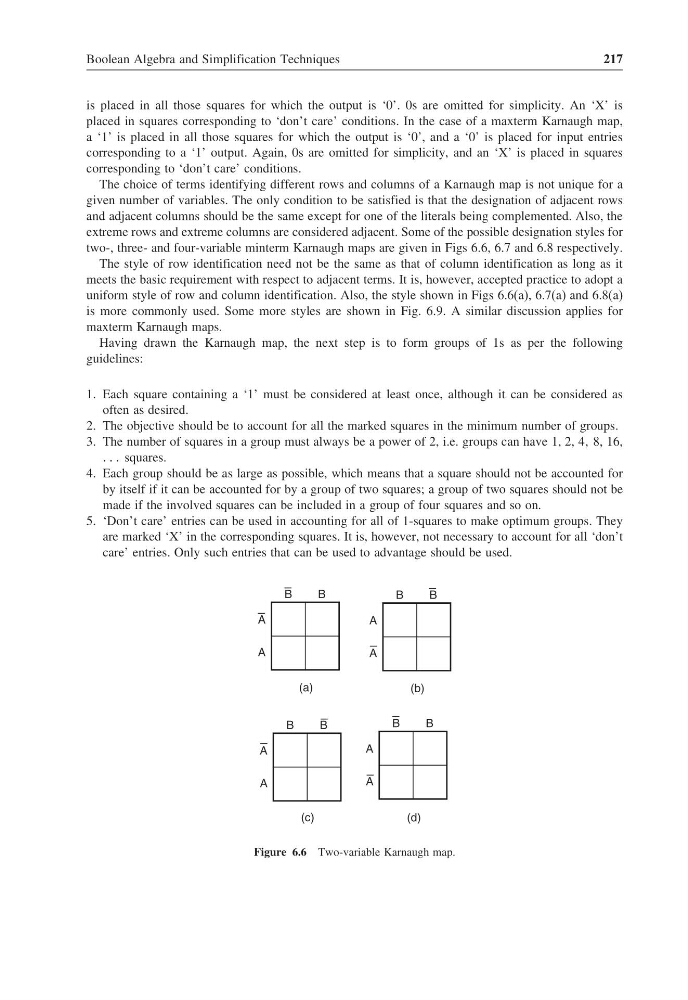
two-, three- and four-variable minterm Karnaugh maps are given in Figs 6.6, 6.7 and 6.8 respectively.
The style of row identification need not be the same as that of column identification as long as it
meets the basic requirement with respect to adjacent terms. It is, however, accepted practice to adopt a
uniform style of row and column identification. Also, the style shown in Figs 6.6(a), 6.7(a) and 6.8(a)
is more commonly used. Some more styles are shown in Fig. 6.9. A similar discussion applies for
maxterm Karnaugh maps.
Having drawn the Karnaugh map, the next step is to form groups of 1s as per the following
guidelines:
1. Each square containing a ‘1’ must be considered at least once, although it can be considered as
often as desired.
2. The objective should be to account for all the marked squares in the minimum number of groups.
3. The number of squares in a group must always be a power of 2, i.e. groups can have 1, 2, 4 8, 16,
squares.
4. Each group should be as large as possible, which means that a square should not be accounted for
by itself if it can be accounted for by a group of two squares; a group of two squares should not be
made if the involved squares can be included in a group of four squares and so on.
5. ‘Don’t care’ entries can be used in accounting for all of 1-squares to make optimum groups. They
are marked ‘X’ in the corresponding squares. It is, however, not necessary to account for all ‘don’t
care’ entries. Only such entries that can be used to advantage should be used.
B
B
A
A
(a)
B
B
A
A
(b)
B
B
A
A
(c)
B
B
A
A
(d)
Figure 6.6 Two-variable Karnaugh map.
217
is placed in all those squares for which the output is ‘0’. 0s are omitted for simplicity. An ‘X’ is
placed in squares corresponding to ‘don’t care’ conditions. In the case of a maxterm Karnaugh map,
a ‘1’ is placed in all those squares for which the output is ‘0’, and a ‘0’ is placed for input entries
corresponding to a ‘1’ output. Again, 0s are omitted for simplicity, and an ‘X’ is placed in squares
corresponding to ‘don’t care’ conditions.
The choice of terms identifying different rows and columns of a Karnaugh map is not unique for a
given number of variables. The only condition to be satisfied is that the designation of adjacent rows
and adjacent columns should be the same except for one of the literals being complemented. Also, the
extreme rows and extreme columns are considered adjacent. Some of the possible designation styles for
two-, three- and four-variable minterm Karnaugh maps are given in Figs 6.6, 6.7 and 6.8 respectively.
The style of row identification need not be the same as that of column identification as long as it
meets the basic requirement with respect to adjacent terms. It is, however, accepted practice to adopt a
uniform style of row and column identification. Also, the style shown in Figs 6.6(a), 6.7(a) and 6.8(a)
is more commonly used. Some more styles are shown in Fig. 6.9. A similar discussion applies for
maxterm Karnaugh maps.
Having drawn the Karnaugh map, the next step is to form groups of 1s as per the following
guidelines:
1. Each square containing a ‘1’ must be considered at least once, although it can be considered as
often as desired.
2. The objective should be to account for all the marked squares in the minimum number of groups.
3. The number of squares in a group must always be a power of 2, i.e. groups can have 1, 2, 4 8, 16,
squares.
4. Each group should be as large as possible, which means that a square should not be accounted for
by itself if it can be accounted for by a group of two squares; a group of two squares should not be
made if the involved squares can be included in a group of four squares and so on.
5. ‘Don’t care’ entries can be used in accounting for all of 1-squares to make optimum groups. They
are marked ‘X’ in the corresponding squares. It is, however, not necessary to account for all ‘don’t
care’ entries. Only such entries that can be used to advantage should be used.
B
B
A
A
(a)
B
B
A
A
(b)
B
B
A
A
(c)
B
B
A
A
(d)
Figure 6.6 Two-variable Karnaugh map.