

Boolean Algebra and Simplification Techniques
213
ABCD
1
2
0000
0010
0100
0011
0101
0110
1010
0111
1011
1111
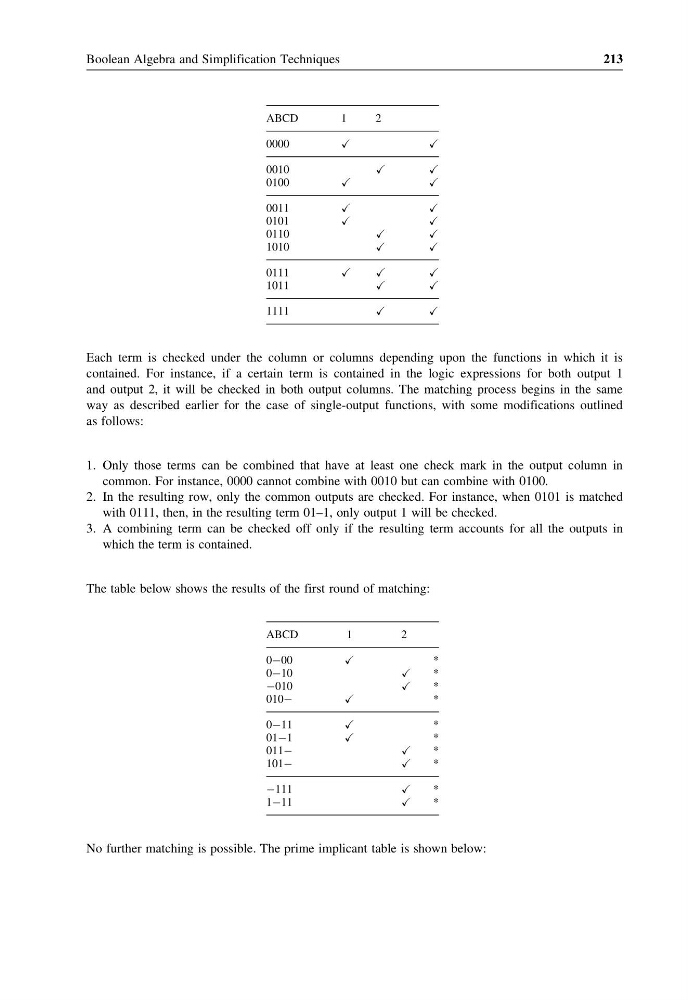
Each term is checked under the column or columns depending upon the functions in which it is
contained. For instance, if a certain term is contained in the logic expressions for both output 1
and output 2, it will be checked in both output columns. The matching process begins in the same
way as described earlier for the case of single-output functions, with some modifications outlined
as follows:
1. Only those terms can be combined that have at least one check mark in the output column in
common. For instance, 0000 cannot combine with 0010 but can combine with 0100.
2. In the resulting row, only the common outputs are checked. For instance, when 0101 is matched
with 0111, then, in the resulting term 01–1, only output 1 will be checked.
3. A combining term can be checked off only if the resulting term accounts for all the outputs in
which the term is contained.
The table below shows the results of the first round of matching:
ABCD
1
2
0−00
*
0−10
*
−010
*
010−
*
0−11
*
01−1
*
011−
*
101−
*
−111
*
1−11
*
No further matching is possible. The prime implicant table is shown below:
213
ABCD
1
2
0000
0010
0100
0011
0101
0110
1010
0111
1011
1111
Each term is checked under the column or columns depending upon the functions in which it is
contained. For instance, if a certain term is contained in the logic expressions for both output 1
and output 2, it will be checked in both output columns. The matching process begins in the same
way as described earlier for the case of single-output functions, with some modifications outlined
as follows:
1. Only those terms can be combined that have at least one check mark in the output column in
common. For instance, 0000 cannot combine with 0010 but can combine with 0100.
2. In the resulting row, only the common outputs are checked. For instance, when 0101 is matched
with 0111, then, in the resulting term 01–1, only output 1 will be checked.
3. A combining term can be checked off only if the resulting term accounts for all the outputs in
which the term is contained.
The table below shows the results of the first round of matching:
ABCD
1
2
0−00
*
0−10
*
−010
*
010−
*
0−11
*
01−1
*
011−
*
101−
*
−111
*
1−11
*
No further matching is possible. The prime implicant table is shown below: