

194
Digital Electronics
Example 6.3
Simplify the following:
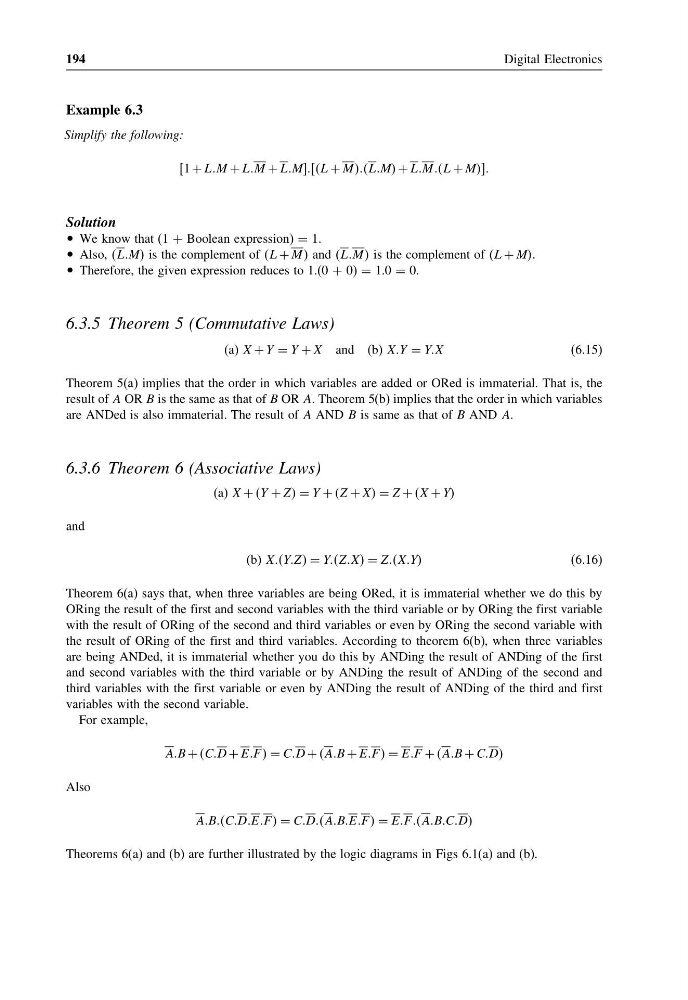
1 + LLM + LLM + LLMMMMML + MMMMLLMM + LLMMML + MMMM
Solution
• We know that (1 + Boolean expression) = 1.
• Also, LLMM is the complement of L + MM and LLMM is the complement of L + MM.
• Therefore, the given expression reduces to 1.(0 + 0) = 1.0 = 0.
6.3.5 Theorem 5 (Commutative Laws)
(a) X + Y = Y + X and (b) XXY = YYX
(6.15)
Theorem 5(a) implies that the order in which variables are added or ORed is immaterial. That is, the
result of A OR B is the same as that of B OR A. Theorem 5(b) implies that the order in which variables
are ANDed is also immaterial. The result of A AND B is same as that of B AND A.
6.3.6 Theorem 6 (Associative Laws)
(a) X + Y + ZZ = Y + Z + XX = Z + X + YY
and
(b) XXXYYZZ = YYYZZXX = ZZZXXYY
(6.16)
Theorem 6(a) says that, when three variables are being ORed, it is immaterial whether we do this by
ORing the result of the first and second variables with the third variable or by ORing the first variable
with the result of ORing of the second and third variables or even by ORing the second variable with
the result of ORing of the first and third variables. According to theorem 6(b), when three variables
are being ANDed, it is immaterial whether you do this by ANDing the result of ANDing of the first
and second variables with the third variable or by ANDing the result of ANDing of the second and
third variables with the first variable or even by ANDing the result of ANDing of the third and first
variables with the second variable.
For example,
AAB + CCD + EEF F = CCD + AAB + EEF F = EEF + AAB + CCDD
Also
AABBBCCDDEEF F = CCDDDAABBEEF F = EEF FFAABBCCDD
Theorems 6(a) and (b) are further illustrated by the logic diagrams in Figs 6.1(a) and (b).
Digital Electronics
Example 6.3
Simplify the following:
1 + LLM + LLM + LLMMMMML + MMMMLLMM + LLMMML + MMMM
Solution
• We know that (1 + Boolean expression) = 1.
• Also, LLMM is the complement of L + MM and LLMM is the complement of L + MM.
• Therefore, the given expression reduces to 1.(0 + 0) = 1.0 = 0.
6.3.5 Theorem 5 (Commutative Laws)
(a) X + Y = Y + X and (b) XXY = YYX
(6.15)
Theorem 5(a) implies that the order in which variables are added or ORed is immaterial. That is, the
result of A OR B is the same as that of B OR A. Theorem 5(b) implies that the order in which variables
are ANDed is also immaterial. The result of A AND B is same as that of B AND A.
6.3.6 Theorem 6 (Associative Laws)
(a) X + Y + ZZ = Y + Z + XX = Z + X + YY
and
(b) XXXYYZZ = YYYZZXX = ZZZXXYY
(6.16)
Theorem 6(a) says that, when three variables are being ORed, it is immaterial whether we do this by
ORing the result of the first and second variables with the third variable or by ORing the first variable
with the result of ORing of the second and third variables or even by ORing the second variable with
the result of ORing of the first and third variables. According to theorem 6(b), when three variables
are being ANDed, it is immaterial whether you do this by ANDing the result of ANDing of the first
and second variables with the third variable or by ANDing the result of ANDing of the second and
third variables with the first variable or even by ANDing the result of ANDing of the third and first
variables with the second variable.
For example,
AAB + CCD + EEF F = CCD + AAB + EEF F = EEF + AAB + CCDD
Also
AABBBCCDDEEF F = CCDDDAABBEEF F = EEF FFAABBCCDD
Theorems 6(a) and (b) are further illustrated by the logic diagrams in Figs 6.1(a) and (b).