

Boolean Algebra and Simplification Techniques
193
6.3.2 Theorem 2 (Operations with ‘0’ and ‘1’)
(a) 1X = X and (b) 0 + X = X
(6.12)
where X could be a variable, a term or even a large expression. According to this theorem, ANDing a
Boolean expression to ‘1’ or ORing ‘0’ to it makes no difference to the expression:
• For X = 0, LHS = 1.0 = 0 = RHS.
• For X = 1, LHS = 1.1 = 1 = RHS.
Also, 1.(Boolean expression) = Boolean expression and 0 + (Boolean expression) = Boolean expression.
For example,
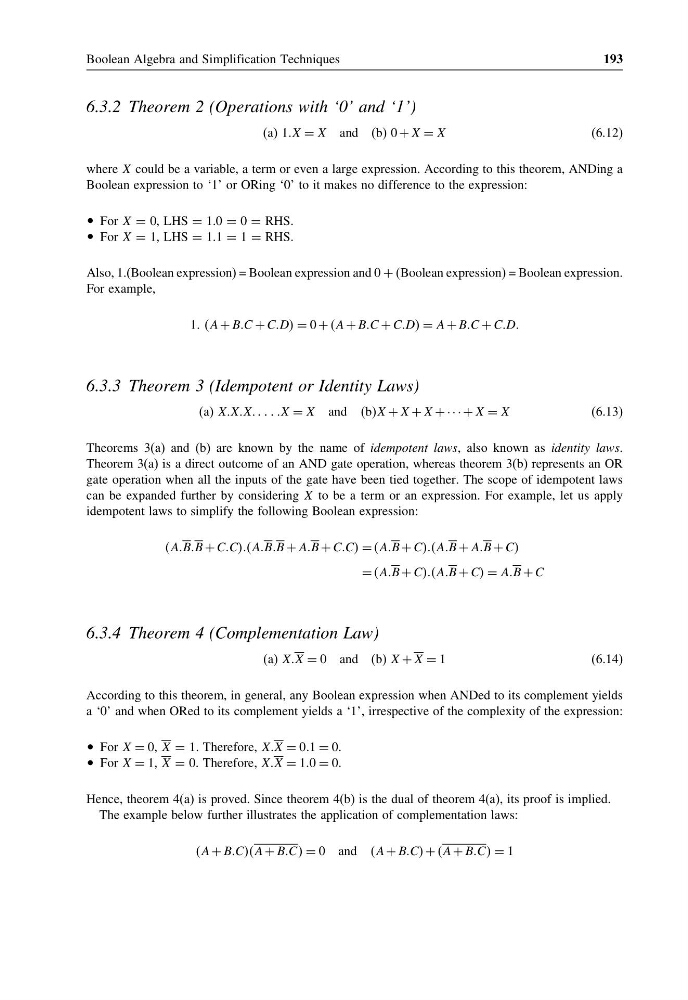
1 + BBC + CCDD = 0 + A + BBC + CCDD = A + BBC + CCDD
6.3.3 Theorem 3 (Idempotent or Identity Laws)
(a) XXXXXX X X X .X = X and bX + X + X + · · · + X = X
(6.13)
Theorems 3(a) and (b) are known by the name of idempotent laws, also known as identity laws.
Theorem 3(a) is a direct outcome of an AND gate operation, whereas theorem 3(b) represents an OR
gate operation when all the inputs of the gate have been tied together. The scope of idempotent laws
can be expanded further by considering X to be a term or an expression. For example, let us apply
idempotent laws to simplify the following Boolean expression:
AABBB + CCCCCCAABBB + AAB + CCCC = AAB + CCCCAAB + AAB + CC
= AAB + CCCCAAB + CC = AAB + C
6.3.4 Theorem 4 (Complementation Law)
(a) XXX = 0 and (b) X + X = 1
(6.14)
According to this theorem, in general, any Boolean expression when ANDed to its complement yields
a ‘0’ and when ORed to its complement yields a ‘1’, irrespective of the complexity of the expression:
• For X = 0, X = 1. Therefore, XXX = 01 = 0.
• For X = 1, X = 0. Therefore, XXX = 10 = 0.
Hence, theorem 4(a) is proved. Since theorem 4(b) is the dual of theorem 4(a), its proof is implied.
The example below further illustrates the application of complementation laws:
A + BBCCCA + BBCC = 0 and A + BBCC + A + BBCC = 1
193
6.3.2 Theorem 2 (Operations with ‘0’ and ‘1’)
(a) 1X = X and (b) 0 + X = X
(6.12)
where X could be a variable, a term or even a large expression. According to this theorem, ANDing a
Boolean expression to ‘1’ or ORing ‘0’ to it makes no difference to the expression:
• For X = 0, LHS = 1.0 = 0 = RHS.
• For X = 1, LHS = 1.1 = 1 = RHS.
Also, 1.(Boolean expression) = Boolean expression and 0 + (Boolean expression) = Boolean expression.
For example,
1 + BBC + CCDD = 0 + A + BBC + CCDD = A + BBC + CCDD
6.3.3 Theorem 3 (Idempotent or Identity Laws)
(a) XXXXXX X X X .X = X and bX + X + X + · · · + X = X
(6.13)
Theorems 3(a) and (b) are known by the name of idempotent laws, also known as identity laws.
Theorem 3(a) is a direct outcome of an AND gate operation, whereas theorem 3(b) represents an OR
gate operation when all the inputs of the gate have been tied together. The scope of idempotent laws
can be expanded further by considering X to be a term or an expression. For example, let us apply
idempotent laws to simplify the following Boolean expression:
AABBB + CCCCCCAABBB + AAB + CCCC = AAB + CCCCAAB + AAB + CC
= AAB + CCCCAAB + CC = AAB + C
6.3.4 Theorem 4 (Complementation Law)
(a) XXX = 0 and (b) X + X = 1
(6.14)
According to this theorem, in general, any Boolean expression when ANDed to its complement yields
a ‘0’ and when ORed to its complement yields a ‘1’, irrespective of the complexity of the expression:
• For X = 0, X = 1. Therefore, XXX = 01 = 0.
• For X = 1, X = 0. Therefore, XXX = 10 = 0.
Hence, theorem 4(a) is proved. Since theorem 4(b) is the dual of theorem 4(a), its proof is implied.
The example below further illustrates the application of complementation laws:
A + BBCCCA + BBCC = 0 and A + BBCC + A + BBCC = 1