

170
Digital Electronics
Y=(AB+AB)
+V DD
B
–
B
B
–
A
B
A
–
A
–
A
+V DD
A
B
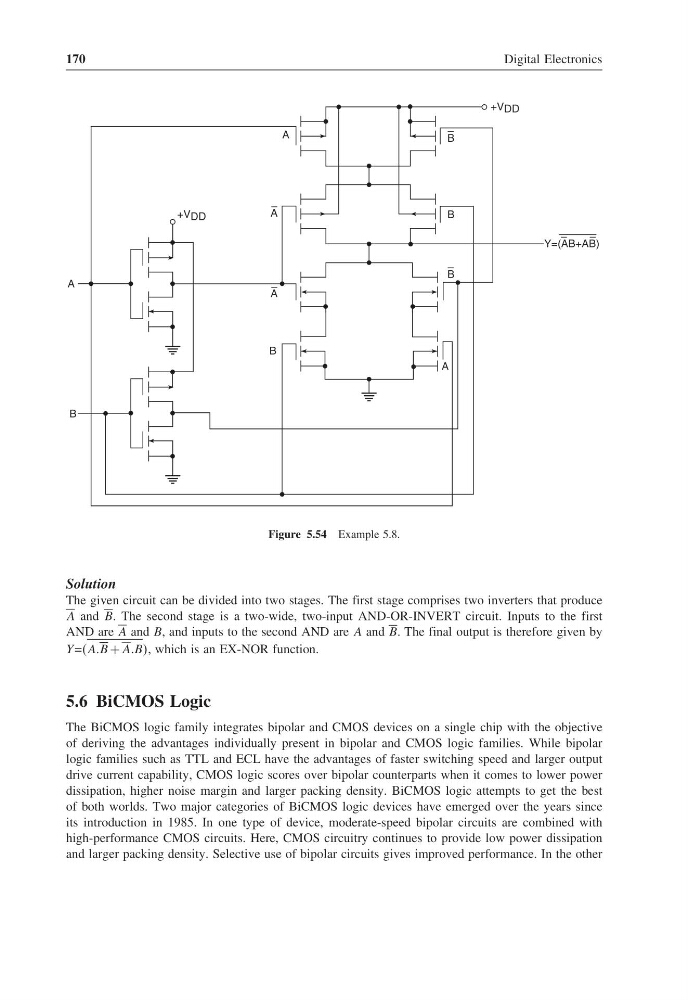
Figure 5.54 Example 5.8.
Solution
The given circuit can be divided into two stages. The first stage comprises two inverters that produce
A and B. The second stage is a two-wide, two-input AND-OR-INVERT circuit. Inputs to the first
AND are A and B, and inputs to the second AND are A and B. The final output is therefore given by
Y =AAB + AABB, which is an EX-NOR function.
5.6 BiCMOS Logic
The BiCMOS logic family integrates bipolar and CMOS devices on a single chip with the objective
of deriving the advantages individually present in bipolar and CMOS logic families. While bipolar
logic families such as TTL and ECL have the advantages of faster switching speed and larger output
drive current capability, CMOS logic scores over bipolar counterparts when it comes to lower power
dissipation, higher noise margin and larger packing density. BiCMOS logic attempts to get the best
of both worlds. Two major categories of BiCMOS logic devices have emerged over the years since
its introduction in 1985. In one type of device, moderate-speed bipolar circuits are combined with
high-performance CMOS circuits. Here, CMOS circuitry continues to provide low power dissipation
and larger packing density. Selective use of bipolar circuits gives improved performance. In the other
Digital Electronics
Y=(AB+AB)
+V DD
B
–
B
B
–
A
B
A
–
A
–
A
+V DD
A
B
Figure 5.54 Example 5.8.
Solution
The given circuit can be divided into two stages. The first stage comprises two inverters that produce
A and B. The second stage is a two-wide, two-input AND-OR-INVERT circuit. Inputs to the first
AND are A and B, and inputs to the second AND are A and B. The final output is therefore given by
Y =AAB + AABB, which is an EX-NOR function.
5.6 BiCMOS Logic
The BiCMOS logic family integrates bipolar and CMOS devices on a single chip with the objective
of deriving the advantages individually present in bipolar and CMOS logic families. While bipolar
logic families such as TTL and ECL have the advantages of faster switching speed and larger output
drive current capability, CMOS logic scores over bipolar counterparts when it comes to lower power
dissipation, higher noise margin and larger packing density. BiCMOS logic attempts to get the best
of both worlds. Two major categories of BiCMOS logic devices have emerged over the years since
its introduction in 1985. In one type of device, moderate-speed bipolar circuits are combined with
high-performance CMOS circuits. Here, CMOS circuitry continues to provide low power dissipation
and larger packing density. Selective use of bipolar circuits gives improved performance. In the other