

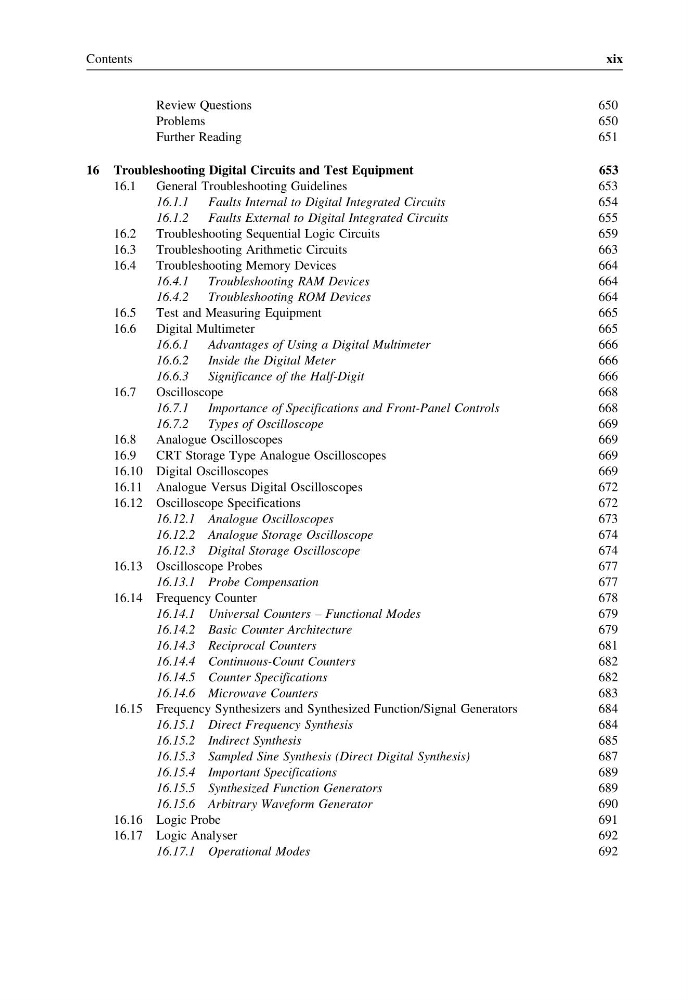
Contents
xix
Review Questions
650
Problems
650
Further Reading
651
16 Troubleshooting Digital Circuits and Test Equipment
653
16.1
General Troubleshooting Guidelines
653
16.1.1 Faults Internal to Digital Integrated Circuits
654
16.1.2 Faults External to Digital Integrated Circuits
655
16.2
Troubleshooting Sequential Logic Circuits
659
16.3
Troubleshooting Arithmetic Circuits
663
16.4
Troubleshooting Memory Devices
664
16.4.1 Troubleshooting RAM Devices
664
16.4.2 Troubleshooting ROM Devices
664
16.5
Test and Measuring Equipment
665
16.6
Digital Multimeter
665
16.6.1 Advantages of Using a Digital Multimeter
666
16.6.2 Inside the Digital Meter
666
16.6.3 Significance of the Half-Digit
666
16.7
Oscilloscope
668
16.7.1 Importance of Specifications and Front-Panel Controls
668
16.7.2 Types of Oscilloscope
669
16.8
Analogue Oscilloscopes
669
16.9
CRT Storage Type Analogue Oscilloscopes
669
16.10 Digital Oscilloscopes
669
16.11 Analogue Versus Digital Oscilloscopes
672
16.12 Oscilloscope Specifications
672
16.12.1 Analogue Oscilloscopes
673
16.12.2 Analogue Storage Oscilloscope
674
16.12.3 Digital Storage Oscilloscope
674
16.13 Oscilloscope Probes
677
16.13.1 Probe Compensation
677
16.14 Frequency Counter
678
16.14.1 Universal Counters – Functional Modes
679
16.14.2 Basic Counter Architecture
679
16.14.3 Reciprocal Counters
681
16.14.4 Continuous-Count Counters
682
16.14.5 Counter Specifications
682
16.14.6 Microwave Counters
683
16.15 Frequency Synthesizers and Synthesized Function/Signal Generators
684
16.15.1 Direct Frequency Synthesis
684
16.15.2 Indirect Synthesis
685
16.15.3 Sampled Sine Synthesis (Direct Digital Synthesis)
687
16.15.4 Important Specifications
689
16.15.5 Synthesized Function Generators
689
16.15.6 Arbitrary Waveform Generator
690
16.16 Logic Probe
691
16.17 Logic Analyser
692
16.17.1 Operational Modes
692
xix
Review Questions
650
Problems
650
Further Reading
651
16 Troubleshooting Digital Circuits and Test Equipment
653
16.1
General Troubleshooting Guidelines
653
16.1.1 Faults Internal to Digital Integrated Circuits
654
16.1.2 Faults External to Digital Integrated Circuits
655
16.2
Troubleshooting Sequential Logic Circuits
659
16.3
Troubleshooting Arithmetic Circuits
663
16.4
Troubleshooting Memory Devices
664
16.4.1 Troubleshooting RAM Devices
664
16.4.2 Troubleshooting ROM Devices
664
16.5
Test and Measuring Equipment
665
16.6
Digital Multimeter
665
16.6.1 Advantages of Using a Digital Multimeter
666
16.6.2 Inside the Digital Meter
666
16.6.3 Significance of the Half-Digit
666
16.7
Oscilloscope
668
16.7.1 Importance of Specifications and Front-Panel Controls
668
16.7.2 Types of Oscilloscope
669
16.8
Analogue Oscilloscopes
669
16.9
CRT Storage Type Analogue Oscilloscopes
669
16.10 Digital Oscilloscopes
669
16.11 Analogue Versus Digital Oscilloscopes
672
16.12 Oscilloscope Specifications
672
16.12.1 Analogue Oscilloscopes
673
16.12.2 Analogue Storage Oscilloscope
674
16.12.3 Digital Storage Oscilloscope
674
16.13 Oscilloscope Probes
677
16.13.1 Probe Compensation
677
16.14 Frequency Counter
678
16.14.1 Universal Counters – Functional Modes
679
16.14.2 Basic Counter Architecture
679
16.14.3 Reciprocal Counters
681
16.14.4 Continuous-Count Counters
682
16.14.5 Counter Specifications
682
16.14.6 Microwave Counters
683
16.15 Frequency Synthesizers and Synthesized Function/Signal Generators
684
16.15.1 Direct Frequency Synthesis
684
16.15.2 Indirect Synthesis
685
16.15.3 Sampled Sine Synthesis (Direct Digital Synthesis)
687
16.15.4 Important Specifications
689
16.15.5 Synthesized Function Generators
689
16.15.6 Arbitrary Waveform Generator
690
16.16 Logic Probe
691
16.17 Logic Analyser
692
16.17.1 Operational Modes
692