

Logic Families
151
5.5 CMOS Logic Family
The CMOS (Complementary Metal Oxide Semiconductor) logic family uses both N-type and P-type
MOSFETs (enhancement MOSFETs, to be more precise) to realize different logic functions. The
two types of MOSFET are designed to have matching characteristics. That is, they exhibit identical
characteristics in switch-OFF and switch-ON conditions. The main advantage of the CMOS logic
family over bipolar logic families discussed so far lies in its extremely low power dissipation, which is
near-zero in static conditions. In fact, CMOS devices draw power only when they are switching. This
allows integration of a much larger number of CMOS gates on a chip than would have been possible
with bipolar or NMOS (to be discussed later) technology. CMOS technology today is the dominant
semiconductor technology used for making microprocessors, memory devices and application-specific
integrated circuits (ASICs). The CMOS logic family, like TTL, has a large number of subfamilies. The
prominent members of CMOS logic were listed in an earlier part of the chapter. The basic difference
between different CMOS logic subfamilies such as 4000A, 4000B, 4000UB, 74C, 74HC, 74HCT,
74AC and 74ACT is in the fabrication process used and not in the design of the circuits employed to
implement the intended logic function. We will firstly look at the circuit implementation of various
logic functions in CMOS and then follow this up with a brief description of different subfamilies of
CMOS logic.
5.5.1 Circuit Implementation of Logic Functions
In the following paragraphs, we will briefly describe the internal schematics of basic logic functions
when implemented in CMOS logic. These include inverter, NAND, NOR, AND, OR, EX-OR, EX-NOR
and AND-OR-INVERT functions.
5.5.1.1 CMOS Inverter
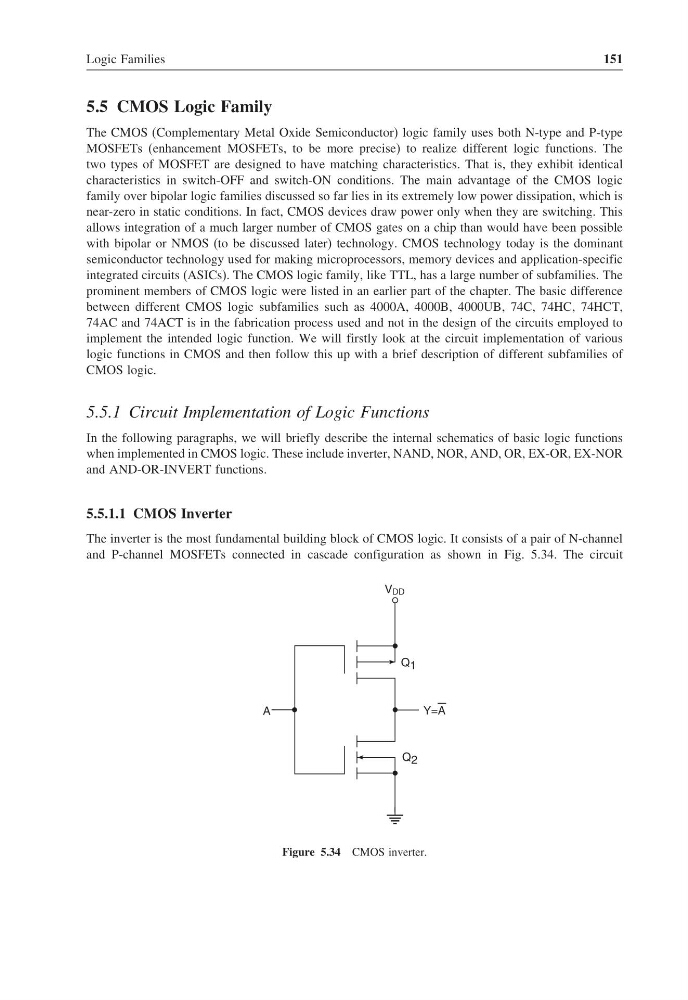
The inverter is the most fundamental building block of CMOS logic. It consists of a pair of N-channel
and P-channel MOSFETs connected in cascade configuration as shown in Fig. 5.34. The circuit
A
V DD
Q 1
Q 2
Y=A
Figure 5.34 CMOS inverter.
151
5.5 CMOS Logic Family
The CMOS (Complementary Metal Oxide Semiconductor) logic family uses both N-type and P-type
MOSFETs (enhancement MOSFETs, to be more precise) to realize different logic functions. The
two types of MOSFET are designed to have matching characteristics. That is, they exhibit identical
characteristics in switch-OFF and switch-ON conditions. The main advantage of the CMOS logic
family over bipolar logic families discussed so far lies in its extremely low power dissipation, which is
near-zero in static conditions. In fact, CMOS devices draw power only when they are switching. This
allows integration of a much larger number of CMOS gates on a chip than would have been possible
with bipolar or NMOS (to be discussed later) technology. CMOS technology today is the dominant
semiconductor technology used for making microprocessors, memory devices and application-specific
integrated circuits (ASICs). The CMOS logic family, like TTL, has a large number of subfamilies. The
prominent members of CMOS logic were listed in an earlier part of the chapter. The basic difference
between different CMOS logic subfamilies such as 4000A, 4000B, 4000UB, 74C, 74HC, 74HCT,
74AC and 74ACT is in the fabrication process used and not in the design of the circuits employed to
implement the intended logic function. We will firstly look at the circuit implementation of various
logic functions in CMOS and then follow this up with a brief description of different subfamilies of
CMOS logic.
5.5.1 Circuit Implementation of Logic Functions
In the following paragraphs, we will briefly describe the internal schematics of basic logic functions
when implemented in CMOS logic. These include inverter, NAND, NOR, AND, OR, EX-OR, EX-NOR
and AND-OR-INVERT functions.
5.5.1.1 CMOS Inverter
The inverter is the most fundamental building block of CMOS logic. It consists of a pair of N-channel
and P-channel MOSFETs connected in cascade configuration as shown in Fig. 5.34. The circuit
A
V DD
Q 1
Q 2
Y=A
Figure 5.34 CMOS inverter.