

195
small area of natural habitats with the highest biodiversity and integrity represent
the reservoir of species and their conservation should have the highest priority. As
noted by Young (2000), “although restoration can enhance conservation efforts, restoration is always a poor second to the preservation of original habitats”. So how to
set our priorities? Walker and Salt (2006) suggest that, to support ecosystem resilience, we should promote diversity in all its dimensions, from biological to economic, and encourage multiple components and resource uses to balance and
complement homogenizing trends. Heller et al. (2015) advise to create conservation
networks that capture the full range of climatic diversity in a region in order to
improve the resilience of biotic communities to climate change compared to networks that do not. Most probably, people will have to consider a new view of landscape protection and follow the New Wilderness Concept: ‘Protected areas that are
usually large, unmodified or slightly modified areas, retaining their natural character and influence, without permanent or significant human habitation, which are
protected and managed so as to preserve their natural condition’ (Dudley 2013,
p. 14). The goal is to maintain the highest integrity of ecosystems, wildlife, and
sacred and traditional cultural-use sites, to preserve intrinsic wilderness values,
while sustaining human values (Casson et al. 2016).
5 Conclusions
Although the value of habitats calculated for the whole Czech Republic increased
(above all due to the significant increase of meadows and pastures at the expense of
arable land and some increase of forest area on abandoned soil), we must not be
misled by this result. The overall biodiversity and species richness of the Czech
0
500
1000
1500
2000
2500
3000
3500
4000
4500
Alpine habitats
Forests
Water habitats
Rock habitats
Bushes
Grasslands
Wetlands
Area of natural/near natural habitat formaƟon (2004)
Area of habitat formaƟon, persistant between 2004 and 2014
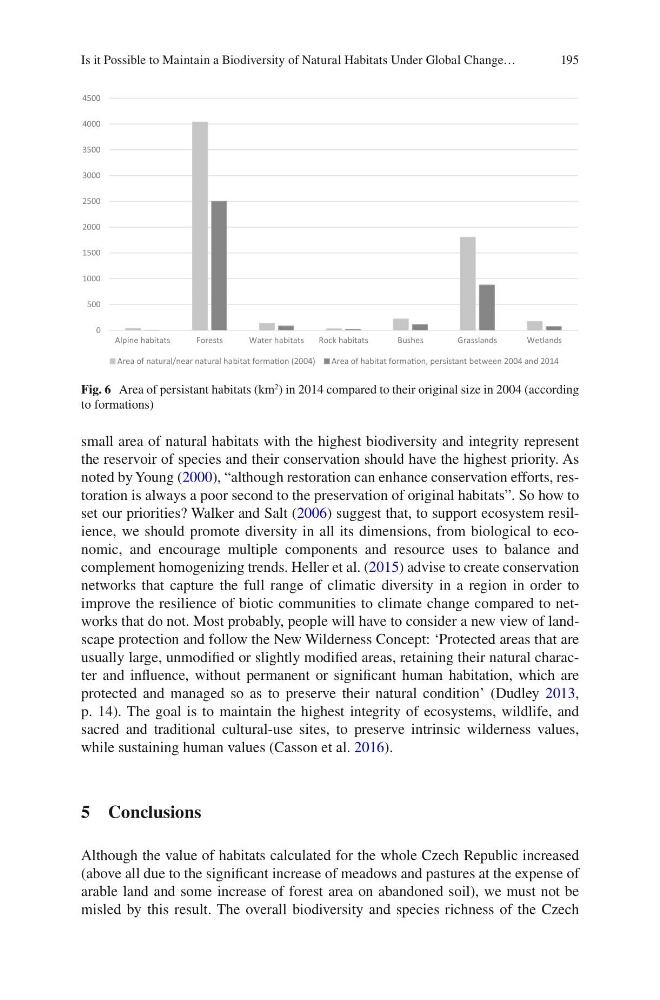
Fig. 6 Area of persistant habitats (km
2 ) in 2014 compared to their original size in 2004 (according
to formations)
Is it Possible to Maintain a Biodiversity of Natural Habitats Under Global Change…
small area of natural habitats with the highest biodiversity and integrity represent
the reservoir of species and their conservation should have the highest priority. As
noted by Young (2000), “although restoration can enhance conservation efforts, restoration is always a poor second to the preservation of original habitats”. So how to
set our priorities? Walker and Salt (2006) suggest that, to support ecosystem resilience, we should promote diversity in all its dimensions, from biological to economic, and encourage multiple components and resource uses to balance and
complement homogenizing trends. Heller et al. (2015) advise to create conservation
networks that capture the full range of climatic diversity in a region in order to
improve the resilience of biotic communities to climate change compared to networks that do not. Most probably, people will have to consider a new view of landscape protection and follow the New Wilderness Concept: ‘Protected areas that are
usually large, unmodified or slightly modified areas, retaining their natural character and influence, without permanent or significant human habitation, which are
protected and managed so as to preserve their natural condition’ (Dudley 2013,
p. 14). The goal is to maintain the highest integrity of ecosystems, wildlife, and
sacred and traditional cultural-use sites, to preserve intrinsic wilderness values,
while sustaining human values (Casson et al. 2016).
5 Conclusions
Although the value of habitats calculated for the whole Czech Republic increased
(above all due to the significant increase of meadows and pastures at the expense of
arable land and some increase of forest area on abandoned soil), we must not be
misled by this result. The overall biodiversity and species richness of the Czech
0
500
1000
1500
2000
2500
3000
3500
4000
4500
Alpine habitats
Forests
Water habitats
Rock habitats
Bushes
Grasslands
Wetlands
Area of natural/near natural habitat formaƟon (2004)
Area of habitat formaƟon, persistant between 2004 and 2014
Fig. 6 Area of persistant habitats (km
2 ) in 2014 compared to their original size in 2004 (according
to formations)
Is it Possible to Maintain a Biodiversity of Natural Habitats Under Global Change…