

79
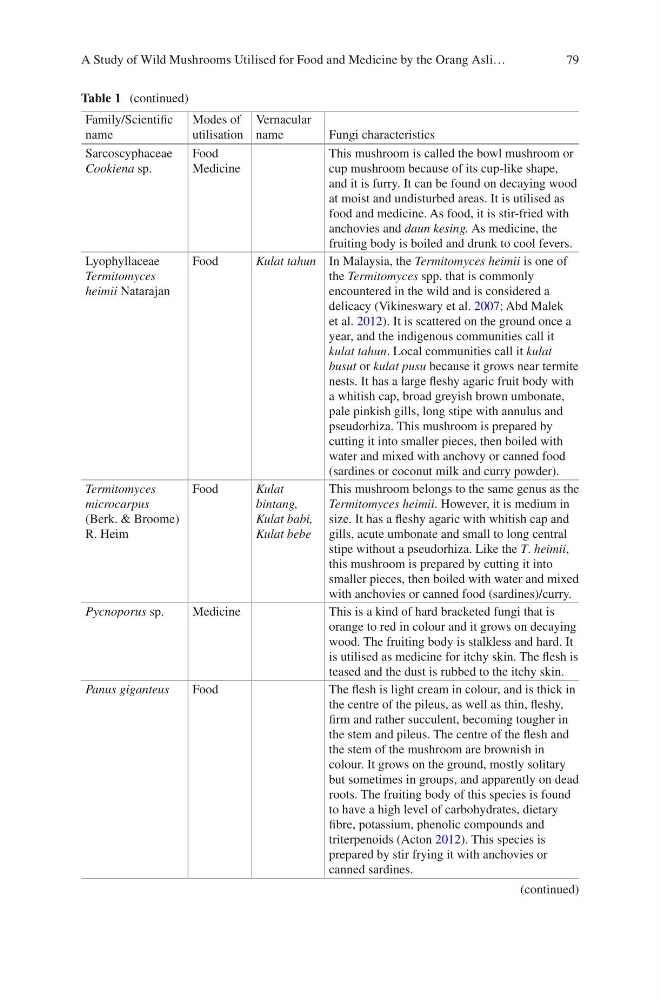
Table 1 (continued)
Family/Scientific
name
Modes of
utilisation
Vernacular
name
Fungi characteristics
Sarcoscyphaceae
Cookiena sp.
Food
Medicine
This mushroom is called the bowl mushroom or
cup mushroom because of its cup-like shape,
and it is furry. It can be found on decaying wood
at moist and undisturbed areas. It is utilised as
food and medicine. As food, it is stir-fried with
anchovies and daun kesing. As medicine, the
fruiting body is boiled and drunk to cool fevers.
Lyophyllaceae
Termitomyces
heimii Natarajan
Food
Kulat tahun In Malaysia, the Termitomyces heimii is one of
the Termitomyces spp. that is commonly
encountered in the wild and is considered a
delicacy (Vikineswary et al. 2007; Abd Malek
et al. 2012). It is scattered on the ground once a
year, and the indigenous communities call it
kulat tahun. Local communities call it kulat
busut or kulat pusu because it grows near termite
nests. It has a large fleshy agaric fruit body with
a whitish cap, broad greyish brown umbonate,
pale pinkish gills, long stipe with annulus and
pseudorhiza. This mushroom is prepared by
cutting it into smaller pieces, then boiled with
water and mixed with anchovy or canned food
(sardines or coconut milk and curry powder).
Termitomyces
microcarpus
(Berk. & Broome)
R. Heim
Food
Kulat
bintang,
Kulat babi,
Kulat bebe
This mushroom belongs to the same genus as the
Termitomyces heimii. However, it is medium in
size. It has a fleshy agaric with whitish cap and
gills, acute umbonate and small to long central
stipe without a pseudorhiza. Like the T. heimii,
this mushroom is prepared by cutting it into
smaller pieces, then boiled with water and mixed
with anchovies or canned food (sardines)/curry.
Pycnoporus sp.
Medicine
This is a kind of hard bracketed fungi that is
orange to red in colour and it grows on decaying
wood. The fruiting body is stalkless and hard. It
is utilised as medicine for itchy skin. The flesh is
teased and the dust is rubbed to the itchy skin.
Panus giganteus
Food
The flesh is light cream in colour, and is thick in
the centre of the pileus, as well as thin, fleshy,
firm and rather succulent, becoming tougher in
the stem and pileus. The centre of the flesh and
the stem of the mushroom are brownish in
colour. It grows on the ground, mostly solitary
but sometimes in groups, and apparently on dead
roots. The fruiting body of this species is found
to have a high level of carbohydrates, dietary
fibre, potassium, phenolic compounds and
triterpenoids (Acton 2012). This species is
prepared by stir frying it with anchovies or
canned sardines.
(continued)
A Study of Wild Mushrooms Utilised for Food and Medicine by the Orang Asli…
Table 1 (continued)
Family/Scientific
name
Modes of
utilisation
Vernacular
name
Fungi characteristics
Sarcoscyphaceae
Cookiena sp.
Food
Medicine
This mushroom is called the bowl mushroom or
cup mushroom because of its cup-like shape,
and it is furry. It can be found on decaying wood
at moist and undisturbed areas. It is utilised as
food and medicine. As food, it is stir-fried with
anchovies and daun kesing. As medicine, the
fruiting body is boiled and drunk to cool fevers.
Lyophyllaceae
Termitomyces
heimii Natarajan
Food
Kulat tahun In Malaysia, the Termitomyces heimii is one of
the Termitomyces spp. that is commonly
encountered in the wild and is considered a
delicacy (Vikineswary et al. 2007; Abd Malek
et al. 2012). It is scattered on the ground once a
year, and the indigenous communities call it
kulat tahun. Local communities call it kulat
busut or kulat pusu because it grows near termite
nests. It has a large fleshy agaric fruit body with
a whitish cap, broad greyish brown umbonate,
pale pinkish gills, long stipe with annulus and
pseudorhiza. This mushroom is prepared by
cutting it into smaller pieces, then boiled with
water and mixed with anchovy or canned food
(sardines or coconut milk and curry powder).
Termitomyces
microcarpus
(Berk. & Broome)
R. Heim
Food
Kulat
bintang,
Kulat babi,
Kulat bebe
This mushroom belongs to the same genus as the
Termitomyces heimii. However, it is medium in
size. It has a fleshy agaric with whitish cap and
gills, acute umbonate and small to long central
stipe without a pseudorhiza. Like the T. heimii,
this mushroom is prepared by cutting it into
smaller pieces, then boiled with water and mixed
with anchovies or canned food (sardines)/curry.
Pycnoporus sp.
Medicine
This is a kind of hard bracketed fungi that is
orange to red in colour and it grows on decaying
wood. The fruiting body is stalkless and hard. It
is utilised as medicine for itchy skin. The flesh is
teased and the dust is rubbed to the itchy skin.
Panus giganteus
Food
The flesh is light cream in colour, and is thick in
the centre of the pileus, as well as thin, fleshy,
firm and rather succulent, becoming tougher in
the stem and pileus. The centre of the flesh and
the stem of the mushroom are brownish in
colour. It grows on the ground, mostly solitary
but sometimes in groups, and apparently on dead
roots. The fruiting body of this species is found
to have a high level of carbohydrates, dietary
fibre, potassium, phenolic compounds and
triterpenoids (Acton 2012). This species is
prepared by stir frying it with anchovies or
canned sardines.
(continued)
A Study of Wild Mushrooms Utilised for Food and Medicine by the Orang Asli…