

78
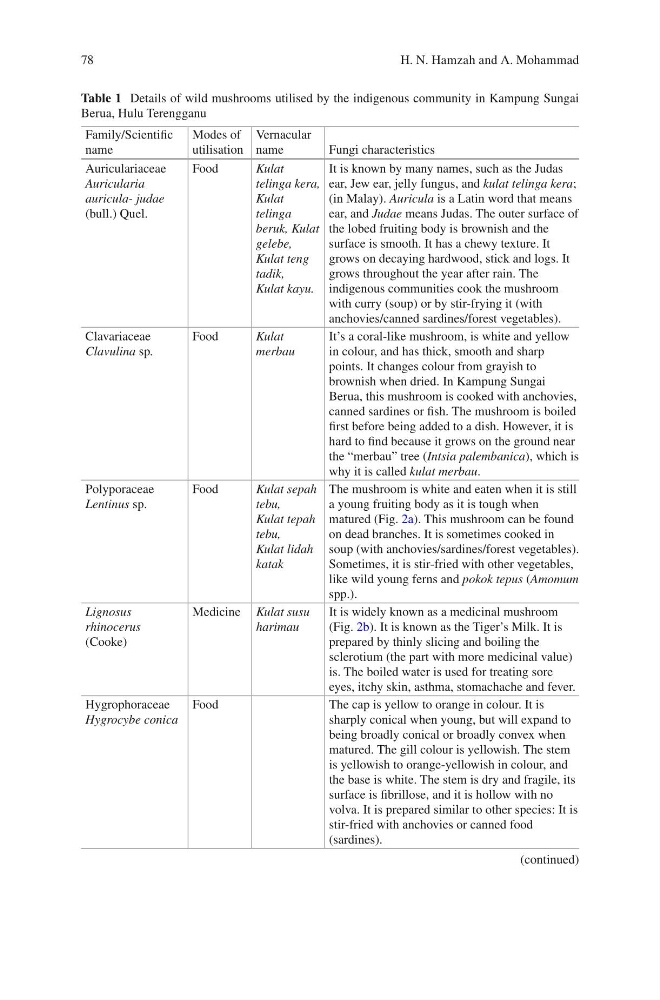
Table 1 Details of wild mushrooms utilised by the indigenous community in Kampung Sungai
Berua, Hulu Terengganu
Family/Scientific
name
Modes of
utilisation
Vernacular
name
Fungi characteristics
Auriculariaceae
Auricularia
auricula- judae
(bull.) Quel.
Food
Kulat
telinga kera,
Kulat
telinga
beruk, Kulat
gelebe,
Kulat teng
tadik,
Kulat kayu.
It is known by many names, such as the Judas
ear, Jew ear, jelly fungus, and kulat telinga kera;
(in Malay). Auricula is a Latin word that means
ear, and Judae means Judas. The outer surface of
the lobed fruiting body is brownish and the
surface is smooth. It has a chewy texture. It
grows on decaying hardwood, stick and logs. It
grows throughout the year after rain. The
indigenous communities cook the mushroom
with curry (soup) or by stir-frying it (with
anchovies/canned sardines/forest vegetables).
Clavariaceae
Clavulina sp.
Food
Kulat
merbau
It’s a coral-like mushroom, is white and yellow
in colour, and has thick, smooth and sharp
points. It changes colour from grayish to
brownish when dried. In Kampung Sungai
Berua, this mushroom is cooked with anchovies,
canned sardines or fish. The mushroom is boiled
first before being added to a dish. However, it is
hard to find because it grows on the ground near
the “merbau” tree (Intsia palembanica), which is
why it is called kulat merbau.
Polyporaceae
Lentinus sp.
Food
Kulat sepah
tebu,
Kulat tepah
tebu,
Kulat lidah
katak
The mushroom is white and eaten when it is still
a young fruiting body as it is tough when
matured (Fig. 2a). This mushroom can be found
on dead branches. It is sometimes cooked in
soup (with anchovies/sardines/forest vegetables).
Sometimes, it is stir-fried with other vegetables,
like wild young ferns and pokok tepus (Amomum
spp.).
Lignosus
rhinocerus
(Cooke)
Medicine Kulat susu
harimau
It is widely known as a medicinal mushroom
(Fig. 2b). It is known as the Tiger’s Milk. It is
prepared by thinly slicing and boiling the
sclerotium (the part with more medicinal value)
is. The boiled water is used for treating sore
eyes, itchy skin, asthma, stomachache and fever.
Hygrophoraceae
Hygrocybe conica
Food
The cap is yellow to orange in colour. It is
sharply conical when young, but will expand to
being broadly conical or broadly convex when
matured. The gill colour is yellowish. The stem
is yellowish to orange-yellowish in colour, and
the base is white. The stem is dry and fragile, its
surface is fibrillose, and it is hollow with no
volva. It is prepared similar to other species: It is
stir-fried with anchovies or canned food
(sardines).
(continued)
H. N. Hamzah and A. Mohammad
Table 1 Details of wild mushrooms utilised by the indigenous community in Kampung Sungai
Berua, Hulu Terengganu
Family/Scientific
name
Modes of
utilisation
Vernacular
name
Fungi characteristics
Auriculariaceae
Auricularia
auricula- judae
(bull.) Quel.
Food
Kulat
telinga kera,
Kulat
telinga
beruk, Kulat
gelebe,
Kulat teng
tadik,
Kulat kayu.
It is known by many names, such as the Judas
ear, Jew ear, jelly fungus, and kulat telinga kera;
(in Malay). Auricula is a Latin word that means
ear, and Judae means Judas. The outer surface of
the lobed fruiting body is brownish and the
surface is smooth. It has a chewy texture. It
grows on decaying hardwood, stick and logs. It
grows throughout the year after rain. The
indigenous communities cook the mushroom
with curry (soup) or by stir-frying it (with
anchovies/canned sardines/forest vegetables).
Clavariaceae
Clavulina sp.
Food
Kulat
merbau
It’s a coral-like mushroom, is white and yellow
in colour, and has thick, smooth and sharp
points. It changes colour from grayish to
brownish when dried. In Kampung Sungai
Berua, this mushroom is cooked with anchovies,
canned sardines or fish. The mushroom is boiled
first before being added to a dish. However, it is
hard to find because it grows on the ground near
the “merbau” tree (Intsia palembanica), which is
why it is called kulat merbau.
Polyporaceae
Lentinus sp.
Food
Kulat sepah
tebu,
Kulat tepah
tebu,
Kulat lidah
katak
The mushroom is white and eaten when it is still
a young fruiting body as it is tough when
matured (Fig. 2a). This mushroom can be found
on dead branches. It is sometimes cooked in
soup (with anchovies/sardines/forest vegetables).
Sometimes, it is stir-fried with other vegetables,
like wild young ferns and pokok tepus (Amomum
spp.).
Lignosus
rhinocerus
(Cooke)
Medicine Kulat susu
harimau
It is widely known as a medicinal mushroom
(Fig. 2b). It is known as the Tiger’s Milk. It is
prepared by thinly slicing and boiling the
sclerotium (the part with more medicinal value)
is. The boiled water is used for treating sore
eyes, itchy skin, asthma, stomachache and fever.
Hygrophoraceae
Hygrocybe conica
Food
The cap is yellow to orange in colour. It is
sharply conical when young, but will expand to
being broadly conical or broadly convex when
matured. The gill colour is yellowish. The stem
is yellowish to orange-yellowish in colour, and
the base is white. The stem is dry and fragile, its
surface is fibrillose, and it is hollow with no
volva. It is prepared similar to other species: It is
stir-fried with anchovies or canned food
(sardines).
(continued)
H. N. Hamzah and A. Mohammad