

A Systems Approach to Ecotourism, Leisure and Education …
265
Table 2 Students at BFI between 2017 and 2019 from universities in the U.S.
University
Project/s
Students’ major
2017 2018 2019
Worcester
Polytechnic
Institute
Ecological corridor
design water systems
Engineering Environm.
Sc.
6
4
8
University of
Nebraska-Lincoln
Marketing plan for
ecotourism at BFI
Business Marketing
0
19
0
Iowa State
University
Sustainable
agriculture
Agric. Sciences
12
0
0
University of Tulsa Global scholars
program
Any
0
33
0
West Texas A&M
U
Global scholars in
agric.
Agric. Sciences
0
0
11
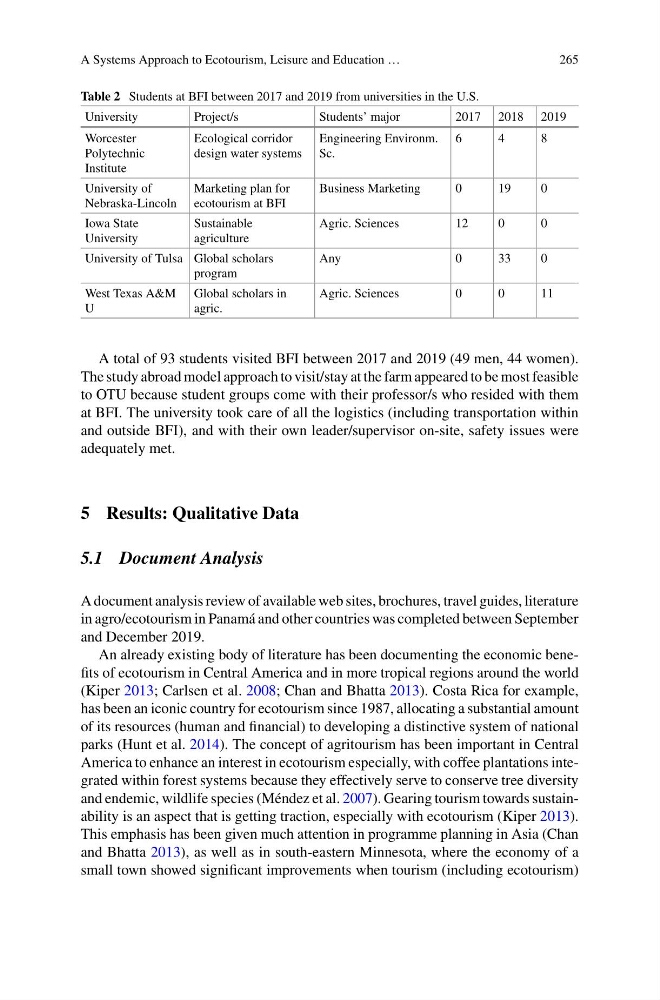
A total of 93 students visited BFI between 2017 and 2019 (49 men, 44 women).
The study abroad model approach to visit/stay at the farm appeared to be most feasible
to OTU because student groups come with their professor/s who resided with them
at BFI. The university took care of all the logistics (including transportation within
and outside BFI), and with their own leader/supervisor on-site, safety issues were
adequately met.
5 Results: Qualitative Data
5.1 Document Analysis
A document analysis review of available web sites, brochures, travel guides, literature
in agro/ecotourism in Panamá and other countries was completed between September
and December 2019.
An already existing body of literature has been documenting the economic benefits of ecotourism in Central America and in more tropical regions around the world
(Kiper 2013; Carlsen et al. 2008; Chan and Bhatta 2013). Costa Rica for example,
has been an iconic country for ecotourism since 1987, allocating a substantial amount
of its resources (human and financial) to developing a distinctive system of national
parks (Hunt et al. 2014). The concept of agritourism has been important in Central
America to enhance an interest in ecotourism especially, with coffee plantations integrated within forest systems because they effectively serve to conserve tree diversity
and endemic, wildlife species (Méndez et al. 2007). Gearing tourism towards sustainability is an aspect that is getting traction, especially with ecotourism (Kiper 2013).
This emphasis has been given much attention in programme planning in Asia (Chan
and Bhatta 2013), as well as in south-eastern Minnesota, where the economy of a
small town showed significant improvements when tourism (including ecotourism)
265
Table 2 Students at BFI between 2017 and 2019 from universities in the U.S.
University
Project/s
Students’ major
2017 2018 2019
Worcester
Polytechnic
Institute
Ecological corridor
design water systems
Engineering Environm.
Sc.
6
4
8
University of
Nebraska-Lincoln
Marketing plan for
ecotourism at BFI
Business Marketing
0
19
0
Iowa State
University
Sustainable
agriculture
Agric. Sciences
12
0
0
University of Tulsa Global scholars
program
Any
0
33
0
West Texas A&M
U
Global scholars in
agric.
Agric. Sciences
0
0
11
A total of 93 students visited BFI between 2017 and 2019 (49 men, 44 women).
The study abroad model approach to visit/stay at the farm appeared to be most feasible
to OTU because student groups come with their professor/s who resided with them
at BFI. The university took care of all the logistics (including transportation within
and outside BFI), and with their own leader/supervisor on-site, safety issues were
adequately met.
5 Results: Qualitative Data
5.1 Document Analysis
A document analysis review of available web sites, brochures, travel guides, literature
in agro/ecotourism in Panamá and other countries was completed between September
and December 2019.
An already existing body of literature has been documenting the economic benefits of ecotourism in Central America and in more tropical regions around the world
(Kiper 2013; Carlsen et al. 2008; Chan and Bhatta 2013). Costa Rica for example,
has been an iconic country for ecotourism since 1987, allocating a substantial amount
of its resources (human and financial) to developing a distinctive system of national
parks (Hunt et al. 2014). The concept of agritourism has been important in Central
America to enhance an interest in ecotourism especially, with coffee plantations integrated within forest systems because they effectively serve to conserve tree diversity
and endemic, wildlife species (Méndez et al. 2007). Gearing tourism towards sustainability is an aspect that is getting traction, especially with ecotourism (Kiper 2013).
This emphasis has been given much attention in programme planning in Asia (Chan
and Bhatta 2013), as well as in south-eastern Minnesota, where the economy of a
small town showed significant improvements when tourism (including ecotourism)