

264
B. Borsari et al.
discussion. These data were anonymous and voluntarily submitted by respondents at
the end of the day. The protection of human subjects was ensured through approval
by the Institutional Review Board (IRB) of Oteima Technological University and
Winona State University.
4 Results: Demographic Data
Ecotourism at BFI began in 2014. The programme consisted in offering an internship
with a focus on primate behaviour and rehabilitation, under the guidance of a resident coordinator. Student interns joined this programme individually, attracted by the
information posted on the BFI website, and stayed between one and six months on
average. During the period 2014–2016, two hundred and thirteen students (98 men
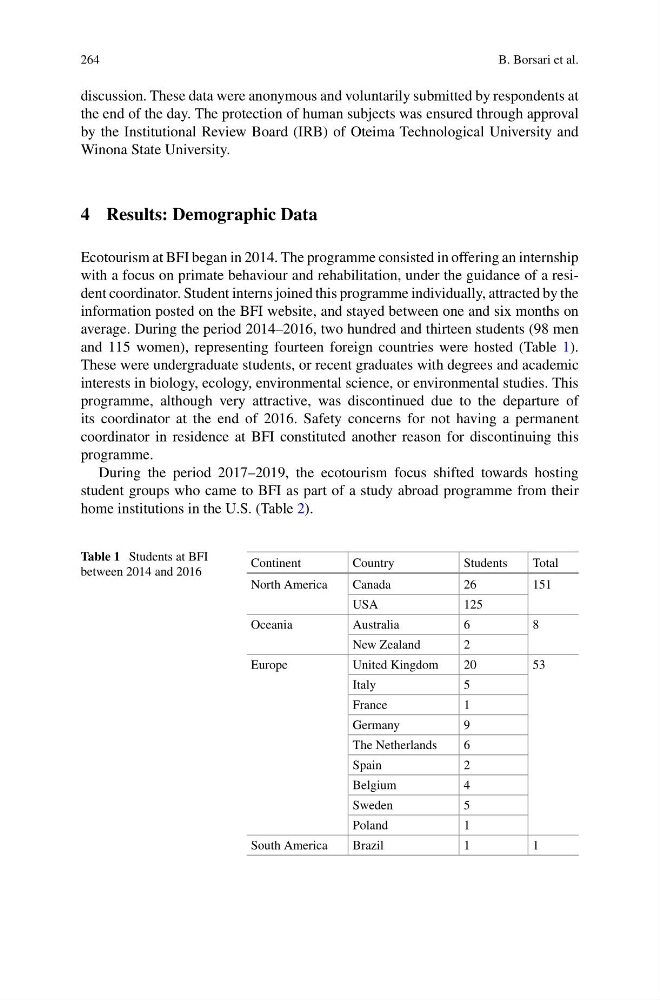
and 115 women), representing fourteen foreign countries were hosted (Table 1).
These were undergraduate students, or recent graduates with degrees and academic
interests in biology, ecology, environmental science, or environmental studies. This
programme, although very attractive, was discontinued due to the departure of
its coordinator at the end of 2016. Safety concerns for not having a permanent
coordinator in residence at BFI constituted another reason for discontinuing this
programme.
During the period 2017–2019, the ecotourism focus shifted towards hosting
student groups who came to BFI as part of a study abroad programme from their
home institutions in the U.S. (Table 2).
Table 1 Students at BFI
between 2014 and 2016
Continent
Country
Students
Total
North America
Canada
26
151
USA
125
Oceania
Australia
6
8
New Zealand
2
Europe
United Kingdom
20
53
Italy
5
France
1
Germany
9
The Netherlands
6
Spain
2
Belgium
4
Sweden
5
Poland
1
South America
Brazil
1
1
B. Borsari et al.
discussion. These data were anonymous and voluntarily submitted by respondents at
the end of the day. The protection of human subjects was ensured through approval
by the Institutional Review Board (IRB) of Oteima Technological University and
Winona State University.
4 Results: Demographic Data
Ecotourism at BFI began in 2014. The programme consisted in offering an internship
with a focus on primate behaviour and rehabilitation, under the guidance of a resident coordinator. Student interns joined this programme individually, attracted by the
information posted on the BFI website, and stayed between one and six months on
average. During the period 2014–2016, two hundred and thirteen students (98 men
and 115 women), representing fourteen foreign countries were hosted (Table 1).
These were undergraduate students, or recent graduates with degrees and academic
interests in biology, ecology, environmental science, or environmental studies. This
programme, although very attractive, was discontinued due to the departure of
its coordinator at the end of 2016. Safety concerns for not having a permanent
coordinator in residence at BFI constituted another reason for discontinuing this
programme.
During the period 2017–2019, the ecotourism focus shifted towards hosting
student groups who came to BFI as part of a study abroad programme from their
home institutions in the U.S. (Table 2).
Table 1 Students at BFI
between 2014 and 2016
Continent
Country
Students
Total
North America
Canada
26
151
USA
125
Oceania
Australia
6
8
New Zealand
2
Europe
United Kingdom
20
53
Italy
5
France
1
Germany
9
The Netherlands
6
Spain
2
Belgium
4
Sweden
5
Poland
1
South America
Brazil
1
1