

7.3 European Water Future: The Impacts of the Anthropocene
77
availability is projected to exacerbate water stress, especially in southern Europe.
Moreover, climate change has already increased water temperatures of rivers and
lakes, and has decreased ice cover (changes in stream flow and water temperature
have important impacts on water quality and on freshwater ecosystems) (EEA 2012c).
In summary: water stress will emerge as a widespread phenomenon and, where
it already exists, is projected to worsen. Importantly, while such negative effects
can partly be reduced by water use efficiency gains (e.g. in the field of irrigation,
industry, etc.) or trade (e.g. import of agricultural produce) these measures will not
be sufficient to compensate for climate-induced increases in water stress. At the
same time, floods and the concomitant economic loss are projected to significantly
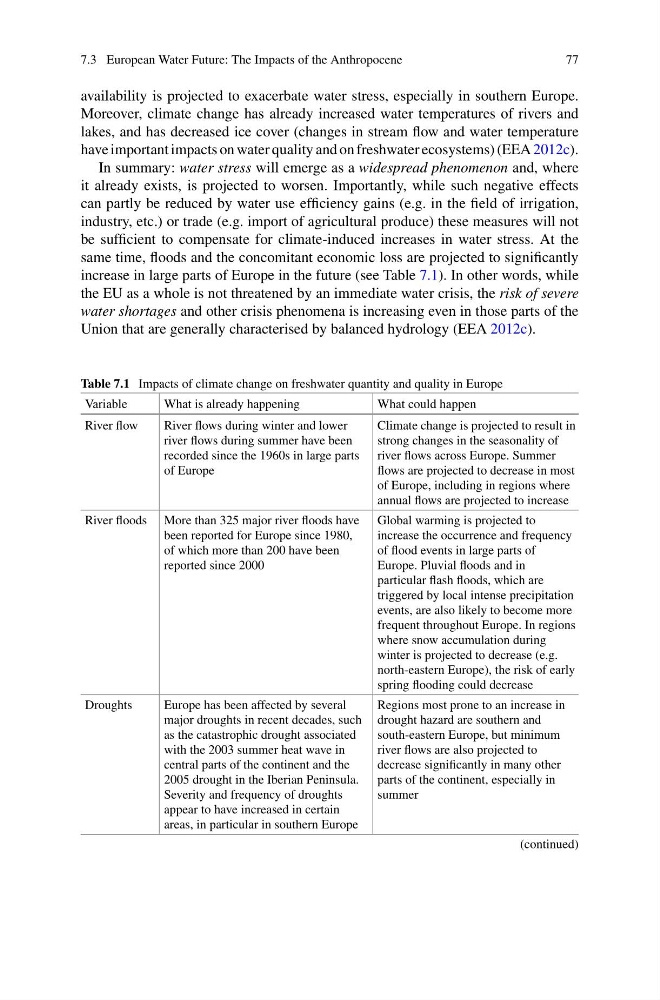
increase in large parts of Europe in the future (see Table 7.1). In other words, while
the EU as a whole is not threatened by an immediate water crisis, the risk of severe
water shortages and other crisis phenomena is increasing even in those parts of the
Union that are generally characterised by balanced hydrology (EEA 2012c).
Table 7.1 Impacts of climate change on freshwater quantity and quality in Europe
Variable
What is already happening
What could happen
River flow
River flows during winter and lower
river flows during summer have been
recorded since the 1960s in large parts
of Europe
Climate change is projected to result in
strong changes in the seasonality of
river flows across Europe. Summer
flows are projected to decrease in most
of Europe, including in regions where
annual flows are projected to increase
River floods More than 325 major river floods have
been reported for Europe since 1980,
of which more than 200 have been
reported since 2000
Global warming is projected to
increase the occurrence and frequency
of flood events in large parts of
Europe. Pluvial floods and in
particular flash floods, which are
triggered by local intense precipitation
events, are also likely to become more
frequent throughout Europe. In regions
where snow accumulation during
winter is projected to decrease (e.g.
north-eastern Europe), the risk of early
spring flooding could decrease
Droughts
Europe has been affected by several
major droughts in recent decades, such
as the catastrophic drought associated
with the 2003 summer heat wave in
central parts of the continent and the
2005 drought in the Iberian Peninsula.
Severity and frequency of droughts
appear to have increased in certain
areas, in particular in southern Europe
Regions most prone to an increase in
drought hazard are southern and
south-eastern Europe, but minimum
river flows are also projected to
decrease significantly in many other
parts of the continent, especially in
summer
(continued)
77
availability is projected to exacerbate water stress, especially in southern Europe.
Moreover, climate change has already increased water temperatures of rivers and
lakes, and has decreased ice cover (changes in stream flow and water temperature
have important impacts on water quality and on freshwater ecosystems) (EEA 2012c).
In summary: water stress will emerge as a widespread phenomenon and, where
it already exists, is projected to worsen. Importantly, while such negative effects
can partly be reduced by water use efficiency gains (e.g. in the field of irrigation,
industry, etc.) or trade (e.g. import of agricultural produce) these measures will not
be sufficient to compensate for climate-induced increases in water stress. At the
same time, floods and the concomitant economic loss are projected to significantly
increase in large parts of Europe in the future (see Table 7.1). In other words, while
the EU as a whole is not threatened by an immediate water crisis, the risk of severe
water shortages and other crisis phenomena is increasing even in those parts of the
Union that are generally characterised by balanced hydrology (EEA 2012c).
Table 7.1 Impacts of climate change on freshwater quantity and quality in Europe
Variable
What is already happening
What could happen
River flow
River flows during winter and lower
river flows during summer have been
recorded since the 1960s in large parts
of Europe
Climate change is projected to result in
strong changes in the seasonality of
river flows across Europe. Summer
flows are projected to decrease in most
of Europe, including in regions where
annual flows are projected to increase
River floods More than 325 major river floods have
been reported for Europe since 1980,
of which more than 200 have been
reported since 2000
Global warming is projected to
increase the occurrence and frequency
of flood events in large parts of
Europe. Pluvial floods and in
particular flash floods, which are
triggered by local intense precipitation
events, are also likely to become more
frequent throughout Europe. In regions
where snow accumulation during
winter is projected to decrease (e.g.
north-eastern Europe), the risk of early
spring flooding could decrease
Droughts
Europe has been affected by several
major droughts in recent decades, such
as the catastrophic drought associated
with the 2003 summer heat wave in
central parts of the continent and the
2005 drought in the Iberian Peninsula.
Severity and frequency of droughts
appear to have increased in certain
areas, in particular in southern Europe
Regions most prone to an increase in
drought hazard are southern and
south-eastern Europe, but minimum
river flows are also projected to
decrease significantly in many other
parts of the continent, especially in
summer
(continued)