

6.4 The Global Water Crisis in a Transboundary Context …
65
1970. Non-Middle East cases accounted for five acute events only. Almost 90% of
all conflicts on record relate to water quantity and infrastructure. The 507 conflictrelated events identified are grossly outnumbered by the nearly 1300 cooperative
events (treaties, projects, institutions, joint initiatives, etc.) accounted for during the
same period (Wolf 2009). The high rate of cooperation is also eloquently illustrated
by the constantly growing number of bilateral or basin treaties and basin institutions.
As outlined above, the past 50 years shows that about 30 new water agreements are
signed every decade that results in a high treaty coverage todays (70% of the world’s
transboundary areas, 80% of the people living in those regions, see Sect. 4.2.3). A
similar token of the cooperative behaviour of riparian states is the steady increase in
the number of river basin organisations worldwide (see Sect. 5.2).
Yet, the application of the various resilience indicators to emerging hydroclimatic
challenges also shows that hydropolitical vulnerabilities exist in all regions of the
world and they are likely to increase. Based on the five above-mentioned vulnerability indicators De Stefano et al. identified 24 transboundary basins with high potential
risk for interstate tensions associated with water variability. These are mainly concentrated in northern and sub-Saharan Africa. The basins displaying the lowest levels
of risks are primarily found in western and central Europe, along the USA–Canada
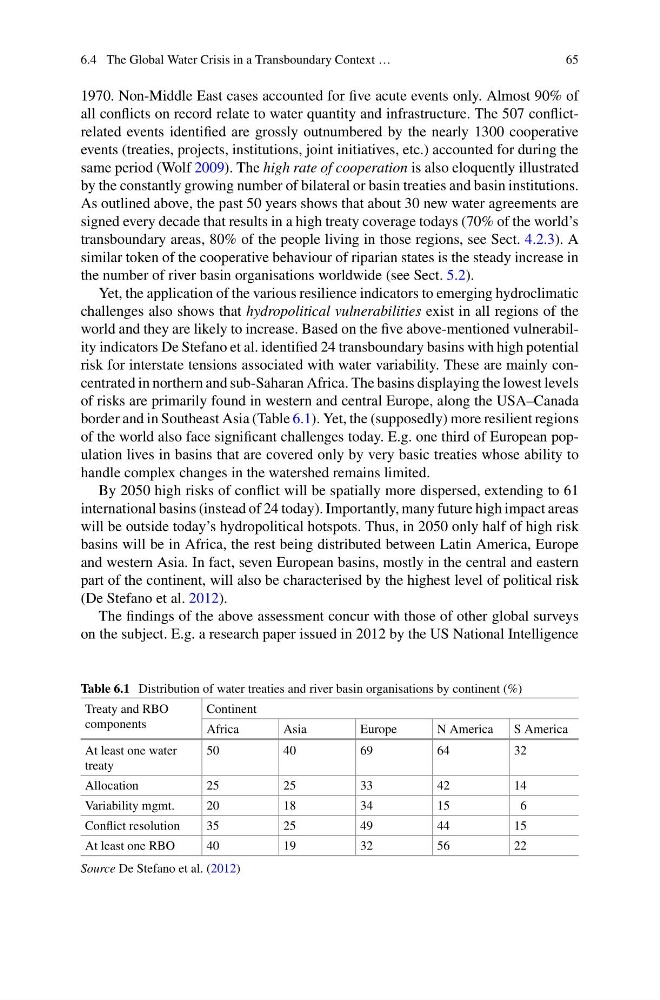
border and in Southeast Asia (Table 6.1). Yet, the (supposedly) more resilient regions
of the world also face significant challenges today. E.g. one third of European population lives in basins that are covered only by very basic treaties whose ability to
handle complex changes in the watershed remains limited.
By 2050 high risks of conflict will be spatially more dispersed, extending to 61
international basins (instead of 24 today). Importantly, many future high impact areas
will be outside today’s hydropolitical hotspots. Thus, in 2050 only half of high risk
basins will be in Africa, the rest being distributed between Latin America, Europe
and western Asia. In fact, seven European basins, mostly in the central and eastern
part of the continent, will also be characterised by the highest level of political risk
(De Stefano et al. 2012).
The findings of the above assessment concur with those of other global surveys
on the subject. E.g. a research paper issued in 2012 by the US National Intelligence
Table 6.1 Distribution of water treaties and river basin organisations by continent (%)
Treaty and RBO
components
Continent
Africa
Asia
Europe
N America
S America
At least one water
treaty
50
40
69
64
32
Allocation
25
25
33
42
14
Variability mgmt.
20
18
34
15
6
Conflict resolution
35
25
49
44
15
At least one RBO
40
19
32
56
22
Source De Stefano et al. (2012)
65
1970. Non-Middle East cases accounted for five acute events only. Almost 90% of
all conflicts on record relate to water quantity and infrastructure. The 507 conflictrelated events identified are grossly outnumbered by the nearly 1300 cooperative
events (treaties, projects, institutions, joint initiatives, etc.) accounted for during the
same period (Wolf 2009). The high rate of cooperation is also eloquently illustrated
by the constantly growing number of bilateral or basin treaties and basin institutions.
As outlined above, the past 50 years shows that about 30 new water agreements are
signed every decade that results in a high treaty coverage todays (70% of the world’s
transboundary areas, 80% of the people living in those regions, see Sect. 4.2.3). A
similar token of the cooperative behaviour of riparian states is the steady increase in
the number of river basin organisations worldwide (see Sect. 5.2).
Yet, the application of the various resilience indicators to emerging hydroclimatic
challenges also shows that hydropolitical vulnerabilities exist in all regions of the
world and they are likely to increase. Based on the five above-mentioned vulnerability indicators De Stefano et al. identified 24 transboundary basins with high potential
risk for interstate tensions associated with water variability. These are mainly concentrated in northern and sub-Saharan Africa. The basins displaying the lowest levels
of risks are primarily found in western and central Europe, along the USA–Canada
border and in Southeast Asia (Table 6.1). Yet, the (supposedly) more resilient regions
of the world also face significant challenges today. E.g. one third of European population lives in basins that are covered only by very basic treaties whose ability to
handle complex changes in the watershed remains limited.
By 2050 high risks of conflict will be spatially more dispersed, extending to 61
international basins (instead of 24 today). Importantly, many future high impact areas
will be outside today’s hydropolitical hotspots. Thus, in 2050 only half of high risk
basins will be in Africa, the rest being distributed between Latin America, Europe
and western Asia. In fact, seven European basins, mostly in the central and eastern
part of the continent, will also be characterised by the highest level of political risk
(De Stefano et al. 2012).
The findings of the above assessment concur with those of other global surveys
on the subject. E.g. a research paper issued in 2012 by the US National Intelligence
Table 6.1 Distribution of water treaties and river basin organisations by continent (%)
Treaty and RBO
components
Continent
Africa
Asia
Europe
N America
S America
At least one water
treaty
50
40
69
64
32
Allocation
25
25
33
42
14
Variability mgmt.
20
18
34
15
6
Conflict resolution
35
25
49
44
15
At least one RBO
40
19
32
56
22
Source De Stefano et al. (2012)