

58
6 Emerging Challenges to Transboundary Water Governance
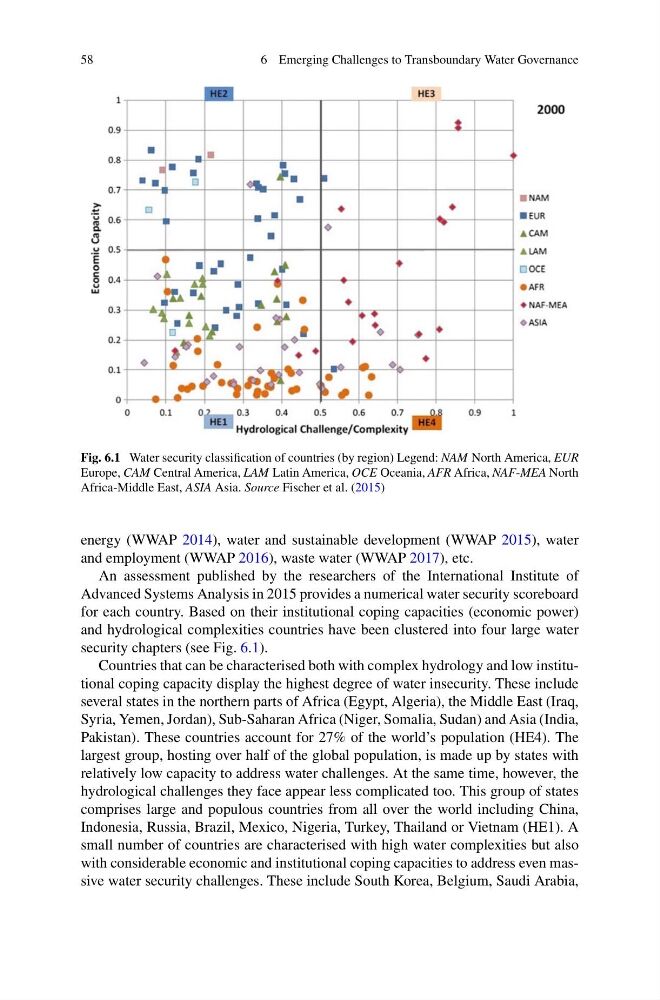
Fig. 6.1 Water security classification of countries (by region) Legend: NAM North America, EUR
Europe, CAM Central America, LAM Latin America, OCE Oceania, AFR Africa, NAF-MEA North
Africa-Middle East, ASIA Asia. Source Fischer et al. (2015)
energy (WWAP 2014), water and sustainable development (WWAP 2015), water
and employment (WWAP 2016), waste water (WWAP 2017), etc.
An assessment published by the researchers of the International Institute of
Advanced Systems Analysis in 2015 provides a numerical water security scoreboard
for each country. Based on their institutional coping capacities (economic power)
and hydrological complexities countries have been clustered into four large water
security chapters (see Fig. 6.1).
Countries that can be characterised both with complex hydrology and low institutional coping capacity display the highest degree of water insecurity. These include
several states in the northern parts of Africa (Egypt, Algeria), the Middle East (Iraq,
Syria, Yemen, Jordan), Sub-Saharan Africa (Niger, Somalia, Sudan) and Asia (India,
Pakistan). These countries account for 27% of the world’s population (HE4). The
largest group, hosting over half of the global population, is made up by states with
relatively low capacity to address water challenges. At the same time, however, the
hydrological challenges they face appear less complicated too. This group of states
comprises large and populous countries from all over the world including China,
Indonesia, Russia, Brazil, Mexico, Nigeria, Turkey, Thailand or Vietnam (HE1). A
small number of countries are characterised with high water complexities but also
with considerable economic and institutional coping capacities to address even massive water security challenges. These include South Korea, Belgium, Saudi Arabia,
6 Emerging Challenges to Transboundary Water Governance
Fig. 6.1 Water security classification of countries (by region) Legend: NAM North America, EUR
Europe, CAM Central America, LAM Latin America, OCE Oceania, AFR Africa, NAF-MEA North
Africa-Middle East, ASIA Asia. Source Fischer et al. (2015)
energy (WWAP 2014), water and sustainable development (WWAP 2015), water
and employment (WWAP 2016), waste water (WWAP 2017), etc.
An assessment published by the researchers of the International Institute of
Advanced Systems Analysis in 2015 provides a numerical water security scoreboard
for each country. Based on their institutional coping capacities (economic power)
and hydrological complexities countries have been clustered into four large water
security chapters (see Fig. 6.1).
Countries that can be characterised both with complex hydrology and low institutional coping capacity display the highest degree of water insecurity. These include
several states in the northern parts of Africa (Egypt, Algeria), the Middle East (Iraq,
Syria, Yemen, Jordan), Sub-Saharan Africa (Niger, Somalia, Sudan) and Asia (India,
Pakistan). These countries account for 27% of the world’s population (HE4). The
largest group, hosting over half of the global population, is made up by states with
relatively low capacity to address water challenges. At the same time, however, the
hydrological challenges they face appear less complicated too. This group of states
comprises large and populous countries from all over the world including China,
Indonesia, Russia, Brazil, Mexico, Nigeria, Turkey, Thailand or Vietnam (HE1). A
small number of countries are characterised with high water complexities but also
with considerable economic and institutional coping capacities to address even massive water security challenges. These include South Korea, Belgium, Saudi Arabia,