

58 Basic Seismological Theory
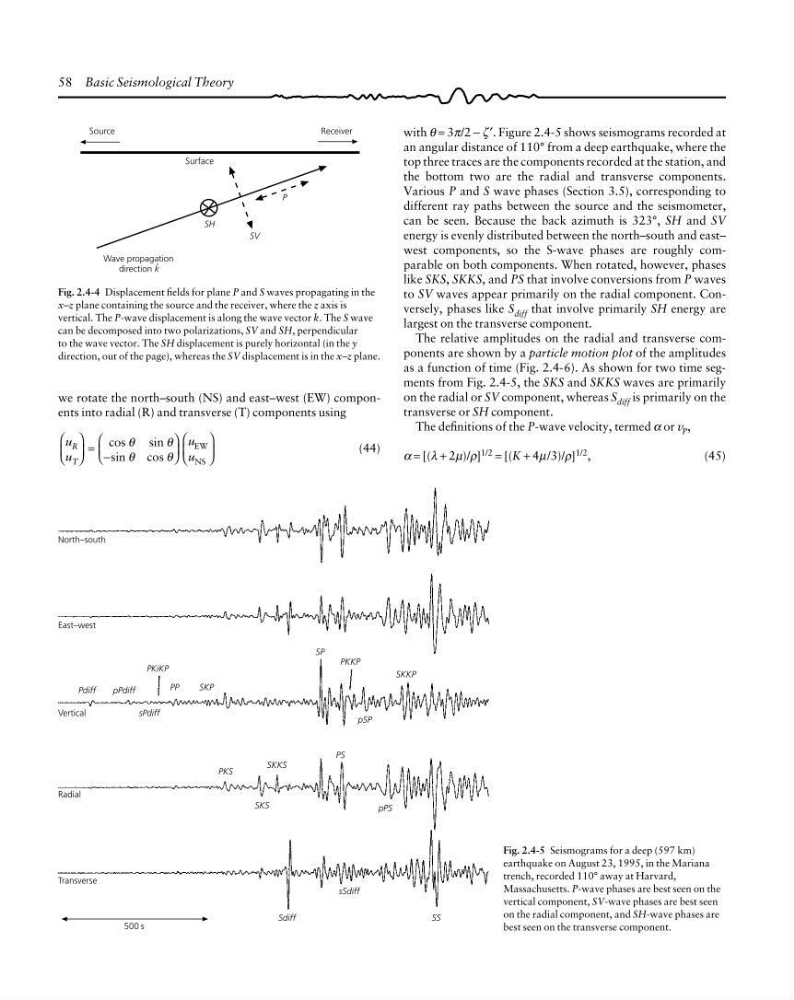
with θ = 3π/2 − ζ ′. Figure 2.4-5 shows seismograms recorded at
an angular distance of 110° from a deep earthquake, where the
top three traces are the components recorded at the station, and
the bottom two are the radial and transverse components.
Various P and S wave phases (Section 3.5), corresponding to
different ray paths between the source and the seismometer,
can be seen. Because the back azimuth is 323°, SH and SV
energy is evenly distributed between the north–south and east–
west components, so the S-wave phases are roughly comparable on both components. When rotated, however, phases
like SKS, SKKS, and PS that involve conversions from P waves
to SV waves appear primarily on the radial component. Conversely, phases like S diff that involve primarily SH energy are
largest on the transverse component.
The relative amplitudes on the radial and transverse components are shown by a particle motion plot of the amplitudes
as a function of time (Fig. 2.4-6). As shown for two time segments from Fig. 2.4-5, the SKS and SKKS waves are primarily
on the radial or SV component, whereas S diff is primarily on the
transverse or SH component.
The definitions of the P-wave velocity, termed α or v P ,
α = [(λ + 2µ)/ρ] 1/2 = [(K + 4µ/3)/ρ] 1/2 ,
(45)
Source
Surface
Receiver
SH
SV
P
Wave propagation
direction k ˆ
Fig. 2.4-4 Displacement fields for plane P and S waves propagating in the
x–z plane containing the source and the receiver, where the z axis is
vertical. The P-wave displacement is along the wave vector k. The S wave
can be decomposed into two polarizations, SV and SH, perpendicular
to the wave vector. The SH displacement is purely horizontal (in the y
direction, out of the page), whereas the SV displacement is in the x–z plane.
Transverse
500 s
Radial
Vertical
sPdiff
pPdiff
Pdiff
PP
SKP
PKiKP
East–west
North–south
SP
PKKP
SKKP
pSP
PKS
SKKS
SKS
pPS
PS
Sdiff
SS
sSdiff
Fig. 2.4-5 Seismograms for a deep (597 km)
earthquake on August 23, 1995, in the Mariana
trench, recorded 110° away at Harvard,
Massachusetts. P-wave phases are best seen on the
vertical component, SV-wave phases are best seen
on the radial component, and SH-wave phases are
best seen on the transverse component.
we rotate the north–south (NS) and east–west (EW) components into radial (R) and transverse (T) components using
u
u
u
u
R
T
⎛
⎝
⎜
⎞
⎠
⎟ = −
⎛
⎝
⎜
⎞
⎠
⎟
⎛
⎝
⎜
⎞
⎠
⎟
cos
sin
sin
cos
θ
θ
θ
θ
EW
NS
(44)
with θ = 3π/2 − ζ ′. Figure 2.4-5 shows seismograms recorded at
an angular distance of 110° from a deep earthquake, where the
top three traces are the components recorded at the station, and
the bottom two are the radial and transverse components.
Various P and S wave phases (Section 3.5), corresponding to
different ray paths between the source and the seismometer,
can be seen. Because the back azimuth is 323°, SH and SV
energy is evenly distributed between the north–south and east–
west components, so the S-wave phases are roughly comparable on both components. When rotated, however, phases
like SKS, SKKS, and PS that involve conversions from P waves
to SV waves appear primarily on the radial component. Conversely, phases like S diff that involve primarily SH energy are
largest on the transverse component.
The relative amplitudes on the radial and transverse components are shown by a particle motion plot of the amplitudes
as a function of time (Fig. 2.4-6). As shown for two time segments from Fig. 2.4-5, the SKS and SKKS waves are primarily
on the radial or SV component, whereas S diff is primarily on the
transverse or SH component.
The definitions of the P-wave velocity, termed α or v P ,
α = [(λ + 2µ)/ρ] 1/2 = [(K + 4µ/3)/ρ] 1/2 ,
(45)
Source
Surface
Receiver
SH
SV
P
Wave propagation
direction k ˆ
Fig. 2.4-4 Displacement fields for plane P and S waves propagating in the
x–z plane containing the source and the receiver, where the z axis is
vertical. The P-wave displacement is along the wave vector k. The S wave
can be decomposed into two polarizations, SV and SH, perpendicular
to the wave vector. The SH displacement is purely horizontal (in the y
direction, out of the page), whereas the SV displacement is in the x–z plane.
Transverse
500 s
Radial
Vertical
sPdiff
pPdiff
Pdiff
PP
SKP
PKiKP
East–west
North–south
SP
PKKP
SKKP
pSP
PKS
SKKS
SKS
pPS
PS
Sdiff
SS
sSdiff
Fig. 2.4-5 Seismograms for a deep (597 km)
earthquake on August 23, 1995, in the Mariana
trench, recorded 110° away at Harvard,
Massachusetts. P-wave phases are best seen on the
vertical component, SV-wave phases are best seen
on the radial component, and SH-wave phases are
best seen on the transverse component.
we rotate the north–south (NS) and east–west (EW) components into radial (R) and transverse (T) components using
u
u
u
u
R
T
⎛
⎝
⎜
⎞
⎠
⎟ = −
⎛
⎝
⎜
⎞
⎠
⎟
⎛
⎝
⎜
⎞
⎠
⎟
cos
sin
sin
cos
θ
θ
θ
θ
EW
NS
(44)