

44 Basic Seismological Theory
Fracture occurs
Rock
1
σ
3
σ
This equation shows that of the three possible local maxima of
the tangential traction, the largest value is
τ = (σ 1 − σ 3 )/2,
(35)
where σ 1 is the maximum principal stress and σ 3 is the
minimum principal stress. This occurs on the planes with unit
normal vectors
4 = (1/ 2 , 0, 1/ 2 ) and 4 = (−1/ 2 , 0, 1/ 2 ).
(36)
Thus the planes of maximum shear stress are halfway between
the maximum (1, 0, 0) and minimum (0, 0, 1) principal stress
axes, and contain the intermediate principal stress axis. The
derivatives (Eqn 33) are also zero at local minima, corresponding to the principal stress axes where τ 2 = 0.
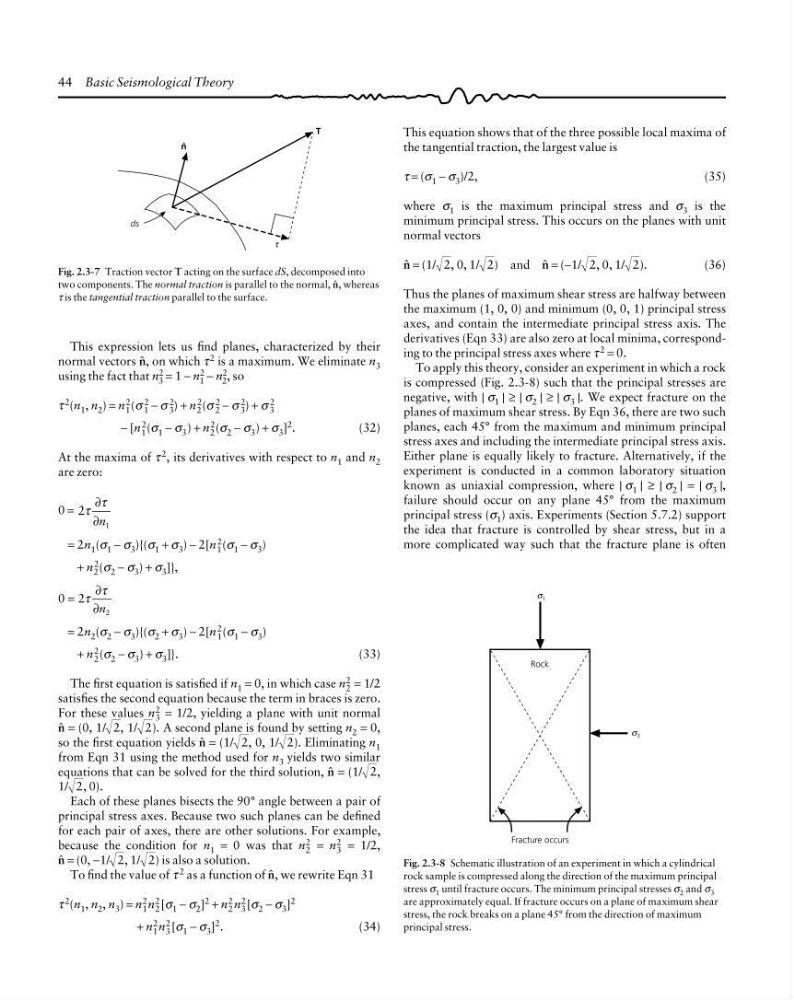
To apply this theory, consider an experiment in which a rock
is compressed (Fig. 2.3-8) such that the principal stresses are
negative, with | σ 1 | ≥ | σ 2 | ≥ | σ 3 |. We expect fracture on the
planes of maximum shear stress. By Eqn 36, there are two such
planes, each 45° from the maximum and minimum principal
stress axes and including the intermediate principal stress axis.
Either plane is equally likely to fracture. Alternatively, if the
experiment is conducted in a common laboratory situation
known as uniaxial compression, where | σ 1 | ≥ | σ 2 | = | σ 3 |,
failure should occur on any plane 45° from the maximum
principal stress (σ 1 ) axis. Experiments (Section 5.7.2) support
the idea that fracture is controlled by shear stress, but in a
more complicated way such that the fracture plane is often
Fig. 2.3-7 Traction vector T acting on the surface dS, decomposed into
two components. The normal traction is parallel to the normal, 4, whereas
τ is the tangential traction parallel to the surface.
T
ds
ˆ
n
τ
This expression lets us find planes, characterized by their
normal vectors 4, on which τ 2 is a maximum. We eliminate n 3
using the fact that n 2
3 = 1 − n 2
1 − n 2
2 , so
τ
2 (n 1 , n 2 ) = n
2
1 (σ
2
1 − σ
2
3 ) + n
2
2 (σ
2
2 − σ
2
3 ) + σ
2
3
− [n 2
1 (σ 1 − σ 3 ) + n 2
2 (σ 2 − σ 3 ) + σ 3 ] 2 .
(32)
At the maxima of τ 2 , its derivatives with respect to n 1 and n 2
are zero:
0 = 2
1
τ
τ
∂
∂n
= 2n 1 (σ 1 − σ 3 ){(σ 1 + σ 3 ) − 2[n 2
1 (σ 1 − σ 3 )
+ n 2
2 (σ 2 − σ 3 ) + σ 3 ]},
0 = 2
2
τ
τ
∂
∂n
= 2n 2 (σ 2 − σ 3 ){(σ 2 + σ 3 ) − 2[n
2
1 (σ 1 − σ 3 )
+ n 2
2 (σ 2 − σ 3 ) + σ 3 ]}.
(33)
The first equation is satisfied if n 1 = 0, in which case n 2
2 = 1/2
satisfies the second equation because the term in braces is zero.
For these values n 2
3 = 1/2, yielding a plane with unit normal
4 = (0, 1/ 2 , 1/ 2 ). A second plane is found by setting n 2 = 0,
so the first equation yields 4 = (1/ 2 , 0, 1/ 2 ). Eliminating n 1
from Eqn 31 using the method used for n 3 yields two similar
equations that can be solved for the third solution, 4 = (1/ 2 ,
1/ 2 , 0).
Each of these planes bisects the 90° angle between a pair of
principal stress axes. Because two such planes can be defined
for each pair of axes, there are other solutions. For example,
because the condition for n 1 = 0 was that n 2
2 = n 2
3 = 1/2,
4 = (0, −1/ 2 , 1/ 2 ) is also a solution.
To find the value of τ 2 as a function of 4, we rewrite Eqn 31
τ 2 (n 1 , n 2 , n 3 ) = n 2
1 n 2
2 [σ 1 − σ 2 ] 2 + n 2
2 n 2
3 [σ 2 − σ 3 ] 2
+ n 2
1 n 2
3 [σ 1 − σ 3 ] 2 .
(34)
Fig. 2.3-8 Schematic illustration of an experiment in which a cylindrical
rock sample is compressed along the direction of the maximum principal
stress σ 1 until fracture occurs. The minimum principal stresses σ 2 and σ 3
are approximately equal. If fracture occurs on a plane of maximum shear
stress, the rock breaks on a plane 45° from the direction of maximum
principal stress.
Fracture occurs
Rock
1
σ
3
σ
This equation shows that of the three possible local maxima of
the tangential traction, the largest value is
τ = (σ 1 − σ 3 )/2,
(35)
where σ 1 is the maximum principal stress and σ 3 is the
minimum principal stress. This occurs on the planes with unit
normal vectors
4 = (1/ 2 , 0, 1/ 2 ) and 4 = (−1/ 2 , 0, 1/ 2 ).
(36)
Thus the planes of maximum shear stress are halfway between
the maximum (1, 0, 0) and minimum (0, 0, 1) principal stress
axes, and contain the intermediate principal stress axis. The
derivatives (Eqn 33) are also zero at local minima, corresponding to the principal stress axes where τ 2 = 0.
To apply this theory, consider an experiment in which a rock
is compressed (Fig. 2.3-8) such that the principal stresses are
negative, with | σ 1 | ≥ | σ 2 | ≥ | σ 3 |. We expect fracture on the
planes of maximum shear stress. By Eqn 36, there are two such
planes, each 45° from the maximum and minimum principal
stress axes and including the intermediate principal stress axis.
Either plane is equally likely to fracture. Alternatively, if the
experiment is conducted in a common laboratory situation
known as uniaxial compression, where | σ 1 | ≥ | σ 2 | = | σ 3 |,
failure should occur on any plane 45° from the maximum
principal stress (σ 1 ) axis. Experiments (Section 5.7.2) support
the idea that fracture is controlled by shear stress, but in a
more complicated way such that the fracture plane is often
Fig. 2.3-7 Traction vector T acting on the surface dS, decomposed into
two components. The normal traction is parallel to the normal, 4, whereas
τ is the tangential traction parallel to the surface.
T
ds
ˆ
n
τ
This expression lets us find planes, characterized by their
normal vectors 4, on which τ 2 is a maximum. We eliminate n 3
using the fact that n 2
3 = 1 − n 2
1 − n 2
2 , so
τ
2 (n 1 , n 2 ) = n
2
1 (σ
2
1 − σ
2
3 ) + n
2
2 (σ
2
2 − σ
2
3 ) + σ
2
3
− [n 2
1 (σ 1 − σ 3 ) + n 2
2 (σ 2 − σ 3 ) + σ 3 ] 2 .
(32)
At the maxima of τ 2 , its derivatives with respect to n 1 and n 2
are zero:
0 = 2
1
τ
τ
∂
∂n
= 2n 1 (σ 1 − σ 3 ){(σ 1 + σ 3 ) − 2[n 2
1 (σ 1 − σ 3 )
+ n 2
2 (σ 2 − σ 3 ) + σ 3 ]},
0 = 2
2
τ
τ
∂
∂n
= 2n 2 (σ 2 − σ 3 ){(σ 2 + σ 3 ) − 2[n
2
1 (σ 1 − σ 3 )
+ n 2
2 (σ 2 − σ 3 ) + σ 3 ]}.
(33)
The first equation is satisfied if n 1 = 0, in which case n 2
2 = 1/2
satisfies the second equation because the term in braces is zero.
For these values n 2
3 = 1/2, yielding a plane with unit normal
4 = (0, 1/ 2 , 1/ 2 ). A second plane is found by setting n 2 = 0,
so the first equation yields 4 = (1/ 2 , 0, 1/ 2 ). Eliminating n 1
from Eqn 31 using the method used for n 3 yields two similar
equations that can be solved for the third solution, 4 = (1/ 2 ,
1/ 2 , 0).
Each of these planes bisects the 90° angle between a pair of
principal stress axes. Because two such planes can be defined
for each pair of axes, there are other solutions. For example,
because the condition for n 1 = 0 was that n 2
2 = n 2
3 = 1/2,
4 = (0, −1/ 2 , 1/ 2 ) is also a solution.
To find the value of τ 2 as a function of 4, we rewrite Eqn 31
τ 2 (n 1 , n 2 , n 3 ) = n 2
1 n 2
2 [σ 1 − σ 2 ] 2 + n 2
2 n 2
3 [σ 2 − σ 3 ] 2
+ n 2
1 n 2
3 [σ 1 − σ 3 ] 2 .
(34)
Fig. 2.3-8 Schematic illustration of an experiment in which a cylindrical
rock sample is compressed along the direction of the maximum principal
stress σ 1 until fracture occurs. The minimum principal stresses σ 2 and σ 3
are approximately equal. If fracture occurs on a plane of maximum shear
stress, the rock breaks on a plane 45° from the direction of maximum
principal stress.