

40 Basic Seismological Theory
22
dS 1
σ
23
σ
21
σ
12
σ
13
σ
11
σ
32
σ
33
σ
31
σ
T
ˆ
n
dS 2
dS 3
dS
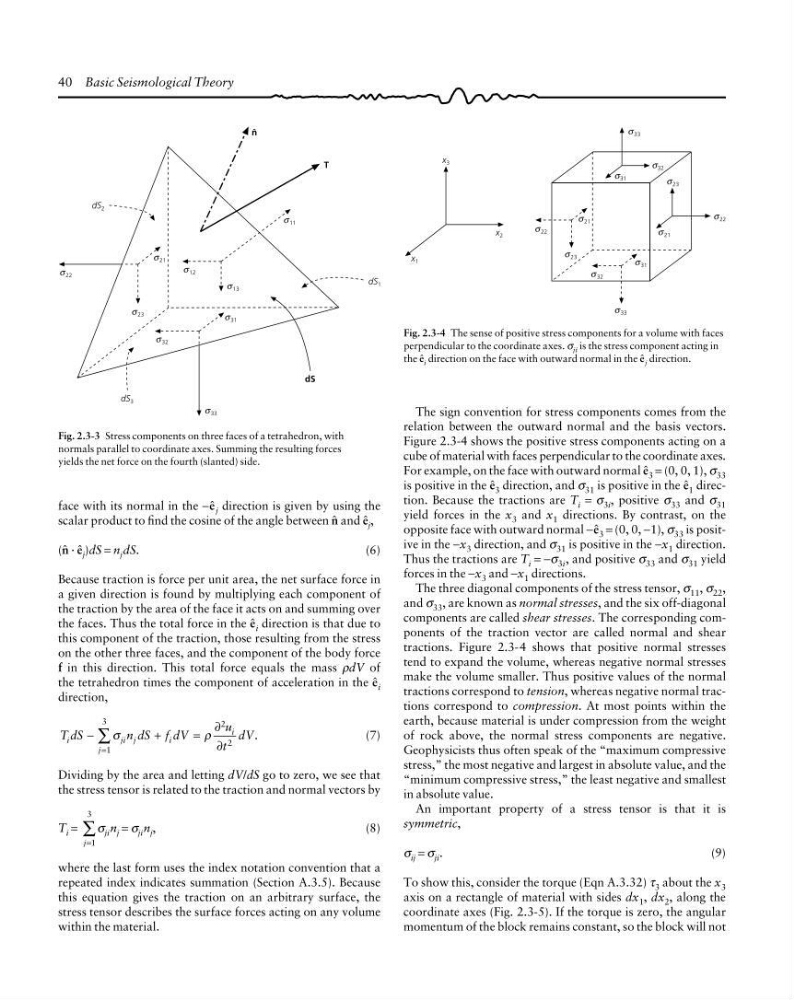
Fig. 2.3-3 Stress components on three faces of a tetrahedron, with
normals parallel to coordinate axes. Summing the resulting forces
yields the net force on the fourth (slanted) side.
x 3
x 2
x 1
22
σ
21
σ
23
σ
32
σ
31
σ
33
σ
21
σ
23
σ
32
σ
31
σ
33
σ
22
σ
Fig. 2.3-4 The sense of positive stress components for a volume with faces
perpendicular to the coordinate axes. σ ji is the stress component acting in
the ê i direction on the face with outward normal in the ê j direction.
face with its normal in the −ê j direction is given by using the
scalar product to find the cosine of the angle between 4 and ê j ,
(4 · ê j )dS = n j dS.
(6)
Because traction is force per unit area, the net surface force in
a given direction is found by multiplying each component of
the traction by the area of the face it acts on and summing over
the faces. Thus the total force in the ê i direction is that due to
this component of the traction, those resulting from the stress
on the other three faces, and the component of the body force
f in this direction. This total force equals the mass ρdV of
the tetrahedron times the component of acceleration in the ê i
direction,
T dS
n dS f dV
u
t
dV
i
j ij
j
i
i
.
−
+
=
=
∑ σ
ρ
1
3
2
2
∂
∂
(7)
Dividing by the area and letting dV/dS go to zero, we see that
the stress tensor is related to the traction and normal vectors by
T i =
j=
∑
1
3
σ ji n j = σ ji n j ,
(8)
where the last form uses the index notation convention that a
repeated index indicates summation (Section A.3.5). Because
this equation gives the traction on an arbitrary surface, the
stress tensor describes the surface forces acting on any volume
within the material.
The sign convention for stress components comes from the
relation between the outward normal and the basis vectors.
Figure 2.3-4 shows the positive stress components acting on a
cube of material with faces perpendicular to the coordinate axes.
For example, on the face with outward normal ê 3 = (0, 0, 1), σ 33
is positive in the ê 3 direction, and σ 31 is positive in the ê 1 direction. Because the tractions are T i = σ 3i , positive σ 33 and σ 31
yield forces in the x 3 and x 1 directions. By contrast, on the
opposite face with outward normal −ê 3 = (0, 0, −1), σ 33 is positive in the −x 3 direction, and σ 31 is positive in the −x 1 direction.
Thus the tractions are T i = −σ 3i , and positive σ 33 and σ 31 yield
forces in the −x 3 and −x 1 directions.
The three diagonal components of the stress tensor, σ 11 , σ 22 ,
and σ 33 , are known as normal stresses, and the six off-diagonal
components are called shear stresses. The corresponding components of the traction vector are called normal and shear
tractions. Figure 2.3-4 shows that positive normal stresses
tend to expand the volume, whereas negative normal stresses
make the volume smaller. Thus positive values of the normal
tractions correspond to tension, whereas negative normal tractions correspond to compression. At most points within the
earth, because material is under compression from the weight
of rock above, the normal stress components are negative.
Geophysicists thus often speak of the “maximum compressive
stress,” the most negative and largest in absolute value, and the
“minimum compressive stress,” the least negative and smallest
in absolute value.
An important property of a stress tensor is that it is
symmetric,
σ ij = σ ji .
(9)
To show this, consider the torque (Eqn A.3.32) τ 3 about the x 3
axis on a rectangle of material with sides dx 1 , dx 2 , along the
coordinate axes (Fig. 2.3-5). If the torque is zero, the angular
momentum of the block remains constant, so the block will not
22
dS 1
σ
23
σ
21
σ
12
σ
13
σ
11
σ
32
σ
33
σ
31
σ
T
ˆ
n
dS 2
dS 3
dS
Fig. 2.3-3 Stress components on three faces of a tetrahedron, with
normals parallel to coordinate axes. Summing the resulting forces
yields the net force on the fourth (slanted) side.
x 3
x 2
x 1
22
σ
21
σ
23
σ
32
σ
31
σ
33
σ
21
σ
23
σ
32
σ
31
σ
33
σ
22
σ
Fig. 2.3-4 The sense of positive stress components for a volume with faces
perpendicular to the coordinate axes. σ ji is the stress component acting in
the ê i direction on the face with outward normal in the ê j direction.
face with its normal in the −ê j direction is given by using the
scalar product to find the cosine of the angle between 4 and ê j ,
(4 · ê j )dS = n j dS.
(6)
Because traction is force per unit area, the net surface force in
a given direction is found by multiplying each component of
the traction by the area of the face it acts on and summing over
the faces. Thus the total force in the ê i direction is that due to
this component of the traction, those resulting from the stress
on the other three faces, and the component of the body force
f in this direction. This total force equals the mass ρdV of
the tetrahedron times the component of acceleration in the ê i
direction,
T dS
n dS f dV
u
t
dV
i
j ij
j
i
i
.
−
+
=
=
∑ σ
ρ
1
3
2
2
∂
∂
(7)
Dividing by the area and letting dV/dS go to zero, we see that
the stress tensor is related to the traction and normal vectors by
T i =
j=
∑
1
3
σ ji n j = σ ji n j ,
(8)
where the last form uses the index notation convention that a
repeated index indicates summation (Section A.3.5). Because
this equation gives the traction on an arbitrary surface, the
stress tensor describes the surface forces acting on any volume
within the material.
The sign convention for stress components comes from the
relation between the outward normal and the basis vectors.
Figure 2.3-4 shows the positive stress components acting on a
cube of material with faces perpendicular to the coordinate axes.
For example, on the face with outward normal ê 3 = (0, 0, 1), σ 33
is positive in the ê 3 direction, and σ 31 is positive in the ê 1 direction. Because the tractions are T i = σ 3i , positive σ 33 and σ 31
yield forces in the x 3 and x 1 directions. By contrast, on the
opposite face with outward normal −ê 3 = (0, 0, −1), σ 33 is positive in the −x 3 direction, and σ 31 is positive in the −x 1 direction.
Thus the tractions are T i = −σ 3i , and positive σ 33 and σ 31 yield
forces in the −x 3 and −x 1 directions.
The three diagonal components of the stress tensor, σ 11 , σ 22 ,
and σ 33 , are known as normal stresses, and the six off-diagonal
components are called shear stresses. The corresponding components of the traction vector are called normal and shear
tractions. Figure 2.3-4 shows that positive normal stresses
tend to expand the volume, whereas negative normal stresses
make the volume smaller. Thus positive values of the normal
tractions correspond to tension, whereas negative normal tractions correspond to compression. At most points within the
earth, because material is under compression from the weight
of rock above, the normal stress components are negative.
Geophysicists thus often speak of the “maximum compressive
stress,” the most negative and largest in absolute value, and the
“minimum compressive stress,” the least negative and smallest
in absolute value.
An important property of a stress tensor is that it is
symmetric,
σ ij = σ ji .
(9)
To show this, consider the torque (Eqn A.3.32) τ 3 about the x 3
axis on a rectangle of material with sides dx 1 , dx 2 , along the
coordinate axes (Fig. 2.3-5). If the torque is zero, the angular
momentum of the block remains constant, so the block will not