

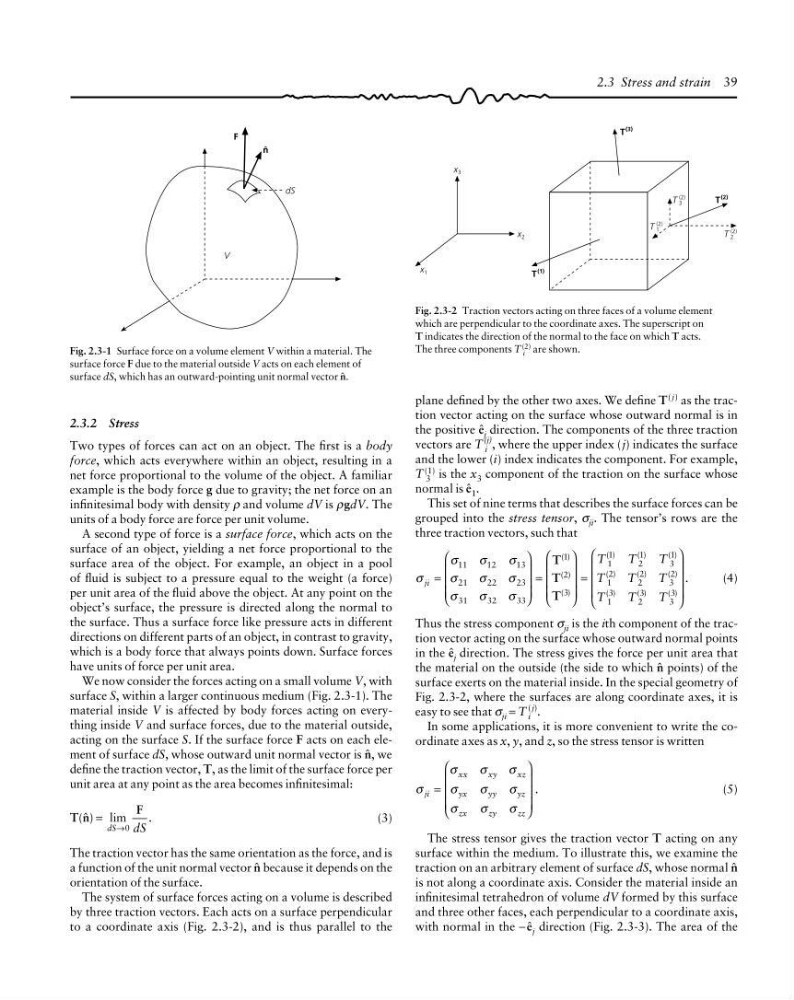
Fig. 2.3-1 Surface force on a volume element V within a material. The
surface force F due to the material outside V acts on each element of
surface dS, which has an outward-pointing unit normal vector 4.
V
dS
F
ˆ
n
Fig. 2.3-2 Traction vectors acting on three faces of a volume element
which are perpendicular to the coordinate axes. The superscript on
T indicates the direction of the normal to the face on which T acts.
The three components T i
(2) are shown.
2.3.2 Stress
Two types of forces can act on an object. The first is a body
force, which acts everywhere within an object, resulting in a
net force proportional to the volume of the object. A familiar
example is the body force g due to gravity; the net force on an
infinitesimal body with density ρ and volume dV is ρgdV. The
units of a body force are force per unit volume.
A second type of force is a surface force, which acts on the
surface of an object, yielding a net force proportional to the
surface area of the object. For example, an object in a pool
of fluid is subject to a pressure equal to the weight (a force)
per unit area of the fluid above the object. At any point on the
object’s surface, the pressure is directed along the normal to
the surface. Thus a surface force like pressure acts in different
directions on different parts of an object, in contrast to gravity,
which is a body force that always points down. Surface forces
have units of force per unit area.
We now consider the forces acting on a small volume V, with
surface S, within a larger continuous medium (Fig. 2.3-1). The
material inside V is affected by body forces acting on everything inside V and surface forces, due to the material outside,
acting on the surface S. If the surface force F acts on each element of surface dS, whose outward unit normal vector is 4, we
define the traction vector, T, as the limit of the surface force per
unit area at any point as the area becomes infinitesimal:
T(4) = lim
.
dS
dS
→0
F
(3)
The traction vector has the same orientation as the force, and is
a function of the unit normal vector 4 because it depends on the
orientation of the surface.
The system of surface forces acting on a volume is described
by three traction vectors. Each acts on a surface perpendicular
to a coordinate axis (Fig. 2.3-2), and is thus parallel to the
2.3 Stress and strain 39
x 3
x 2
x 1
T 3
(2)
T 2
(2)
T 1
(2)
T
(2)
T
(3)
T
(1)
plane defined by the other two axes. We define T ( j) as the traction vector acting on the surface whose outward normal is in
the positive ê j direction. The components of the three traction
vectors are T i
(j)
, where the upper index (j) indicates the surface
and the lower (i) index indicates the component. For example,
T 3
(1) is the x 3 component of the traction on the surface whose
normal is ê 1 .
This set of nine terms that describes the surface forces can be
grouped into the stress tensor, σ ji . The tensor’s rows are the
three traction vectors, such that
σ
σ
σ
σ
σ
σ
σ
σ
σ
σ
ji
T
T
T
T
T
T
T
T
T
.
( )
( )
( )
( )
( )
( )
( )
( )
( )
( )
( )
( )
=
⎛
⎝
⎜
⎜
⎜
⎞
⎠
⎟
⎟
⎟
=
⎛
⎝
⎜
⎜
⎜
⎞
⎠
⎟
⎟
⎟
=
⎛
⎝
⎜
⎜
⎜
⎞
⎠
⎟
⎟
⎟
11
12
13
21
22
23
31
32
33
1
2
3
1
1
2
1
3
1
1
2
2
2
3
2
1
3
2
3
3
3
T
T
T
(4)
Thus the stress component σ ji is the ith component of the traction vector acting on the surface whose outward normal points
in the ê j direction. The stress gives the force per unit area that
the material on the outside (the side to which 4 points) of the
surface exerts on the material inside. In the special geometry of
Fig. 2.3-2, where the surfaces are along coordinate axes, it is
easy to see that σ ji = T i
( j)
.
In some applications, it is more convenient to write the coordinate axes as x, y, and z, so the stress tensor is written
σ
σ
σ
σ
σ
σ
σ
σ
σ
σ
ji
xx
xy
xz
yx
yy
yz
zx
zy
zz
.
=
⎛
⎝
⎜
⎜
⎜
⎞
⎠
⎟
⎟
⎟
(5)
The stress tensor gives the traction vector T acting on any
surface within the medium. To illustrate this, we examine the
traction on an arbitrary element of surface dS, whose normal 4
is not along a coordinate axis. Consider the material inside an
infinitesimal tetrahedron of volume dV formed by this surface
and three other faces, each perpendicular to a coordinate axis,
with normal in the −ê j direction (Fig. 2.3-3). The area of the
surface force F due to the material outside V acts on each element of
surface dS, which has an outward-pointing unit normal vector 4.
V
dS
F
ˆ
n
Fig. 2.3-2 Traction vectors acting on three faces of a volume element
which are perpendicular to the coordinate axes. The superscript on
T indicates the direction of the normal to the face on which T acts.
The three components T i
(2) are shown.
2.3.2 Stress
Two types of forces can act on an object. The first is a body
force, which acts everywhere within an object, resulting in a
net force proportional to the volume of the object. A familiar
example is the body force g due to gravity; the net force on an
infinitesimal body with density ρ and volume dV is ρgdV. The
units of a body force are force per unit volume.
A second type of force is a surface force, which acts on the
surface of an object, yielding a net force proportional to the
surface area of the object. For example, an object in a pool
of fluid is subject to a pressure equal to the weight (a force)
per unit area of the fluid above the object. At any point on the
object’s surface, the pressure is directed along the normal to
the surface. Thus a surface force like pressure acts in different
directions on different parts of an object, in contrast to gravity,
which is a body force that always points down. Surface forces
have units of force per unit area.
We now consider the forces acting on a small volume V, with
surface S, within a larger continuous medium (Fig. 2.3-1). The
material inside V is affected by body forces acting on everything inside V and surface forces, due to the material outside,
acting on the surface S. If the surface force F acts on each element of surface dS, whose outward unit normal vector is 4, we
define the traction vector, T, as the limit of the surface force per
unit area at any point as the area becomes infinitesimal:
T(4) = lim
.
dS
dS
→0
F
(3)
The traction vector has the same orientation as the force, and is
a function of the unit normal vector 4 because it depends on the
orientation of the surface.
The system of surface forces acting on a volume is described
by three traction vectors. Each acts on a surface perpendicular
to a coordinate axis (Fig. 2.3-2), and is thus parallel to the
2.3 Stress and strain 39
x 3
x 2
x 1
T 3
(2)
T 2
(2)
T 1
(2)
T
(2)
T
(3)
T
(1)
plane defined by the other two axes. We define T ( j) as the traction vector acting on the surface whose outward normal is in
the positive ê j direction. The components of the three traction
vectors are T i
(j)
, where the upper index (j) indicates the surface
and the lower (i) index indicates the component. For example,
T 3
(1) is the x 3 component of the traction on the surface whose
normal is ê 1 .
This set of nine terms that describes the surface forces can be
grouped into the stress tensor, σ ji . The tensor’s rows are the
three traction vectors, such that
σ
σ
σ
σ
σ
σ
σ
σ
σ
σ
ji
T
T
T
T
T
T
T
T
T
.
( )
( )
( )
( )
( )
( )
( )
( )
( )
( )
( )
( )
=
⎛
⎝
⎜
⎜
⎜
⎞
⎠
⎟
⎟
⎟
=
⎛
⎝
⎜
⎜
⎜
⎞
⎠
⎟
⎟
⎟
=
⎛
⎝
⎜
⎜
⎜
⎞
⎠
⎟
⎟
⎟
11
12
13
21
22
23
31
32
33
1
2
3
1
1
2
1
3
1
1
2
2
2
3
2
1
3
2
3
3
3
T
T
T
(4)
Thus the stress component σ ji is the ith component of the traction vector acting on the surface whose outward normal points
in the ê j direction. The stress gives the force per unit area that
the material on the outside (the side to which 4 points) of the
surface exerts on the material inside. In the special geometry of
Fig. 2.3-2, where the surfaces are along coordinate axes, it is
easy to see that σ ji = T i
( j)
.
In some applications, it is more convenient to write the coordinate axes as x, y, and z, so the stress tensor is written
σ
σ
σ
σ
σ
σ
σ
σ
σ
σ
ji
xx
xy
xz
yx
yy
yz
zx
zy
zz
.
=
⎛
⎝
⎜
⎜
⎜
⎞
⎠
⎟
⎟
⎟
(5)
The stress tensor gives the traction vector T acting on any
surface within the medium. To illustrate this, we examine the
traction on an arbitrary element of surface dS, whose normal 4
is not along a coordinate axis. Consider the material inside an
infinitesimal tetrahedron of volume dV formed by this surface
and three other faces, each perpendicular to a coordinate axis,
with normal in the −ê j direction (Fig. 2.3-3). The area of the