

460 Appendix
dS
Vector field
u(x)
ˆ
n(x)
dv
flow into an adjacent cell, which cancels to zero. Only flow in
or out of the volume’s surface is not canceled out in this way.
Written in full, ∫dV is a triple integral over the volume, and ∫dS
is a double integral over the surface.
In index notation, using the summation convention, the
divergence is written
∇
∇ ∇
∇ ∇ · u =
∂
∂
u
x
i
i
= u i, i ,
(11)
which is a scalar because no free index remains. Gauss’s theorem is written
Ύ
S
u i n i dS = Ύ
V
∂
∂
u
x
dV
i
i
,
(12)
or, using the comma notation for derivatives,
Ύ
S
u i n i dS = Ύ
V
u i, i dV.
(13)
As before, it is implicit in the notation that the field u, its derivatives, and the normal vector 4 vary with position.
A.6.4 Curl
The curl operator, the cross product of the ∇
∇ ∇
∇ ∇ operator with a
vector field, yields another vector field
∇ ∇
.
× =
−
⎛
⎝
⎜
⎞
⎠
⎟ +
−
⎛
⎝
⎜
⎞
⎠
⎟ +
−
⎛
⎝
⎜
⎞
⎠
⎟
u ê
ê
ê
1
3
2
2
3
2
1
3
3
1
3
2
1
1
2
∂
∂
∂
∂
∂
∂
∂
∂
∂
∂
∂
∂
u
x
u
x
u
x
u
x
u
x
u
x
(14)
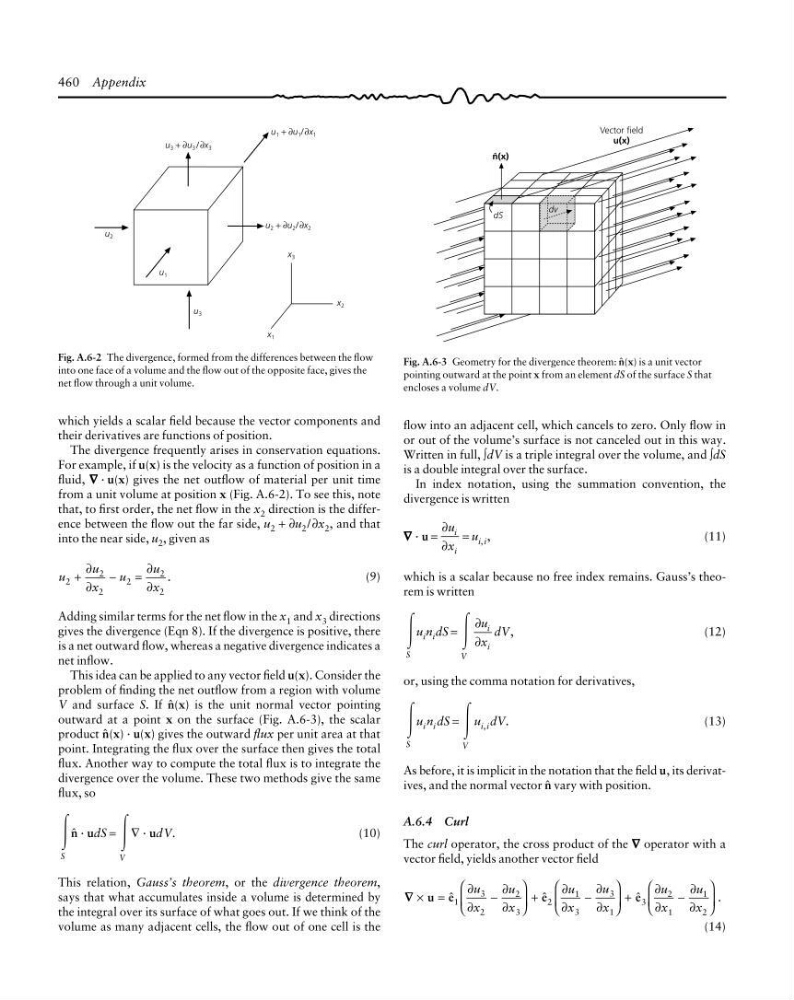
Fig. A.6-2 The divergence, formed from the differences between the flow
into one face of a volume and the flow out of the opposite face, gives the
net flow through a unit volume.
u 1
u 3
u 2
u 3 + ∂u 3 / ∂x 3
u 1 + ∂u 1 / ∂x 1
u 2 + ∂u 2 / ∂x 2
x 3
x 1
x 2
which yields a scalar field because the vector components and
their derivatives are functions of position.
The divergence frequently arises in conservation equations.
For example, if u(x) is the velocity as a function of position in a
fluid, ∇
∇ ∇
∇ ∇ · u(x) gives the net outflow of material per unit time
from a unit volume at position x (Fig. A.6-2). To see this, note
that, to first order, the net flow in the x 2 direction is the difference between the flow out the far side, u 2 + ∂u 2 / ∂x 2 , and that
into the near side, u 2 , given as
u
u
x
u
u
x
2
2
2
2
2
2
.
+
−
=
∂
∂
∂
∂
(9)
Adding similar terms for the net flow in the x 1 and x 3 directions
gives the divergence (Eqn 8). If the divergence is positive, there
is a net outward flow, whereas a negative divergence indicates a
net inflow.
This idea can be applied to any vector field u(x). Consider the
problem of finding the net outflow from a region with volume
V and surface S. If 4(x) is the unit normal vector pointing
outward at a point x on the surface (Fig. A.6-3), the scalar
product 4(x) · u(x) gives the outward flux per unit area at that
point. Integrating the flux over the surface then gives the total
flux. Another way to compute the total flux is to integrate the
divergence over the volume. These two methods give the same
flux, so
Ύ
S
4 · udS = Ύ
V
∇ · udV.
(10)
This relation, Gauss’s theorem, or the divergence theorem,
says that what accumulates inside a volume is determined by
the integral over its surface of what goes out. If we think of the
volume as many adjacent cells, the flow out of one cell is the
Fig. A.6-3 Geometry for the divergence theorem: 4(x) is a unit vector
pointing outward at the point x from an element dS of the surface S that
encloses a volume dV.
dS
Vector field
u(x)
ˆ
n(x)
dv
flow into an adjacent cell, which cancels to zero. Only flow in
or out of the volume’s surface is not canceled out in this way.
Written in full, ∫dV is a triple integral over the volume, and ∫dS
is a double integral over the surface.
In index notation, using the summation convention, the
divergence is written
∇
∇ ∇
∇ ∇ · u =
∂
∂
u
x
i
i
= u i, i ,
(11)
which is a scalar because no free index remains. Gauss’s theorem is written
Ύ
S
u i n i dS = Ύ
V
∂
∂
u
x
dV
i
i
,
(12)
or, using the comma notation for derivatives,
Ύ
S
u i n i dS = Ύ
V
u i, i dV.
(13)
As before, it is implicit in the notation that the field u, its derivatives, and the normal vector 4 vary with position.
A.6.4 Curl
The curl operator, the cross product of the ∇
∇ ∇
∇ ∇ operator with a
vector field, yields another vector field
∇ ∇
.
× =
−
⎛
⎝
⎜
⎞
⎠
⎟ +
−
⎛
⎝
⎜
⎞
⎠
⎟ +
−
⎛
⎝
⎜
⎞
⎠
⎟
u ê
ê
ê
1
3
2
2
3
2
1
3
3
1
3
2
1
1
2
∂
∂
∂
∂
∂
∂
∂
∂
∂
∂
∂
∂
u
x
u
x
u
x
u
x
u
x
u
x
(14)
Fig. A.6-2 The divergence, formed from the differences between the flow
into one face of a volume and the flow out of the opposite face, gives the
net flow through a unit volume.
u 1
u 3
u 2
u 3 + ∂u 3 / ∂x 3
u 1 + ∂u 1 / ∂x 1
u 2 + ∂u 2 / ∂x 2
x 3
x 1
x 2
which yields a scalar field because the vector components and
their derivatives are functions of position.
The divergence frequently arises in conservation equations.
For example, if u(x) is the velocity as a function of position in a
fluid, ∇
∇ ∇
∇ ∇ · u(x) gives the net outflow of material per unit time
from a unit volume at position x (Fig. A.6-2). To see this, note
that, to first order, the net flow in the x 2 direction is the difference between the flow out the far side, u 2 + ∂u 2 / ∂x 2 , and that
into the near side, u 2 , given as
u
u
x
u
u
x
2
2
2
2
2
2
.
+
−
=
∂
∂
∂
∂
(9)
Adding similar terms for the net flow in the x 1 and x 3 directions
gives the divergence (Eqn 8). If the divergence is positive, there
is a net outward flow, whereas a negative divergence indicates a
net inflow.
This idea can be applied to any vector field u(x). Consider the
problem of finding the net outflow from a region with volume
V and surface S. If 4(x) is the unit normal vector pointing
outward at a point x on the surface (Fig. A.6-3), the scalar
product 4(x) · u(x) gives the outward flux per unit area at that
point. Integrating the flux over the surface then gives the total
flux. Another way to compute the total flux is to integrate the
divergence over the volume. These two methods give the same
flux, so
Ύ
S
4 · udS = Ύ
V
∇ · udV.
(10)
This relation, Gauss’s theorem, or the divergence theorem,
says that what accumulates inside a volume is determined by
the integral over its surface of what goes out. If we think of the
volume as many adjacent cells, the flow out of one cell is the
Fig. A.6-3 Geometry for the divergence theorem: 4(x) is a unit vector
pointing outward at the point x from an element dS of the surface S that
encloses a volume dV.