

412 Seismograms as Signals
Problems
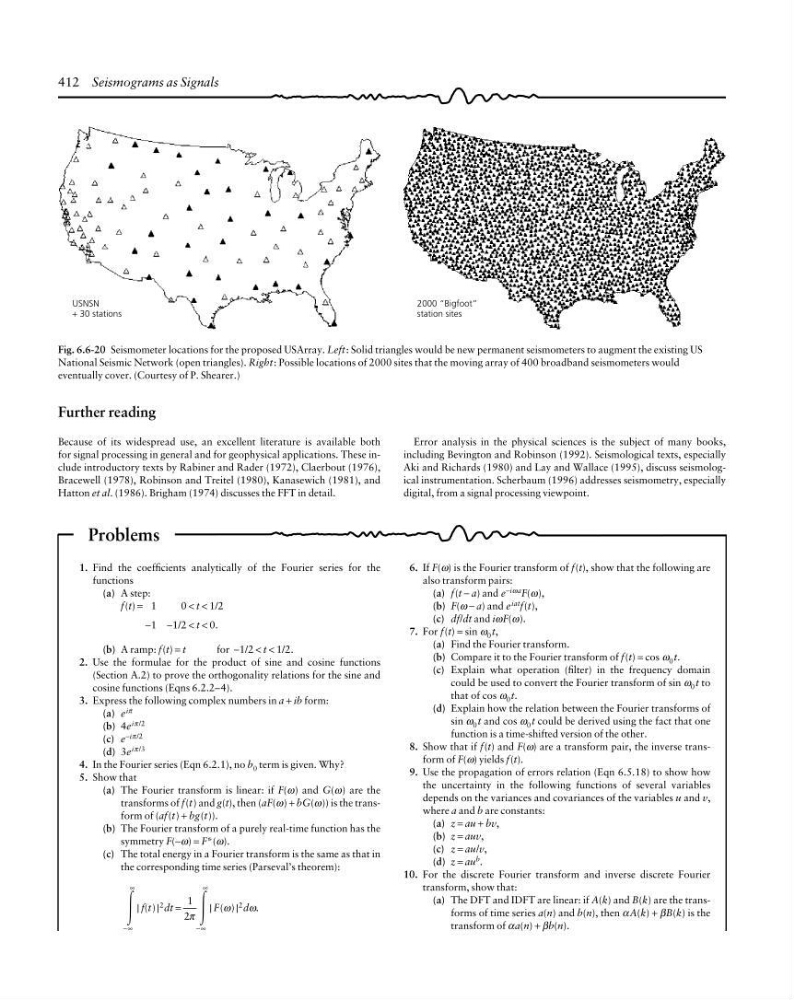
Fig. 6.6-20 Seismometer locations for the proposed USArray. Left: Solid triangles would be new permanent seismometers to augment the existing US
National Seismic Network (open triangles). Right: Possible locations of 2000 sites that the moving array of 400 broadband seismometers would
eventually cover. (Courtesy of P. Shearer.)
Further reading
Because of its widespread use, an excellent literature is available both
for signal processing in general and for geophysical applications. These include introductory texts by Rabiner and Rader (1972), Claerbout (1976),
Bracewell (1978), Robinson and Treitel (1980), Kanasewich (1981), and
Hatton et al. (1986). Brigham (1974) discusses the FFT in detail.
Error analysis in the physical sciences is the subject of many books,
including Bevington and Robinson (1992). Seismological texts, especially
Aki and Richards (1980) and Lay and Wallace (1995), discuss seismological instrumentation. Scherbaum (1996) addresses seismometry, especially
digital, from a signal processing viewpoint.
6. If F(ω) is the Fourier transform of f(t), show that the following are
also transform pairs:
(a) f(t − a) and e −iωa F(ω),
(b) F(ω − a) and e
iat
f(t),
(c) df/dt and iωF(ω).
7. For f(t) = sin ω 0 t,
(a) Find the Fourier transform.
(b) Compare it to the Fourier transform of f(t) = cos ω 0 t.
(c) Explain what operation (filter) in the frequency domain
could be used to convert the Fourier transform of sin ω 0 t to
that of cos ω 0 t.
(d) Explain how the relation between the Fourier transforms of
sin ω 0 t and cos ω 0 t could be derived using the fact that one
function is a time-shifted version of the other.
8. Show that if f(t) and F(ω) are a transform pair, the inverse transform of F(ω) yields f(t).
9. Use the propagation of errors relation (Eqn 6.5.18) to show how
the uncertainty in the following functions of several variables
depends on the variances and covariances of the variables u and v,
where a and b are constants:
(a) z = au + bv,
(b) z = auv,
(c) z = au/v,
(d) z = au
b .
10. For the discrete Fourier transform and inverse discrete Fourier
transform, show that:
(a) The DFT and IDFT are linear: if A(k) and B(k) are the transforms of time series a(n) and b(n), then αA(k) + βB(k) is the
transform of αa(n) + βb(n).
1. Find the coefficients analytically of the Fourier series for the
functions
(a) A step:
f(t) = 1
0 < t < 1/2
−1 −1/2 < t < 0.
(b) A ramp: f(t) = t
for −1/2 < t < 1/2.
2. Use the formulae for the product of sine and cosine functions
(Section A.2) to prove the orthogonality relations for the sine and
cosine functions (Eqns 6.2.2–4).
3. Express the following complex numbers in a + ib form:
(a) e iπ
(b) 4e
iπ /2
(c) e
−iπ /2
(d) 3e
iπ /3
4. In the Fourier series (Eqn 6.2.1), no b 0 term is given. Why?
5. Show that
(a) The Fourier transform is linear: if F(ω) and G(ω) are the
transforms of f(t) and g(t), then (aF(ω) + bG(ω)) is the transform of (af(t) + bg(t)).
(b) The Fourier transform of a purely real-time function has the
symmetry F(−ω) = F*(ω).
(c) The total energy in a Fourier transform is the same as that in
the corresponding time series (Parseval’s theorem):
Ύ
−∞
∞
| f(t) |
2 dt =
1
2π Ύ
−∞
∞
| F(ω) |
2 dω.
USNSN
+ 30 stations
2000 “Bigfoot”
station sites
Problems
Fig. 6.6-20 Seismometer locations for the proposed USArray. Left: Solid triangles would be new permanent seismometers to augment the existing US
National Seismic Network (open triangles). Right: Possible locations of 2000 sites that the moving array of 400 broadband seismometers would
eventually cover. (Courtesy of P. Shearer.)
Further reading
Because of its widespread use, an excellent literature is available both
for signal processing in general and for geophysical applications. These include introductory texts by Rabiner and Rader (1972), Claerbout (1976),
Bracewell (1978), Robinson and Treitel (1980), Kanasewich (1981), and
Hatton et al. (1986). Brigham (1974) discusses the FFT in detail.
Error analysis in the physical sciences is the subject of many books,
including Bevington and Robinson (1992). Seismological texts, especially
Aki and Richards (1980) and Lay and Wallace (1995), discuss seismological instrumentation. Scherbaum (1996) addresses seismometry, especially
digital, from a signal processing viewpoint.
6. If F(ω) is the Fourier transform of f(t), show that the following are
also transform pairs:
(a) f(t − a) and e −iωa F(ω),
(b) F(ω − a) and e
iat
f(t),
(c) df/dt and iωF(ω).
7. For f(t) = sin ω 0 t,
(a) Find the Fourier transform.
(b) Compare it to the Fourier transform of f(t) = cos ω 0 t.
(c) Explain what operation (filter) in the frequency domain
could be used to convert the Fourier transform of sin ω 0 t to
that of cos ω 0 t.
(d) Explain how the relation between the Fourier transforms of
sin ω 0 t and cos ω 0 t could be derived using the fact that one
function is a time-shifted version of the other.
8. Show that if f(t) and F(ω) are a transform pair, the inverse transform of F(ω) yields f(t).
9. Use the propagation of errors relation (Eqn 6.5.18) to show how
the uncertainty in the following functions of several variables
depends on the variances and covariances of the variables u and v,
where a and b are constants:
(a) z = au + bv,
(b) z = auv,
(c) z = au/v,
(d) z = au
b .
10. For the discrete Fourier transform and inverse discrete Fourier
transform, show that:
(a) The DFT and IDFT are linear: if A(k) and B(k) are the transforms of time series a(n) and b(n), then αA(k) + βB(k) is the
transform of αa(n) + βb(n).
1. Find the coefficients analytically of the Fourier series for the
functions
(a) A step:
f(t) = 1
0 < t < 1/2
−1 −1/2 < t < 0.
(b) A ramp: f(t) = t
for −1/2 < t < 1/2.
2. Use the formulae for the product of sine and cosine functions
(Section A.2) to prove the orthogonality relations for the sine and
cosine functions (Eqns 6.2.2–4).
3. Express the following complex numbers in a + ib form:
(a) e iπ
(b) 4e
iπ /2
(c) e
−iπ /2
(d) 3e
iπ /3
4. In the Fourier series (Eqn 6.2.1), no b 0 term is given. Why?
5. Show that
(a) The Fourier transform is linear: if F(ω) and G(ω) are the
transforms of f(t) and g(t), then (aF(ω) + bG(ω)) is the transform of (af(t) + bg(t)).
(b) The Fourier transform of a purely real-time function has the
symmetry F(−ω) = F*(ω).
(c) The total energy in a Fourier transform is the same as that in
the corresponding time series (Parseval’s theorem):
Ύ
−∞
∞
| f(t) |
2 dt =
1
2π Ύ
−∞
∞
| F(ω) |
2 dω.
USNSN
+ 30 stations
2000 “Bigfoot”
station sites