

408 Seismograms as Signals
IRIS GSN
France
Japan
Italy
Germany
China
Australia
USA
Canada
Other
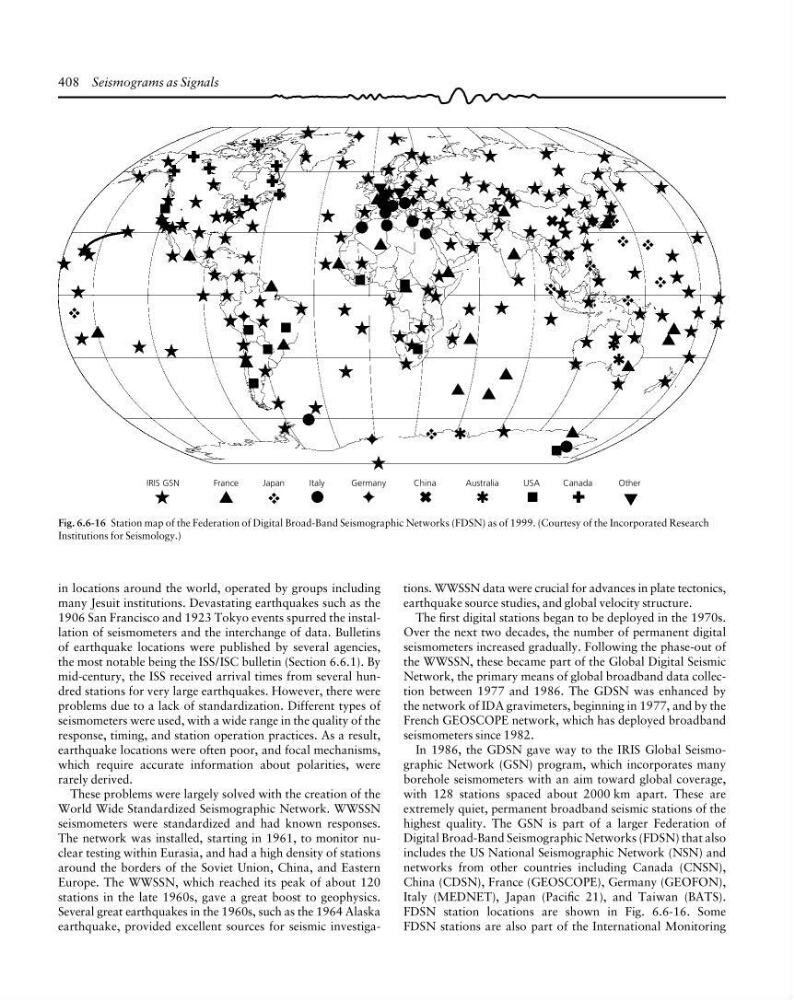
Fig. 6.6-16 Station map of the Federation of Digital Broad-Band Seismographic Networks (FDSN) as of 1999. (Courtesy of the Incorporated Research
Institutions for Seismology.)
in locations around the world, operated by groups including
many Jesuit institutions. Devastating earthquakes such as the
1906 San Francisco and 1923 Tokyo events spurred the installation of seismometers and the interchange of data. Bulletins
of earthquake locations were published by several agencies,
the most notable being the ISS/ISC bulletin (Section 6.6.1). By
mid-century, the ISS received arrival times from several hundred stations for very large earthquakes. However, there were
problems due to a lack of standardization. Different types of
seismometers were used, with a wide range in the quality of the
response, timing, and station operation practices. As a result,
earthquake locations were often poor, and focal mechanisms,
which require accurate information about polarities, were
rarely derived.
These problems were largely solved with the creation of the
World Wide Standardized Seismographic Network. WWSSN
seismometers were standardized and had known responses.
The network was installed, starting in 1961, to monitor nuclear testing within Eurasia, and had a high density of stations
around the borders of the Soviet Union, China, and Eastern
Europe. The WWSSN, which reached its peak of about 120
stations in the late 1960s, gave a great boost to geophysics.
Several great earthquakes in the 1960s, such as the 1964 Alaska
earthquake, provided excellent sources for seismic investigations. WWSSN data were crucial for advances in plate tectonics,
earthquake source studies, and global velocity structure.
The first digital stations began to be deployed in the 1970s.
Over the next two decades, the number of permanent digital
seismometers increased gradually. Following the phase-out of
the WWSSN, these became part of the Global Digital Seismic
Network, the primary means of global broadband data collection between 1977 and 1986. The GDSN was enhanced by
the network of IDA gravimeters, beginning in 1977, and by the
French GEOSCOPE network, which has deployed broadband
seismometers since 1982.
In 1986, the GDSN gave way to the IRIS Global Seismographic Network (GSN) program, which incorporates many
borehole seismometers with an aim toward global coverage,
with 128 stations spaced about 2000 km apart. These are
extremely quiet, permanent broadband seismic stations of the
highest quality. The GSN is part of a larger Federation of
Digital Broad-Band Seismographic Networks (FDSN) that also
includes the US National Seismographic Network (NSN) and
networks from other countries including Canada (CNSN),
China (CDSN), France (GEOSCOPE), Germany (GEOFON),
Italy (MEDNET), Japan (Pacific 21), and Taiwan (BATS).
FDSN station locations are shown in Fig. 6.6-16. Some
FDSN stations are also part of the International Monitoring
IRIS GSN
France
Japan
Italy
Germany
China
Australia
USA
Canada
Other
Fig. 6.6-16 Station map of the Federation of Digital Broad-Band Seismographic Networks (FDSN) as of 1999. (Courtesy of the Incorporated Research
Institutions for Seismology.)
in locations around the world, operated by groups including
many Jesuit institutions. Devastating earthquakes such as the
1906 San Francisco and 1923 Tokyo events spurred the installation of seismometers and the interchange of data. Bulletins
of earthquake locations were published by several agencies,
the most notable being the ISS/ISC bulletin (Section 6.6.1). By
mid-century, the ISS received arrival times from several hundred stations for very large earthquakes. However, there were
problems due to a lack of standardization. Different types of
seismometers were used, with a wide range in the quality of the
response, timing, and station operation practices. As a result,
earthquake locations were often poor, and focal mechanisms,
which require accurate information about polarities, were
rarely derived.
These problems were largely solved with the creation of the
World Wide Standardized Seismographic Network. WWSSN
seismometers were standardized and had known responses.
The network was installed, starting in 1961, to monitor nuclear testing within Eurasia, and had a high density of stations
around the borders of the Soviet Union, China, and Eastern
Europe. The WWSSN, which reached its peak of about 120
stations in the late 1960s, gave a great boost to geophysics.
Several great earthquakes in the 1960s, such as the 1964 Alaska
earthquake, provided excellent sources for seismic investigations. WWSSN data were crucial for advances in plate tectonics,
earthquake source studies, and global velocity structure.
The first digital stations began to be deployed in the 1970s.
Over the next two decades, the number of permanent digital
seismometers increased gradually. Following the phase-out of
the WWSSN, these became part of the Global Digital Seismic
Network, the primary means of global broadband data collection between 1977 and 1986. The GDSN was enhanced by
the network of IDA gravimeters, beginning in 1977, and by the
French GEOSCOPE network, which has deployed broadband
seismometers since 1982.
In 1986, the GDSN gave way to the IRIS Global Seismographic Network (GSN) program, which incorporates many
borehole seismometers with an aim toward global coverage,
with 128 stations spaced about 2000 km apart. These are
extremely quiet, permanent broadband seismic stations of the
highest quality. The GSN is part of a larger Federation of
Digital Broad-Band Seismographic Networks (FDSN) that also
includes the US National Seismographic Network (NSN) and
networks from other countries including Canada (CNSN),
China (CDSN), France (GEOSCOPE), Germany (GEOFON),
Italy (MEDNET), Japan (Pacific 21), and Taiwan (BATS).
FDSN station locations are shown in Fig. 6.6-16. Some
FDSN stations are also part of the International Monitoring