

366 Seismology and Plate Tectonics
2.5
2.0
1.5
1.0
0.5
0
Shear strain rate ( rad/yr)
µ
0
30
60
90
120
150
Time since last great earthquake (yr)
FR
PA
PR
SC
PR
SF
PR
M
PD
CP
C V
PD
Northern
San Andreas
Southern
San Andreas
SC
PA
PR
FR
SF
CP
M PD
CV
1 9 0 6
1 8 5 7
N e v a d a
C a l i f o r n i a
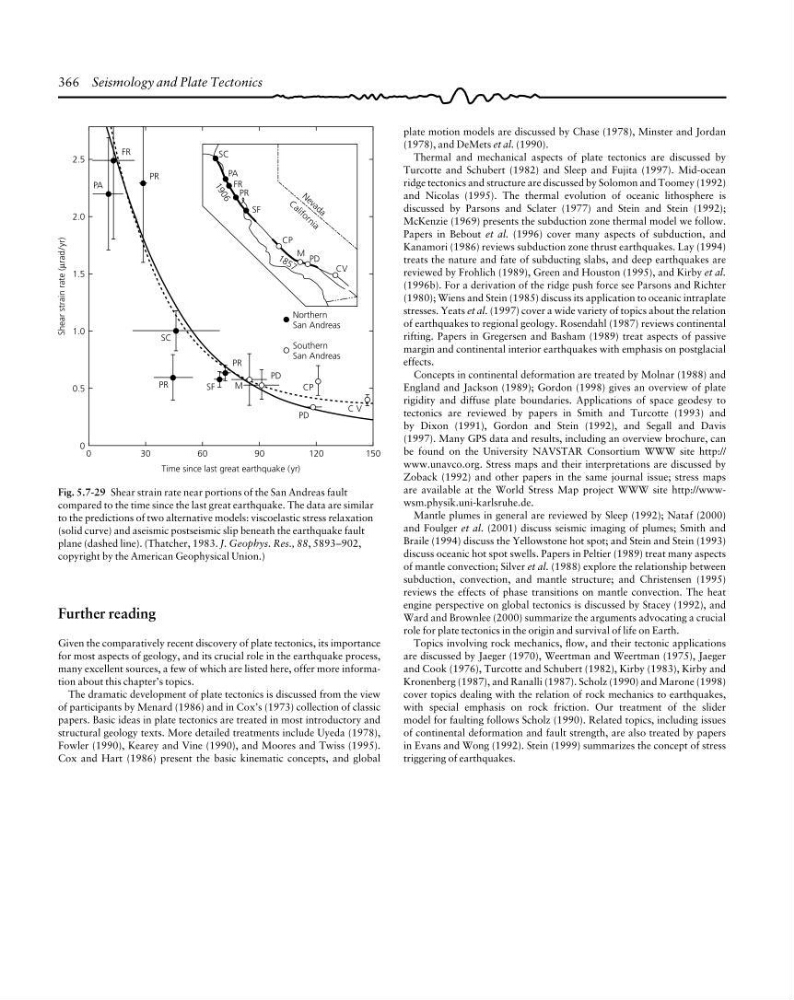
Fig. 5.7-29 Shear strain rate near portions of the San Andreas fault
compared to the time since the last great earthquake. The data are similar
to the predictions of two alternative models: viscoelastic stress relaxation
(solid curve) and aseismic postseismic slip beneath the earthquake fault
plane (dashed line). (Thatcher, 1983. J. Geophys. Res., 88, 5893–902,
copyright by the American Geophysical Union.)
plate motion models are discussed by Chase (1978), Minster and Jordan
(1978), and DeMets et al. (1990).
Thermal and mechanical aspects of plate tectonics are discussed by
Turcotte and Schubert (1982) and Sleep and Fujita (1997). Mid-ocean
ridge tectonics and structure are discussed by Solomon and Toomey (1992)
and Nicolas (1995). The thermal evolution of oceanic lithosphere is
discussed by Parsons and Sclater (1977) and Stein and Stein (1992);
McKenzie (1969) presents the subduction zone thermal model we follow.
Papers in Bebout et al. (1996) cover many aspects of subduction, and
Kanamori (1986) reviews subduction zone thrust earthquakes. Lay (1994)
treats the nature and fate of subducting slabs, and deep earthquakes are
reviewed by Frohlich (1989), Green and Houston (1995), and Kirby et al.
(1996b). For a derivation of the ridge push force see Parsons and Richter
(1980); Wiens and Stein (1985) discuss its application to oceanic intraplate
stresses. Yeats et al. (1997) cover a wide variety of topics about the relation
of earthquakes to regional geology. Rosendahl (1987) reviews continental
rifting. Papers in Gregersen and Basham (1989) treat aspects of passive
margin and continental interior earthquakes with emphasis on postglacial
effects.
Concepts in continental deformation are treated by Molnar (1988) and
England and Jackson (1989); Gordon (1998) gives an overview of plate
rigidity and diffuse plate boundaries. Applications of space geodesy to
tectonics are reviewed by papers in Smith and Turcotte (1993) and
by Dixon (1991), Gordon and Stein (1992), and Segall and Davis
(1997). Many GPS data and results, including an overview brochure, can
be found on the University NAVSTAR Consortium WWW site http://
www.unavco.org. Stress maps and their interpretations are discussed by
Zoback (1992) and other papers in the same journal issue; stress maps
are available at the World Stress Map project WWW site http://wwwwsm.physik.uni-karlsruhe.de.
Mantle plumes in general are reviewed by Sleep (1992); Nataf (2000)
and Foulger et al. (2001) discuss seismic imaging of plumes; Smith and
Braile (1994) discuss the Yellowstone hot spot; and Stein and Stein (1993)
discuss oceanic hot spot swells. Papers in Peltier (1989) treat many aspects
of mantle convection; Silver et al. (1988) explore the relationship between
subduction, convection, and mantle structure; and Christensen (1995)
reviews the effects of phase transitions on mantle convection. The heat
engine perspective on global tectonics is discussed by Stacey (1992), and
Ward and Brownlee (2000) summarize the arguments advocating a crucial
role for plate tectonics in the origin and survival of life on Earth.
Topics involving rock mechanics, flow, and their tectonic applications
are discussed by Jaeger (1970), Weertman and Weertman (1975), Jaeger
and Cook (1976), Turcotte and Schubert (1982), Kirby (1983), Kirby and
Kronenberg (1987), and Ranalli (1987). Scholz (1990) and Marone (1998)
cover topics dealing with the relation of rock mechanics to earthquakes,
with special emphasis on rock friction. Our treatment of the slider
model for faulting follows Scholz (1990). Related topics, including issues
of continental deformation and fault strength, are also treated by papers
in Evans and Wong (1992). Stein (1999) summarizes the concept of stress
triggering of earthquakes.
Further reading
Given the comparatively recent discovery of plate tectonics, its importance
for most aspects of geology, and its crucial role in the earthquake process,
many excellent sources, a few of which are listed here, offer more information about this chapter’s topics.
The dramatic development of plate tectonics is discussed from the view
of participants by Menard (1986) and in Cox’s (1973) collection of classic
papers. Basic ideas in plate tectonics are treated in most introductory and
structural geology texts. More detailed treatments include Uyeda (1978),
Fowler (1990), Kearey and Vine (1990), and Moores and Twiss (1995).
Cox and Hart (1986) present the basic kinematic concepts, and global
2.5
2.0
1.5
1.0
0.5
0
Shear strain rate ( rad/yr)
µ
0
30
60
90
120
150
Time since last great earthquake (yr)
FR
PA
PR
SC
PR
SF
PR
M
PD
CP
C V
PD
Northern
San Andreas
Southern
San Andreas
SC
PA
PR
FR
SF
CP
M PD
CV
1 9 0 6
1 8 5 7
N e v a d a
C a l i f o r n i a
Fig. 5.7-29 Shear strain rate near portions of the San Andreas fault
compared to the time since the last great earthquake. The data are similar
to the predictions of two alternative models: viscoelastic stress relaxation
(solid curve) and aseismic postseismic slip beneath the earthquake fault
plane (dashed line). (Thatcher, 1983. J. Geophys. Res., 88, 5893–902,
copyright by the American Geophysical Union.)
plate motion models are discussed by Chase (1978), Minster and Jordan
(1978), and DeMets et al. (1990).
Thermal and mechanical aspects of plate tectonics are discussed by
Turcotte and Schubert (1982) and Sleep and Fujita (1997). Mid-ocean
ridge tectonics and structure are discussed by Solomon and Toomey (1992)
and Nicolas (1995). The thermal evolution of oceanic lithosphere is
discussed by Parsons and Sclater (1977) and Stein and Stein (1992);
McKenzie (1969) presents the subduction zone thermal model we follow.
Papers in Bebout et al. (1996) cover many aspects of subduction, and
Kanamori (1986) reviews subduction zone thrust earthquakes. Lay (1994)
treats the nature and fate of subducting slabs, and deep earthquakes are
reviewed by Frohlich (1989), Green and Houston (1995), and Kirby et al.
(1996b). For a derivation of the ridge push force see Parsons and Richter
(1980); Wiens and Stein (1985) discuss its application to oceanic intraplate
stresses. Yeats et al. (1997) cover a wide variety of topics about the relation
of earthquakes to regional geology. Rosendahl (1987) reviews continental
rifting. Papers in Gregersen and Basham (1989) treat aspects of passive
margin and continental interior earthquakes with emphasis on postglacial
effects.
Concepts in continental deformation are treated by Molnar (1988) and
England and Jackson (1989); Gordon (1998) gives an overview of plate
rigidity and diffuse plate boundaries. Applications of space geodesy to
tectonics are reviewed by papers in Smith and Turcotte (1993) and
by Dixon (1991), Gordon and Stein (1992), and Segall and Davis
(1997). Many GPS data and results, including an overview brochure, can
be found on the University NAVSTAR Consortium WWW site http://
www.unavco.org. Stress maps and their interpretations are discussed by
Zoback (1992) and other papers in the same journal issue; stress maps
are available at the World Stress Map project WWW site http://wwwwsm.physik.uni-karlsruhe.de.
Mantle plumes in general are reviewed by Sleep (1992); Nataf (2000)
and Foulger et al. (2001) discuss seismic imaging of plumes; Smith and
Braile (1994) discuss the Yellowstone hot spot; and Stein and Stein (1993)
discuss oceanic hot spot swells. Papers in Peltier (1989) treat many aspects
of mantle convection; Silver et al. (1988) explore the relationship between
subduction, convection, and mantle structure; and Christensen (1995)
reviews the effects of phase transitions on mantle convection. The heat
engine perspective on global tectonics is discussed by Stacey (1992), and
Ward and Brownlee (2000) summarize the arguments advocating a crucial
role for plate tectonics in the origin and survival of life on Earth.
Topics involving rock mechanics, flow, and their tectonic applications
are discussed by Jaeger (1970), Weertman and Weertman (1975), Jaeger
and Cook (1976), Turcotte and Schubert (1982), Kirby (1983), Kirby and
Kronenberg (1987), and Ranalli (1987). Scholz (1990) and Marone (1998)
cover topics dealing with the relation of rock mechanics to earthquakes,
with special emphasis on rock friction. Our treatment of the slider
model for faulting follows Scholz (1990). Related topics, including issues
of continental deformation and fault strength, are also treated by papers
in Evans and Wong (1992). Stein (1999) summarizes the concept of stress
triggering of earthquakes.
Further reading
Given the comparatively recent discovery of plate tectonics, its importance
for most aspects of geology, and its crucial role in the earthquake process,
many excellent sources, a few of which are listed here, offer more information about this chapter’s topics.
The dramatic development of plate tectonics is discussed from the view
of participants by Menard (1986) and in Cox’s (1973) collection of classic
papers. Basic ideas in plate tectonics are treated in most introductory and
structural geology texts. More detailed treatments include Uyeda (1978),
Fowler (1990), Kearey and Vine (1990), and Moores and Twiss (1995).
Cox and Hart (1986) present the basic kinematic concepts, and global