

326 Seismology and Plate Tectonics
5.5 Oceanic intraplate earthquakes and tectonics
The vast majority of earthquakes a especially when measured
in terms of seismic moment release a occur on plate boundaries
and reflect the relative plate motions there. However, intraplate earthquakes, those within plates, also provide important
tectonic information. We discuss intraplate earthquakes that
occur in oceanic lithosphere in this section, and then discuss
their counterparts in continental lithosphere in the next.
5.5.1 Locations of oceanic intraplate seismicity
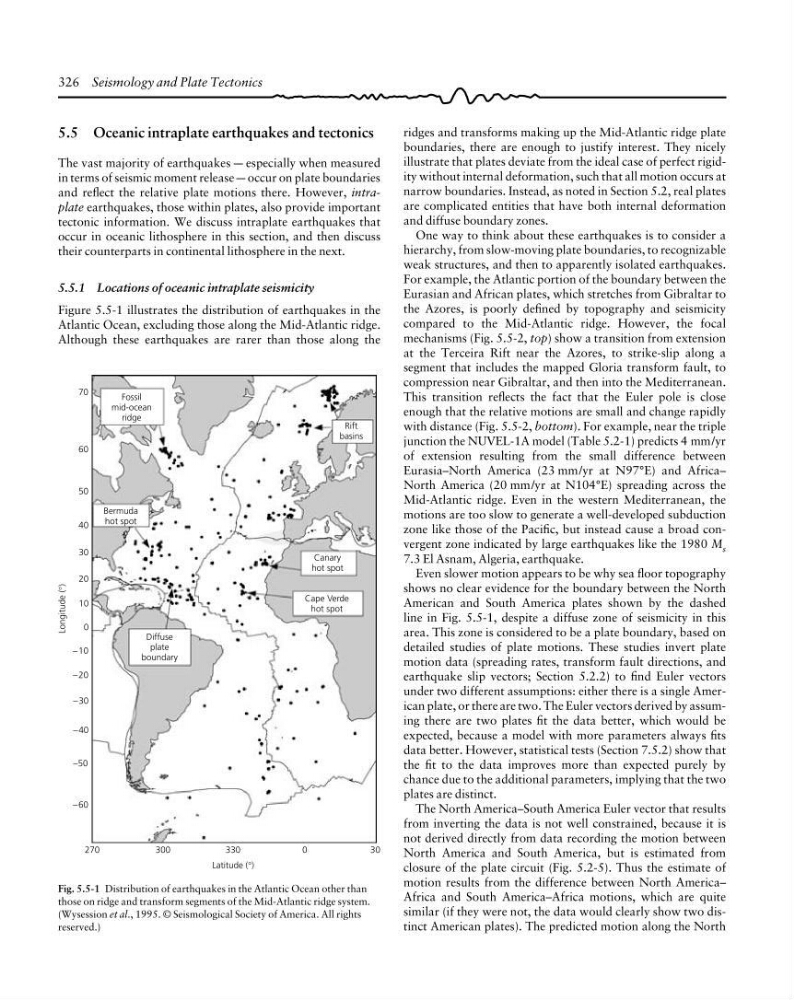
Figure 5.5-1 illustrates the distribution of earthquakes in the
Atlantic Ocean, excluding those along the Mid-Atlantic ridge.
Although these earthquakes are rarer than those along the
ridges and transforms making up the Mid-Atlantic ridge plate
boundaries, there are enough to justify interest. They nicely
illustrate that plates deviate from the ideal case of perfect rigidity without internal deformation, such that all motion occurs at
narrow boundaries. Instead, as noted in Section 5.2, real plates
are complicated entities that have both internal deformation
and diffuse boundary zones.
One way to think about these earthquakes is to consider a
hierarchy, from slow-moving plate boundaries, to recognizable
weak structures, and then to apparently isolated earthquakes.
For example, the Atlantic portion of the boundary between the
Eurasian and African plates, which stretches from Gibraltar to
the Azores, is poorly defined by topography and seismicity
compared to the Mid-Atlantic ridge. However, the focal
mechanisms (Fig. 5.5-2, top) show a transition from extension
at the Terceira Rift near the Azores, to strike-slip along a
segment that includes the mapped Gloria transform fault, to
compression near Gibraltar, and then into the Mediterranean.
This transition reflects the fact that the Euler pole is close
enough that the relative motions are small and change rapidly
with distance (Fig. 5.5-2, bottom). For example, near the triple
junction the NUVEL-1A model (Table 5.2-1) predicts 4 mm/yr
of extension resulting from the small difference between
Eurasia–North America (23 mm/yr at N97°E) and Africa–
North America (20 mm/yr at N104°E) spreading across the
Mid-Atlantic ridge. Even in the western Mediterranean, the
motions are too slow to generate a well-developed subduction
zone like those of the Pacific, but instead cause a broad convergent zone indicated by large earthquakes like the 1980 M s
7.3 El Asnam, Algeria, earthquake.
Even slower motion appears to be why sea floor topography
shows no clear evidence for the boundary between the North
American and South America plates shown by the dashed
line in Fig. 5.5-1, despite a diffuse zone of seismicity in this
area. This zone is considered to be a plate boundary, based on
detailed studies of plate motions. These studies invert plate
motion data (spreading rates, transform fault directions, and
earthquake slip vectors; Section 5.2.2) to find Euler vectors
under two different assumptions: either there is a single American plate, or there are two. The Euler vectors derived by assuming there are two plates fit the data better, which would be
expected, because a model with more parameters always fits
data better. However, statistical tests (Section 7.5.2) show that
the fit to the data improves more than expected purely by
chance due to the additional parameters, implying that the two
plates are distinct.
The North America–South America Euler vector that results
from inverting the data is not well constrained, because it is
not derived directly from data recording the motion between
North America and South America, but is estimated from
closure of the plate circuit (Fig. 5.2-5). Thus the estimate of
motion results from the difference between North America–
Africa and South America–Africa motions, which are quite
similar (if they were not, the data would clearly show two distinct American plates). The predicted motion along the North
Fig. 5.5-1 Distribution of earthquakes in the Atlantic Ocean other than
those on ridge and transform segments of the Mid-Atlantic ridge system.
(Wysession et al., 1995. © Seismological Society of America. All rights
reserved.)
Longitude (°)
70
−10
30
0
330
300
270
60
50
40
30
20
10
0
−60
−50
−40
−30
−20
Fossil
mid-ocean
ridge
Bermuda
hot spot
Diffuse
plate
boundary
Cape Verde
hot spot
Canary
hot spot
Rift
basins
Latitude (°)
5.5 Oceanic intraplate earthquakes and tectonics
The vast majority of earthquakes a especially when measured
in terms of seismic moment release a occur on plate boundaries
and reflect the relative plate motions there. However, intraplate earthquakes, those within plates, also provide important
tectonic information. We discuss intraplate earthquakes that
occur in oceanic lithosphere in this section, and then discuss
their counterparts in continental lithosphere in the next.
5.5.1 Locations of oceanic intraplate seismicity
Figure 5.5-1 illustrates the distribution of earthquakes in the
Atlantic Ocean, excluding those along the Mid-Atlantic ridge.
Although these earthquakes are rarer than those along the
ridges and transforms making up the Mid-Atlantic ridge plate
boundaries, there are enough to justify interest. They nicely
illustrate that plates deviate from the ideal case of perfect rigidity without internal deformation, such that all motion occurs at
narrow boundaries. Instead, as noted in Section 5.2, real plates
are complicated entities that have both internal deformation
and diffuse boundary zones.
One way to think about these earthquakes is to consider a
hierarchy, from slow-moving plate boundaries, to recognizable
weak structures, and then to apparently isolated earthquakes.
For example, the Atlantic portion of the boundary between the
Eurasian and African plates, which stretches from Gibraltar to
the Azores, is poorly defined by topography and seismicity
compared to the Mid-Atlantic ridge. However, the focal
mechanisms (Fig. 5.5-2, top) show a transition from extension
at the Terceira Rift near the Azores, to strike-slip along a
segment that includes the mapped Gloria transform fault, to
compression near Gibraltar, and then into the Mediterranean.
This transition reflects the fact that the Euler pole is close
enough that the relative motions are small and change rapidly
with distance (Fig. 5.5-2, bottom). For example, near the triple
junction the NUVEL-1A model (Table 5.2-1) predicts 4 mm/yr
of extension resulting from the small difference between
Eurasia–North America (23 mm/yr at N97°E) and Africa–
North America (20 mm/yr at N104°E) spreading across the
Mid-Atlantic ridge. Even in the western Mediterranean, the
motions are too slow to generate a well-developed subduction
zone like those of the Pacific, but instead cause a broad convergent zone indicated by large earthquakes like the 1980 M s
7.3 El Asnam, Algeria, earthquake.
Even slower motion appears to be why sea floor topography
shows no clear evidence for the boundary between the North
American and South America plates shown by the dashed
line in Fig. 5.5-1, despite a diffuse zone of seismicity in this
area. This zone is considered to be a plate boundary, based on
detailed studies of plate motions. These studies invert plate
motion data (spreading rates, transform fault directions, and
earthquake slip vectors; Section 5.2.2) to find Euler vectors
under two different assumptions: either there is a single American plate, or there are two. The Euler vectors derived by assuming there are two plates fit the data better, which would be
expected, because a model with more parameters always fits
data better. However, statistical tests (Section 7.5.2) show that
the fit to the data improves more than expected purely by
chance due to the additional parameters, implying that the two
plates are distinct.
The North America–South America Euler vector that results
from inverting the data is not well constrained, because it is
not derived directly from data recording the motion between
North America and South America, but is estimated from
closure of the plate circuit (Fig. 5.2-5). Thus the estimate of
motion results from the difference between North America–
Africa and South America–Africa motions, which are quite
similar (if they were not, the data would clearly show two distinct American plates). The predicted motion along the North
Fig. 5.5-1 Distribution of earthquakes in the Atlantic Ocean other than
those on ridge and transform segments of the Mid-Atlantic ridge system.
(Wysession et al., 1995. © Seismological Society of America. All rights
reserved.)
Longitude (°)
70
−10
30
0
330
300
270
60
50
40
30
20
10
0
−60
−50
−40
−30
−20
Fossil
mid-ocean
ridge
Bermuda
hot spot
Diffuse
plate
boundary
Cape Verde
hot spot
Canary
hot spot
Rift
basins
Latitude (°)