

288 Seismology and Plate Tectonics
Volcanism
Continental
rifting
Ocean/atmosphere
Uplift/erosion
— climatic change
Plate boundary zone
Continental
convergence
Volcanism
Oceanic
convergence
Sea
level
changes
Oceanic
rifting
Volcanism,
hydrothermal
circulation
Sublithospheric mantle
Continental
accretion
Upward
flow
Plume
Return
flow
Upward
flow
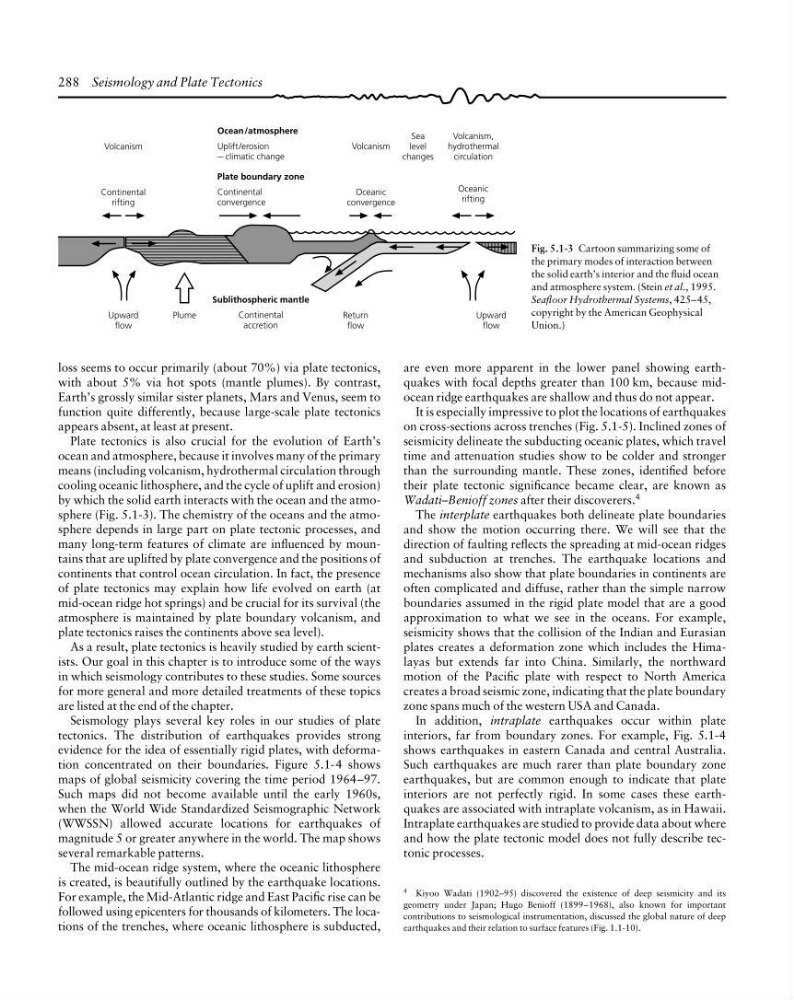
Fig. 5.1-3 Cartoon summarizing some of
the primary modes of interaction between
the solid earth’s interior and the fluid ocean
and atmosphere system. (Stein et al., 1995.
Seafloor Hydrothermal Systems, 425–45,
copyright by the American Geophysical
Union.)
are even more apparent in the lower panel showing earthquakes with focal depths greater than 100 km, because midocean ridge earthquakes are shallow and thus do not appear.
It is especially impressive to plot the locations of earthquakes
on cross-sections across trenches (Fig. 5.1-5). Inclined zones of
seismicity delineate the subducting oceanic plates, which travel
time and attenuation studies show to be colder and stronger
than the surrounding mantle. These zones, identified before
their plate tectonic significance became clear, are known as
Wadati–Benioff zones after their discoverers. 4
The interplate earthquakes both delineate plate boundaries
and show the motion occurring there. We will see that the
direction of faulting reflects the spreading at mid-ocean ridges
and subduction at trenches. The earthquake locations and
mechanisms also show that plate boundaries in continents are
often complicated and diffuse, rather than the simple narrow
boundaries assumed in the rigid plate model that are a good
approximation to what we see in the oceans. For example,
seismicity shows that the collision of the Indian and Eurasian
plates creates a deformation zone which includes the Himalayas but extends far into China. Similarly, the northward
motion of the Pacific plate with respect to North America
creates a broad seismic zone, indicating that the plate boundary
zone spans much of the western USA and Canada.
In addition, intraplate earthquakes occur within plate
interiors, far from boundary zones. For example, Fig. 5.1-4
shows earthquakes in eastern Canada and central Australia.
Such earthquakes are much rarer than plate boundary zone
earthquakes, but are common enough to indicate that plate
interiors are not perfectly rigid. In some cases these earthquakes are associated with intraplate volcanism, as in Hawaii.
Intraplate earthquakes are studied to provide data about where
and how the plate tectonic model does not fully describe tectonic processes.
4 Kiyoo Wadati (1902–95) discovered the existence of deep seismicity and its
geometry under Japan; Hugo Benioff (1899–1968), also known for important
contributions to seismological instrumentation, discussed the global nature of deep
earthquakes and their relation to surface features (Fig. 1.1-10).
loss seems to occur primarily (about 70%) via plate tectonics,
with about 5% via hot spots (mantle plumes). By contrast,
Earth’s grossly similar sister planets, Mars and Venus, seem to
function quite differently, because large-scale plate tectonics
appears absent, at least at present.
Plate tectonics is also crucial for the evolution of Earth’s
ocean and atmosphere, because it involves many of the primary
means (including volcanism, hydrothermal circulation through
cooling oceanic lithosphere, and the cycle of uplift and erosion)
by which the solid earth interacts with the ocean and the atmosphere (Fig. 5.1-3). The chemistry of the oceans and the atmosphere depends in large part on plate tectonic processes, and
many long-term features of climate are influenced by mountains that are uplifted by plate convergence and the positions of
continents that control ocean circulation. In fact, the presence
of plate tectonics may explain how life evolved on earth (at
mid-ocean ridge hot springs) and be crucial for its survival (the
atmosphere is maintained by plate boundary volcanism, and
plate tectonics raises the continents above sea level).
As a result, plate tectonics is heavily studied by earth scientists. Our goal in this chapter is to introduce some of the ways
in which seismology contributes to these studies. Some sources
for more general and more detailed treatments of these topics
are listed at the end of the chapter.
Seismology plays several key roles in our studies of plate
tectonics. The distribution of earthquakes provides strong
evidence for the idea of essentially rigid plates, with deformation concentrated on their boundaries. Figure 5.1-4 shows
maps of global seismicity covering the time period 1964–97.
Such maps did not become available until the early 1960s,
when the World Wide Standardized Seismographic Network
(WWSSN) allowed accurate locations for earthquakes of
magnitude 5 or greater anywhere in the world. The map shows
several remarkable patterns.
The mid-ocean ridge system, where the oceanic lithosphere
is created, is beautifully outlined by the earthquake locations.
For example, the Mid-Atlantic ridge and East Pacific rise can be
followed using epicenters for thousands of kilometers. The locations of the trenches, where oceanic lithosphere is subducted,
Volcanism
Continental
rifting
Ocean/atmosphere
Uplift/erosion
— climatic change
Plate boundary zone
Continental
convergence
Volcanism
Oceanic
convergence
Sea
level
changes
Oceanic
rifting
Volcanism,
hydrothermal
circulation
Sublithospheric mantle
Continental
accretion
Upward
flow
Plume
Return
flow
Upward
flow
Fig. 5.1-3 Cartoon summarizing some of
the primary modes of interaction between
the solid earth’s interior and the fluid ocean
and atmosphere system. (Stein et al., 1995.
Seafloor Hydrothermal Systems, 425–45,
copyright by the American Geophysical
Union.)
are even more apparent in the lower panel showing earthquakes with focal depths greater than 100 km, because midocean ridge earthquakes are shallow and thus do not appear.
It is especially impressive to plot the locations of earthquakes
on cross-sections across trenches (Fig. 5.1-5). Inclined zones of
seismicity delineate the subducting oceanic plates, which travel
time and attenuation studies show to be colder and stronger
than the surrounding mantle. These zones, identified before
their plate tectonic significance became clear, are known as
Wadati–Benioff zones after their discoverers. 4
The interplate earthquakes both delineate plate boundaries
and show the motion occurring there. We will see that the
direction of faulting reflects the spreading at mid-ocean ridges
and subduction at trenches. The earthquake locations and
mechanisms also show that plate boundaries in continents are
often complicated and diffuse, rather than the simple narrow
boundaries assumed in the rigid plate model that are a good
approximation to what we see in the oceans. For example,
seismicity shows that the collision of the Indian and Eurasian
plates creates a deformation zone which includes the Himalayas but extends far into China. Similarly, the northward
motion of the Pacific plate with respect to North America
creates a broad seismic zone, indicating that the plate boundary
zone spans much of the western USA and Canada.
In addition, intraplate earthquakes occur within plate
interiors, far from boundary zones. For example, Fig. 5.1-4
shows earthquakes in eastern Canada and central Australia.
Such earthquakes are much rarer than plate boundary zone
earthquakes, but are common enough to indicate that plate
interiors are not perfectly rigid. In some cases these earthquakes are associated with intraplate volcanism, as in Hawaii.
Intraplate earthquakes are studied to provide data about where
and how the plate tectonic model does not fully describe tectonic processes.
4 Kiyoo Wadati (1902–95) discovered the existence of deep seismicity and its
geometry under Japan; Hugo Benioff (1899–1968), also known for important
contributions to seismological instrumentation, discussed the global nature of deep
earthquakes and their relation to surface features (Fig. 1.1-10).
loss seems to occur primarily (about 70%) via plate tectonics,
with about 5% via hot spots (mantle plumes). By contrast,
Earth’s grossly similar sister planets, Mars and Venus, seem to
function quite differently, because large-scale plate tectonics
appears absent, at least at present.
Plate tectonics is also crucial for the evolution of Earth’s
ocean and atmosphere, because it involves many of the primary
means (including volcanism, hydrothermal circulation through
cooling oceanic lithosphere, and the cycle of uplift and erosion)
by which the solid earth interacts with the ocean and the atmosphere (Fig. 5.1-3). The chemistry of the oceans and the atmosphere depends in large part on plate tectonic processes, and
many long-term features of climate are influenced by mountains that are uplifted by plate convergence and the positions of
continents that control ocean circulation. In fact, the presence
of plate tectonics may explain how life evolved on earth (at
mid-ocean ridge hot springs) and be crucial for its survival (the
atmosphere is maintained by plate boundary volcanism, and
plate tectonics raises the continents above sea level).
As a result, plate tectonics is heavily studied by earth scientists. Our goal in this chapter is to introduce some of the ways
in which seismology contributes to these studies. Some sources
for more general and more detailed treatments of these topics
are listed at the end of the chapter.
Seismology plays several key roles in our studies of plate
tectonics. The distribution of earthquakes provides strong
evidence for the idea of essentially rigid plates, with deformation concentrated on their boundaries. Figure 5.1-4 shows
maps of global seismicity covering the time period 1964–97.
Such maps did not become available until the early 1960s,
when the World Wide Standardized Seismographic Network
(WWSSN) allowed accurate locations for earthquakes of
magnitude 5 or greater anywhere in the world. The map shows
several remarkable patterns.
The mid-ocean ridge system, where the oceanic lithosphere
is created, is beautifully outlined by the earthquake locations.
For example, the Mid-Atlantic ridge and East Pacific rise can be
followed using epicenters for thousands of kilometers. The locations of the trenches, where oceanic lithosphere is subducted,