

differences between granitic and basaltic rocks discussed in
Section 3.2), and so does not subduct. The oceanic lithosphere
is continuously subducted and reformed at ridges, and so never
gets older than about 200 Myr. The continental lithosphere,
however, can be billions of years old.
Put another way, plate tectonics is the primary surface manifestation of the heat engine whose nature and history govern
the planet’s thermal, mechanical, and chemical evolution. 3
Earth’s heat engine is characterized by the balance between
three modes of heat transfer from the interior: the plate tectonic
cycle involving the cooling of oceanic lithosphere; mantle
plumes, which are thought to be a secondary feature of mantle
convection; and heat conduction through continents that are
not subducted and hence do not participate directly in the
oceanic plate tectonic cycle. Based on estimates from sea floor
topography and heat flow, discussed shortly, terrestrial heat
C o n t i n e n t
Andesite volcanos
Volcanic chain
Hot spot
A s t h e n o s p h e r e
6 7 0 k m
Crypto-ocean
Crypto-continents
Established
plume
New
plume
Mid-ocean ridge
Subduction
zone
Island
arc
D′′
CORE
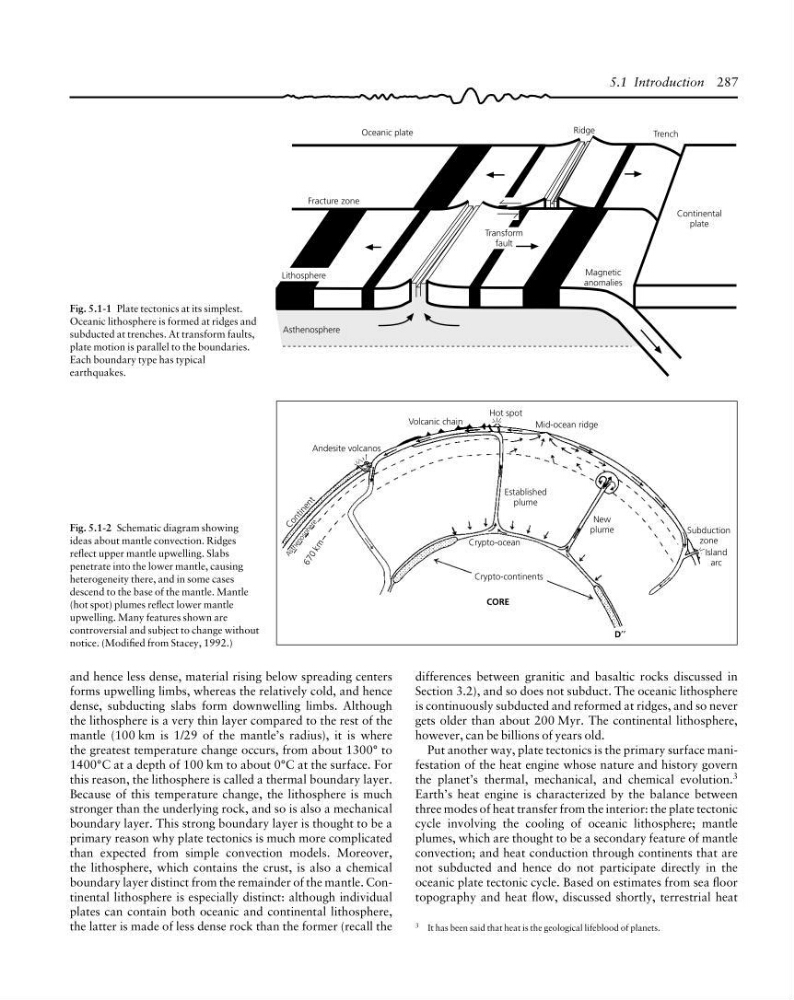
Fig. 5.1-2 Schematic diagram showing
ideas about mantle convection. Ridges
reflect upper mantle upwelling. Slabs
penetrate into the lower mantle, causing
heterogeneity there, and in some cases
descend to the base of the mantle. Mantle
(hot spot) plumes reflect lower mantle
upwelling. Many features shown are
controversial and subject to change without
notice. (Modified from Stacey, 1992.)
3 It has been said that heat is the geological lifeblood of planets.
5.1 Introduction 287
and hence less dense, material rising below spreading centers
forms upwelling limbs, whereas the relatively cold, and hence
dense, subducting slabs form downwelling limbs. Although
the lithosphere is a very thin layer compared to the rest of the
mantle (100 km is 1/29 of the mantle’s radius), it is where
the greatest temperature change occurs, from about 1300° to
1400°C at a depth of 100 km to about 0°C at the surface. For
this reason, the lithosphere is called a thermal boundary layer.
Because of this temperature change, the lithosphere is much
stronger than the underlying rock, and so is also a mechanical
boundary layer. This strong boundary layer is thought to be a
primary reason why plate tectonics is much more complicated
than expected from simple convection models. Moreover,
the lithosphere, which contains the crust, is also a chemical
boundary layer distinct from the remainder of the mantle. Continental lithosphere is especially distinct: although individual
plates can contain both oceanic and continental lithosphere,
the latter is made of less dense rock than the former (recall the
Oceanic plate
Ridge
Trench
Continental
plate
Magnetic
anomalies
Transform
fault
Lithosphere
Asthenosphere
Fracture zone
Fig. 5.1-1 Plate tectonics at its simplest.
Oceanic lithosphere is formed at ridges and
subducted at trenches. At transform faults,
plate motion is parallel to the boundaries.
Each boundary type has typical
earthquakes.
Section 3.2), and so does not subduct. The oceanic lithosphere
is continuously subducted and reformed at ridges, and so never
gets older than about 200 Myr. The continental lithosphere,
however, can be billions of years old.
Put another way, plate tectonics is the primary surface manifestation of the heat engine whose nature and history govern
the planet’s thermal, mechanical, and chemical evolution. 3
Earth’s heat engine is characterized by the balance between
three modes of heat transfer from the interior: the plate tectonic
cycle involving the cooling of oceanic lithosphere; mantle
plumes, which are thought to be a secondary feature of mantle
convection; and heat conduction through continents that are
not subducted and hence do not participate directly in the
oceanic plate tectonic cycle. Based on estimates from sea floor
topography and heat flow, discussed shortly, terrestrial heat
C o n t i n e n t
Andesite volcanos
Volcanic chain
Hot spot
A s t h e n o s p h e r e
6 7 0 k m
Crypto-ocean
Crypto-continents
Established
plume
New
plume
Mid-ocean ridge
Subduction
zone
Island
arc
D′′
CORE
Fig. 5.1-2 Schematic diagram showing
ideas about mantle convection. Ridges
reflect upper mantle upwelling. Slabs
penetrate into the lower mantle, causing
heterogeneity there, and in some cases
descend to the base of the mantle. Mantle
(hot spot) plumes reflect lower mantle
upwelling. Many features shown are
controversial and subject to change without
notice. (Modified from Stacey, 1992.)
3 It has been said that heat is the geological lifeblood of planets.
5.1 Introduction 287
and hence less dense, material rising below spreading centers
forms upwelling limbs, whereas the relatively cold, and hence
dense, subducting slabs form downwelling limbs. Although
the lithosphere is a very thin layer compared to the rest of the
mantle (100 km is 1/29 of the mantle’s radius), it is where
the greatest temperature change occurs, from about 1300° to
1400°C at a depth of 100 km to about 0°C at the surface. For
this reason, the lithosphere is called a thermal boundary layer.
Because of this temperature change, the lithosphere is much
stronger than the underlying rock, and so is also a mechanical
boundary layer. This strong boundary layer is thought to be a
primary reason why plate tectonics is much more complicated
than expected from simple convection models. Moreover,
the lithosphere, which contains the crust, is also a chemical
boundary layer distinct from the remainder of the mantle. Continental lithosphere is especially distinct: although individual
plates can contain both oceanic and continental lithosphere,
the latter is made of less dense rock than the former (recall the
Oceanic plate
Ridge
Trench
Continental
plate
Magnetic
anomalies
Transform
fault
Lithosphere
Asthenosphere
Fracture zone
Fig. 5.1-1 Plate tectonics at its simplest.
Oceanic lithosphere is formed at ridges and
subducted at trenches. At transform faults,
plate motion is parallel to the boundaries.
Each boundary type has typical
earthquakes.