

264 Earthquakes
500
400
300
200
60
100
40
20
5
0
100
50
20
10
5
2
1
0.5
0.2
0.1
Distance (km)
S − P (s)
Magnitude
Amplitude (mm)
S − P = 24 s
P
S
0
10 20
10 20 30
Amplitude = 23 mm
6
5
4
3
2
1
0
50
40
30
20
10
8
6
4
2
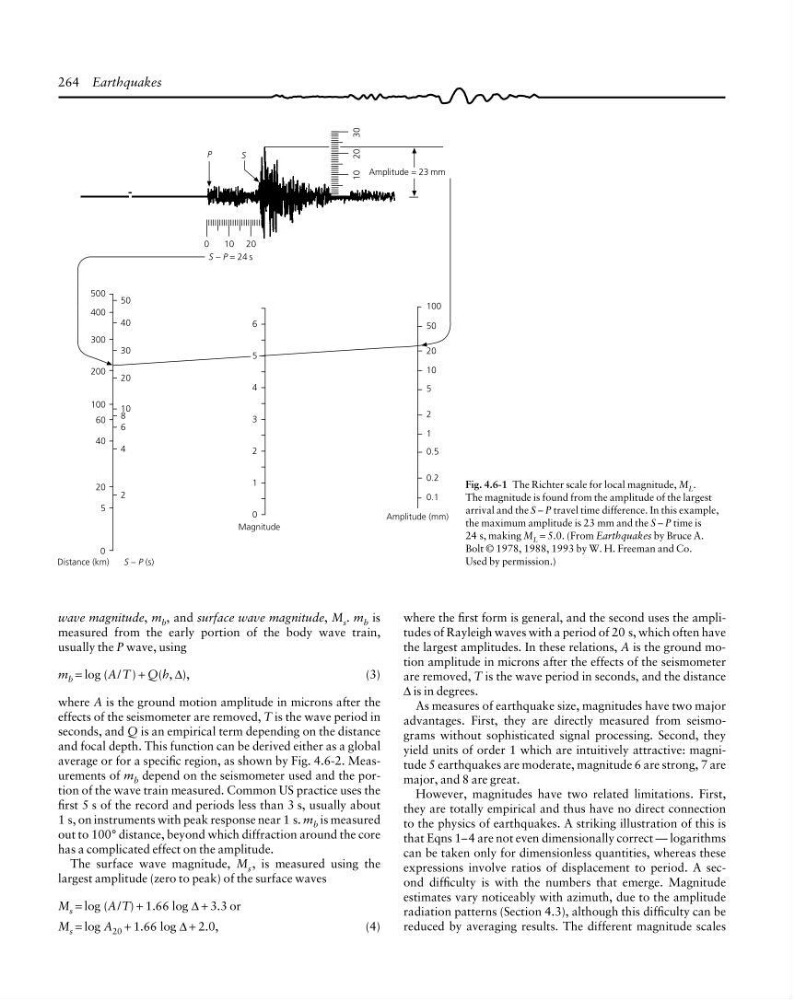
Fig. 4.6-1 The Richter scale for local magnitude, M L .
The magnitude is found from the amplitude of the largest
arrival and the S – P travel time difference. In this example,
the maximum amplitude is 23 mm and the S – P time is
24 s, making M L = 5.0. (From Earthquakes by Bruce A.
Bolt © 1978, 1988, 1993 by W. H. Freeman and Co.
Used by permission.)
wave magnitude, m b , and surface wave magnitude, M s . m b is
measured from the early portion of the body wave train,
usually the P wave, using
m b = log (A/ T ) + Q(h, ∆),
(3)
where A is the ground motion amplitude in microns after the
effects of the seismometer are removed, T is the wave period in
seconds, and Q is an empirical term depending on the distance
and focal depth. This function can be derived either as a global
average or for a specific region, as shown by Fig. 4.6-2. Measurements of m b depend on the seismometer used and the portion of the wave train measured. Common US practice uses the
first 5 s of the record and periods less than 3 s, usually about
1 s, on instruments with peak response near 1 s. m b is measured
out to 100° distance, beyond which diffraction around the core
has a complicated effect on the amplitude.
The surface wave magnitude, M s , is measured using the
largest amplitude (zero to peak) of the surface waves
M s = log (A/T) + 1.66 log ∆ + 3.3 or
M s = log A 20 + 1.66 log ∆ + 2.0,
(4)
where the first form is general, and the second uses the amplitudes of Rayleigh waves with a period of 20 s, which often have
the largest amplitudes. In these relations, A is the ground motion amplitude in microns after the effects of the seismometer
are removed, T is the wave period in seconds, and the distance
∆ is in degrees.
As measures of earthquake size, magnitudes have two major
advantages. First, they are directly measured from seismograms without sophisticated signal processing. Second, they
yield units of order 1 which are intuitively attractive: magnitude 5 earthquakes are moderate, magnitude 6 are strong, 7 are
major, and 8 are great.
However, magnitudes have two related limitations. First,
they are totally empirical and thus have no direct connection
to the physics of earthquakes. A striking illustration of this is
that Eqns 1–4 are not even dimensionally correct — logarithms
can be taken only for dimensionless quantities, whereas these
expressions involve ratios of displacement to period. A second difficulty is with the numbers that emerge. Magnitude
estimates vary noticeably with azimuth, due to the amplitude
radiation patterns (Section 4.3), although this difficulty can be
reduced by averaging results. The different magnitude scales
500
400
300
200
60
100
40
20
5
0
100
50
20
10
5
2
1
0.5
0.2
0.1
Distance (km)
S − P (s)
Magnitude
Amplitude (mm)
S − P = 24 s
P
S
0
10 20
10 20 30
Amplitude = 23 mm
6
5
4
3
2
1
0
50
40
30
20
10
8
6
4
2
Fig. 4.6-1 The Richter scale for local magnitude, M L .
The magnitude is found from the amplitude of the largest
arrival and the S – P travel time difference. In this example,
the maximum amplitude is 23 mm and the S – P time is
24 s, making M L = 5.0. (From Earthquakes by Bruce A.
Bolt © 1978, 1988, 1993 by W. H. Freeman and Co.
Used by permission.)
wave magnitude, m b , and surface wave magnitude, M s . m b is
measured from the early portion of the body wave train,
usually the P wave, using
m b = log (A/ T ) + Q(h, ∆),
(3)
where A is the ground motion amplitude in microns after the
effects of the seismometer are removed, T is the wave period in
seconds, and Q is an empirical term depending on the distance
and focal depth. This function can be derived either as a global
average or for a specific region, as shown by Fig. 4.6-2. Measurements of m b depend on the seismometer used and the portion of the wave train measured. Common US practice uses the
first 5 s of the record and periods less than 3 s, usually about
1 s, on instruments with peak response near 1 s. m b is measured
out to 100° distance, beyond which diffraction around the core
has a complicated effect on the amplitude.
The surface wave magnitude, M s , is measured using the
largest amplitude (zero to peak) of the surface waves
M s = log (A/T) + 1.66 log ∆ + 3.3 or
M s = log A 20 + 1.66 log ∆ + 2.0,
(4)
where the first form is general, and the second uses the amplitudes of Rayleigh waves with a period of 20 s, which often have
the largest amplitudes. In these relations, A is the ground motion amplitude in microns after the effects of the seismometer
are removed, T is the wave period in seconds, and the distance
∆ is in degrees.
As measures of earthquake size, magnitudes have two major
advantages. First, they are directly measured from seismograms without sophisticated signal processing. Second, they
yield units of order 1 which are intuitively attractive: magnitude 5 earthquakes are moderate, magnitude 6 are strong, 7 are
major, and 8 are great.
However, magnitudes have two related limitations. First,
they are totally empirical and thus have no direct connection
to the physics of earthquakes. A striking illustration of this is
that Eqns 1–4 are not even dimensionally correct — logarithms
can be taken only for dimensionless quantities, whereas these
expressions involve ratios of displacement to period. A second difficulty is with the numbers that emerge. Magnitude
estimates vary noticeably with azimuth, due to the amplitude
radiation patterns (Section 4.3), although this difficulty can be
reduced by averaging results. The different magnitude scales