

226 Earthquakes
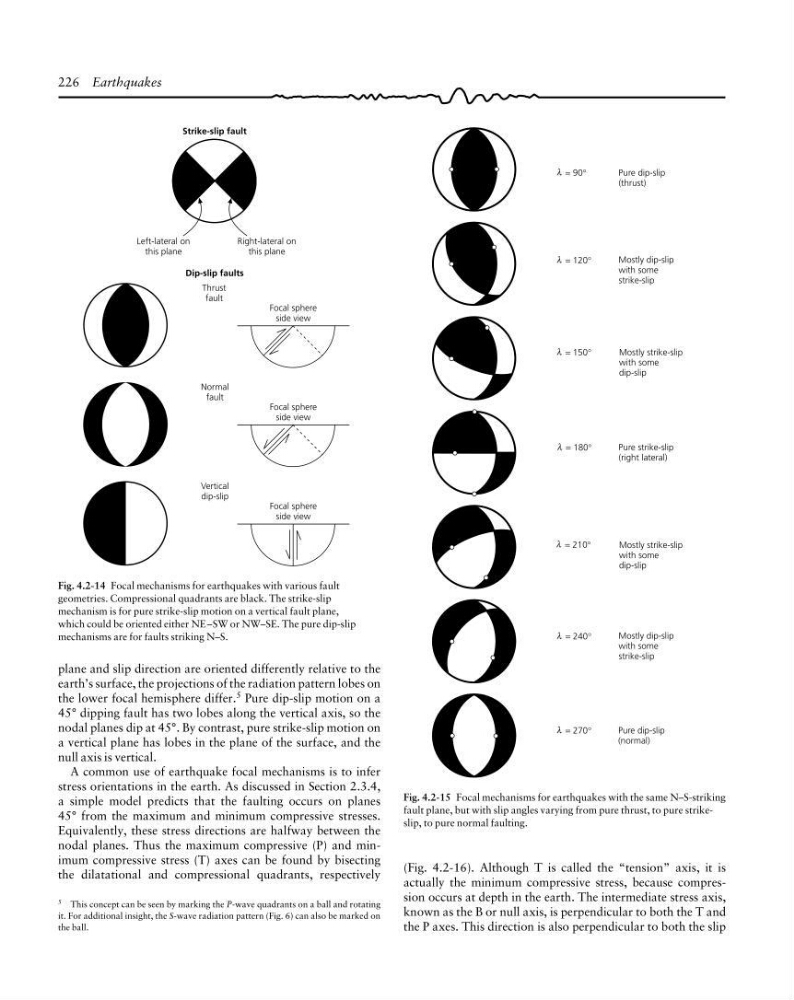
Fig. 4.2-14 Focal mechanisms for earthquakes with various fault
geometries. Compressional quadrants are black. The strike-slip
mechanism is for pure strike-slip motion on a vertical fault plane,
which could be oriented either NE –SW or NW–SE. The pure dip-slip
mechanisms are for faults striking N–S.
Strike-slip fault
Left-lateral on
this plane
Right-lateral on
this plane
Dip-slip faults
Focal sphere
side view
Thrust
fault
Focal sphere
side view
Normal
fault
Focal sphere
side view
Vertical
dip-slip
5 This concept can be seen by marking the P-wave quadrants on a ball and rotating
it. For additional insight, the S-wave radiation pattern (Fig. 6) can also be marked on
the ball.
plane and slip direction are oriented differently relative to the
earth’s surface, the projections of the radiation pattern lobes on
the lower focal hemisphere differ. 5 Pure dip-slip motion on a
45° dipping fault has two lobes along the vertical axis, so the
nodal planes dip at 45°. By contrast, pure strike-slip motion on
a vertical plane has lobes in the plane of the surface, and the
null axis is vertical.
A common use of earthquake focal mechanisms is to infer
stress orientations in the earth. As discussed in Section 2.3.4,
a simple model predicts that the faulting occurs on planes
45° from the maximum and minimum compressive stresses.
Equivalently, these stress directions are halfway between the
nodal planes. Thus the maximum compressive (P) and minimum compressive stress (T) axes can be found by bisecting
the dilatational and compressional quadrants, respectively
Fig. 4.2-15 Focal mechanisms for earthquakes with the same N–S-striking
fault plane, but with slip angles varying from pure thrust, to pure strikeslip, to pure normal faulting.
Pure dip-slip
(thrust)
= 90°
λ
= 120°
λ
= 150°
λ
= 180°
λ
= 210°
λ
= 240°
λ
= 270°
λ
Mostly dip-slip
with some
strike-slip
Mostly strike-slip
with some
dip-slip
Pure strike-slip
(right lateral)
Mostly strike-slip
with some
dip-slip
Mostly dip-slip
with some
strike-slip
Pure dip-slip
(normal)
(Fig. 4.2-16). Although T is called the “tension” axis, it is
actually the minimum compressive stress, because compression occurs at depth in the earth. The intermediate stress axis,
known as the B or null axis, is perpendicular to both the T and
the P axes. This direction is also perpendicular to both the slip
Fig. 4.2-14 Focal mechanisms for earthquakes with various fault
geometries. Compressional quadrants are black. The strike-slip
mechanism is for pure strike-slip motion on a vertical fault plane,
which could be oriented either NE –SW or NW–SE. The pure dip-slip
mechanisms are for faults striking N–S.
Strike-slip fault
Left-lateral on
this plane
Right-lateral on
this plane
Dip-slip faults
Focal sphere
side view
Thrust
fault
Focal sphere
side view
Normal
fault
Focal sphere
side view
Vertical
dip-slip
5 This concept can be seen by marking the P-wave quadrants on a ball and rotating
it. For additional insight, the S-wave radiation pattern (Fig. 6) can also be marked on
the ball.
plane and slip direction are oriented differently relative to the
earth’s surface, the projections of the radiation pattern lobes on
the lower focal hemisphere differ. 5 Pure dip-slip motion on a
45° dipping fault has two lobes along the vertical axis, so the
nodal planes dip at 45°. By contrast, pure strike-slip motion on
a vertical plane has lobes in the plane of the surface, and the
null axis is vertical.
A common use of earthquake focal mechanisms is to infer
stress orientations in the earth. As discussed in Section 2.3.4,
a simple model predicts that the faulting occurs on planes
45° from the maximum and minimum compressive stresses.
Equivalently, these stress directions are halfway between the
nodal planes. Thus the maximum compressive (P) and minimum compressive stress (T) axes can be found by bisecting
the dilatational and compressional quadrants, respectively
Fig. 4.2-15 Focal mechanisms for earthquakes with the same N–S-striking
fault plane, but with slip angles varying from pure thrust, to pure strikeslip, to pure normal faulting.
Pure dip-slip
(thrust)
= 90°
λ
= 120°
λ
= 150°
λ
= 180°
λ
= 210°
λ
= 240°
λ
= 270°
λ
Mostly dip-slip
with some
strike-slip
Mostly strike-slip
with some
dip-slip
Pure strike-slip
(right lateral)
Mostly strike-slip
with some
dip-slip
Mostly dip-slip
with some
strike-slip
Pure dip-slip
(normal)
(Fig. 4.2-16). Although T is called the “tension” axis, it is
actually the minimum compressive stress, because compression occurs at depth in the earth. The intermediate stress axis,
known as the B or null axis, is perpendicular to both the T and
the P axes. This direction is also perpendicular to both the slip