

Volcanoes
0
Depth (km)
Trench
Trench
Volcanoes
Mountain range
D
D
Lower crustal boundary
Oceanic
Marginal and continental
C
C
C
C
B
M
32°
61°
35
60
300
700
60°
ancient Jewish sages’ observation that “the rivalry of scholars
increases wisdom.” 7 This process requires a constant cycle of
learning and unlearning in which old models are discarded,
even by those who helped create them, in favor of new models.
The classic geological example of advancing beyond conventional thinking is the plate tectonic revolution of the late 1960s.
Although the idea of continental drift had been around for a
long time and was strongly advocated by Alfred Wegener in
1915, it was not accepted by most of the geological community
in the USA and Europe, 8 in part because seismological pioneer
Harold Jeffreys argued that it was impossible. As a result,
although it was recognized in the 1950s that earthquakes
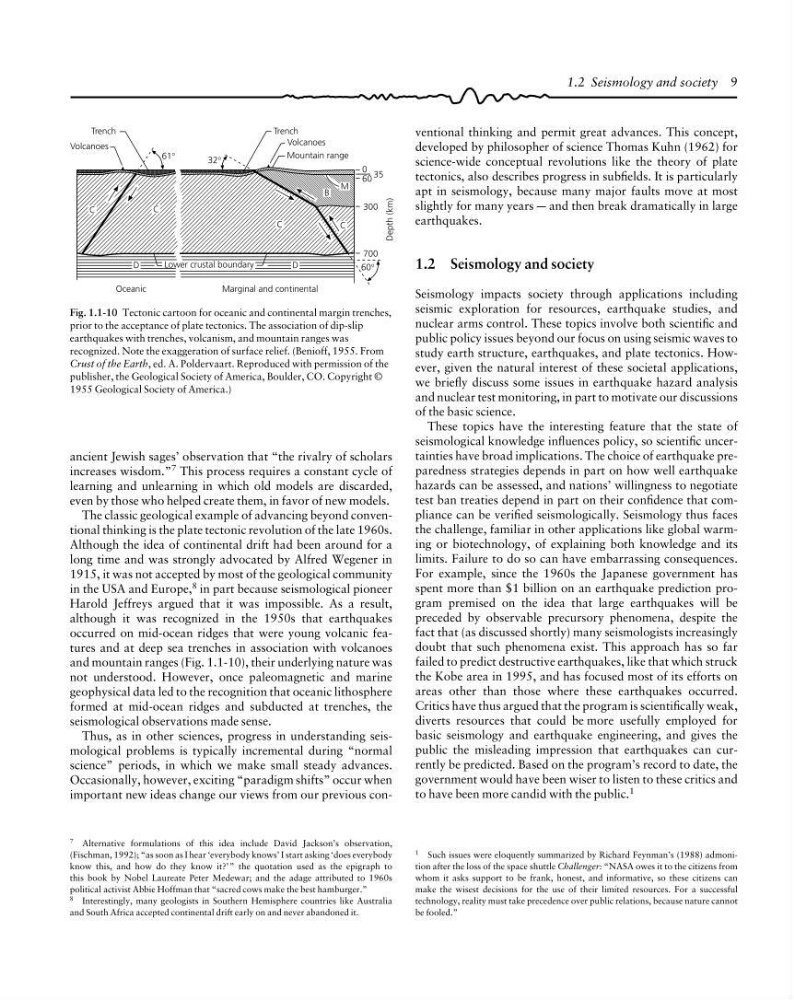
occurred on mid-ocean ridges that were young volcanic features and at deep sea trenches in association with volcanoes
and mountain ranges (Fig. 1.1-10), their underlying nature was
not understood. However, once paleomagnetic and marine
geophysical data led to the recognition that oceanic lithosphere
formed at mid-ocean ridges and subducted at trenches, the
seismological observations made sense.
Thus, as in other sciences, progress in understanding seismological problems is typically incremental during “normal
science” periods, in which we make small steady advances.
Occasionally, however, exciting “paradigm shifts” occur when
important new ideas change our views from our previous conventional thinking and permit great advances. This concept,
developed by philosopher of science Thomas Kuhn (1962) for
science-wide conceptual revolutions like the theory of plate
tectonics, also describes progress in subfields. It is particularly
apt in seismology, because many major faults move at most
slightly for many years a and then break dramatically in large
earthquakes.
1.2 Seismology and society
Seismology impacts society through applications including
seismic exploration for resources, earthquake studies, and
nuclear arms control. These topics involve both scientific and
public policy issues beyond our focus on using seismic waves to
study earth structure, earthquakes, and plate tectonics. However, given the natural interest of these societal applications,
we briefly discuss some issues in earthquake hazard analysis
and nuclear test monitoring, in part to motivate our discussions
of the basic science.
These topics have the interesting feature that the state of
seismological knowledge influences policy, so scientific uncertainties have broad implications. The choice of earthquake preparedness strategies depends in part on how well earthquake
hazards can be assessed, and nations’ willingness to negotiate
test ban treaties depend in part on their confidence that compliance can be verified seismologically. Seismology thus faces
the challenge, familiar in other applications like global warming or biotechnology, of explaining both knowledge and its
limits. Failure to do so can have embarrassing consequences.
For example, since the 1960s the Japanese government has
spent more than $1 billion on an earthquake prediction program premised on the idea that large earthquakes will be
preceded by observable precursory phenomena, despite the
fact that (as discussed shortly) many seismologists increasingly
doubt that such phenomena exist. This approach has so far
failed to predict destructive earthquakes, like that which struck
the Kobe area in 1995, and has focused most of its efforts on
areas other than those where these earthquakes occurred.
Critics have thus argued that the program is scientifically weak,
diverts resources that could be more usefully employed for
basic seismology and earthquake engineering, and gives the
public the misleading impression that earthquakes can currently be predicted. Based on the program’s record to date, the
government would have been wiser to listen to these critics and
to have been more candid with the public. 1
1 Such issues were eloquently summarized by Richard Feynman’s (1988) admonition after the loss of the space shuttle Challenger: “NASA owes it to the citizens from
whom it asks support to be frank, honest, and informative, so these citizens can
make the wisest decisions for the use of their limited resources. For a successful
technology, reality must take precedence over public relations, because nature cannot
be fooled.”
7 Alternative formulations of this idea include David Jackson’s observation,
(Fischman, 1992); “as soon as I hear ‘everybody knows’ I start asking ‘does everybody
know this, and how do they know it?’” the quotation used as the epigraph to
this book by Nobel Laureate Peter Medewar; and the adage attributed to 1960s
political activist Abbie Hoffman that “sacred cows make the best hamburger.”
8 Interestingly, many geologists in Southern Hemisphere countries like Australia
and South Africa accepted continental drift early on and never abandoned it.
1.2 Seismology and society 9
Fig. 1.1-10 Tectonic cartoon for oceanic and continental margin trenches,
prior to the acceptance of plate tectonics. The association of dip-slip
earthquakes with trenches, volcanism, and mountain ranges was
recognized. Note the exaggeration of surface relief. (Benioff, 1955. From
Crust of the Earth, ed. A. Poldervaart. Reproduced with permission of the
publisher, the Geological Society of America, Boulder, CO. Copyright ©
1955 Geological Society of America.)
0
Depth (km)
Trench
Trench
Volcanoes
Mountain range
D
D
Lower crustal boundary
Oceanic
Marginal and continental
C
C
C
C
B
M
32°
61°
35
60
300
700
60°
ancient Jewish sages’ observation that “the rivalry of scholars
increases wisdom.” 7 This process requires a constant cycle of
learning and unlearning in which old models are discarded,
even by those who helped create them, in favor of new models.
The classic geological example of advancing beyond conventional thinking is the plate tectonic revolution of the late 1960s.
Although the idea of continental drift had been around for a
long time and was strongly advocated by Alfred Wegener in
1915, it was not accepted by most of the geological community
in the USA and Europe, 8 in part because seismological pioneer
Harold Jeffreys argued that it was impossible. As a result,
although it was recognized in the 1950s that earthquakes
occurred on mid-ocean ridges that were young volcanic features and at deep sea trenches in association with volcanoes
and mountain ranges (Fig. 1.1-10), their underlying nature was
not understood. However, once paleomagnetic and marine
geophysical data led to the recognition that oceanic lithosphere
formed at mid-ocean ridges and subducted at trenches, the
seismological observations made sense.
Thus, as in other sciences, progress in understanding seismological problems is typically incremental during “normal
science” periods, in which we make small steady advances.
Occasionally, however, exciting “paradigm shifts” occur when
important new ideas change our views from our previous conventional thinking and permit great advances. This concept,
developed by philosopher of science Thomas Kuhn (1962) for
science-wide conceptual revolutions like the theory of plate
tectonics, also describes progress in subfields. It is particularly
apt in seismology, because many major faults move at most
slightly for many years a and then break dramatically in large
earthquakes.
1.2 Seismology and society
Seismology impacts society through applications including
seismic exploration for resources, earthquake studies, and
nuclear arms control. These topics involve both scientific and
public policy issues beyond our focus on using seismic waves to
study earth structure, earthquakes, and plate tectonics. However, given the natural interest of these societal applications,
we briefly discuss some issues in earthquake hazard analysis
and nuclear test monitoring, in part to motivate our discussions
of the basic science.
These topics have the interesting feature that the state of
seismological knowledge influences policy, so scientific uncertainties have broad implications. The choice of earthquake preparedness strategies depends in part on how well earthquake
hazards can be assessed, and nations’ willingness to negotiate
test ban treaties depend in part on their confidence that compliance can be verified seismologically. Seismology thus faces
the challenge, familiar in other applications like global warming or biotechnology, of explaining both knowledge and its
limits. Failure to do so can have embarrassing consequences.
For example, since the 1960s the Japanese government has
spent more than $1 billion on an earthquake prediction program premised on the idea that large earthquakes will be
preceded by observable precursory phenomena, despite the
fact that (as discussed shortly) many seismologists increasingly
doubt that such phenomena exist. This approach has so far
failed to predict destructive earthquakes, like that which struck
the Kobe area in 1995, and has focused most of its efforts on
areas other than those where these earthquakes occurred.
Critics have thus argued that the program is scientifically weak,
diverts resources that could be more usefully employed for
basic seismology and earthquake engineering, and gives the
public the misleading impression that earthquakes can currently be predicted. Based on the program’s record to date, the
government would have been wiser to listen to these critics and
to have been more candid with the public. 1
1 Such issues were eloquently summarized by Richard Feynman’s (1988) admonition after the loss of the space shuttle Challenger: “NASA owes it to the citizens from
whom it asks support to be frank, honest, and informative, so these citizens can
make the wisest decisions for the use of their limited resources. For a successful
technology, reality must take precedence over public relations, because nature cannot
be fooled.”
7 Alternative formulations of this idea include David Jackson’s observation,
(Fischman, 1992); “as soon as I hear ‘everybody knows’ I start asking ‘does everybody
know this, and how do they know it?’” the quotation used as the epigraph to
this book by Nobel Laureate Peter Medewar; and the adage attributed to 1960s
political activist Abbie Hoffman that “sacred cows make the best hamburger.”
8 Interestingly, many geologists in Southern Hemisphere countries like Australia
and South Africa accepted continental drift early on and never abandoned it.
1.2 Seismology and society 9
Fig. 1.1-10 Tectonic cartoon for oceanic and continental margin trenches,
prior to the acceptance of plate tectonics. The association of dip-slip
earthquakes with trenches, volcanism, and mountain ranges was
recognized. Note the exaggeration of surface relief. (Benioff, 1955. From
Crust of the Earth, ed. A. Poldervaart. Reproduced with permission of the
publisher, the Geological Society of America, Boulder, CO. Copyright ©
1955 Geological Society of America.)