

4.2 Focal mechanisms 221
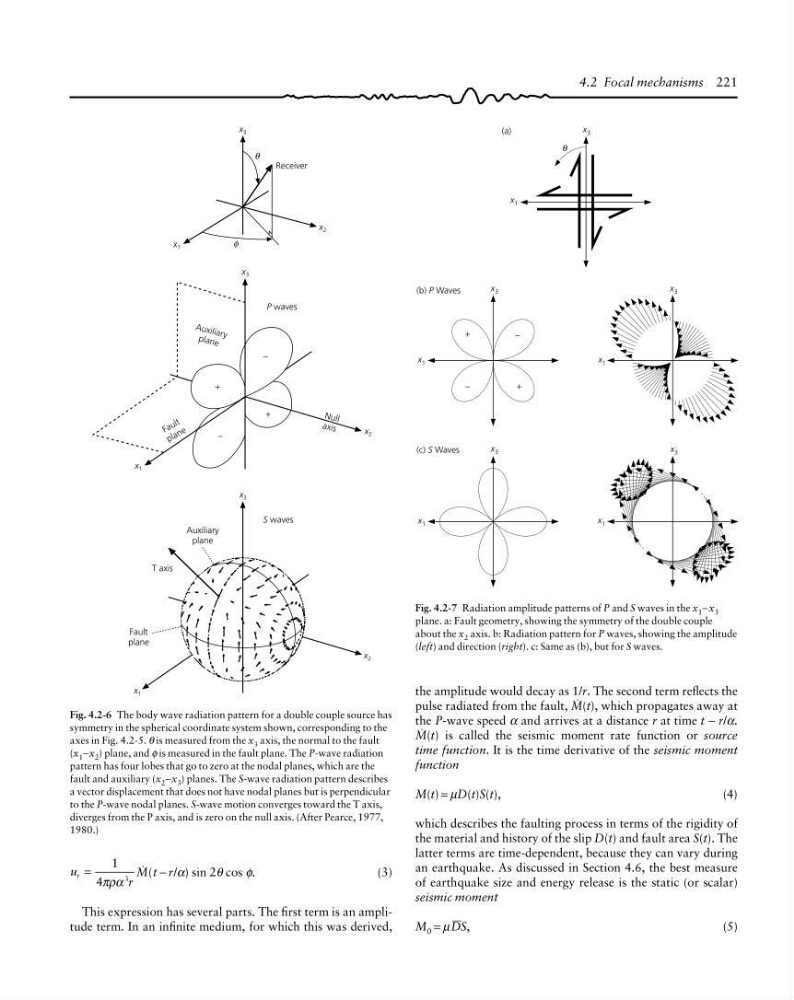
Fig. 4.2-6 The body wave radiation pattern for a double couple source has
symmetry in the spherical coordinate system shown, corresponding to the
axes in Fig. 4.2-5. θ is measured from the x 3 axis, the normal to the fault
(x 1 −x 2 ) plane, and φ is measured in the fault plane. The P-wave radiation
pattern has four lobes that go to zero at the nodal planes, which are the
fault and auxiliary (x 2 −x 3 ) planes. The S-wave radiation pattern describes
a vector displacement that does not have nodal planes but is perpendicular
to the P-wave nodal planes. S-wave motion converges toward the T axis,
diverges from the P axis, and is zero on the null axis. (After Pearce, 1977,
1980.)
Auxiliary
plane
Receiver
x 2
x 3
x 1
φ
θ
x 3
x 2
x 1
P waves
+
−
−
+
A u xi lia ry
p la n e
F a u lt
p la n e
N u ll
ax is
S waves
T axis
Fault
plane
x 1
x 2
x 3
u
r
r =
1
4
3
πρα
F(t − r/α) sin 2θ cos φ.
(3)
This expression has several parts. The first term is an amplitude term. In an infinite medium, for which this was derived,
the amplitude would decay as 1/r. The second term reflects the
pulse radiated from the fault, F(t), which propagates away at
the P-wave speed α and arrives at a distance r at time t − r/α.
F(t) is called the seismic moment rate function or source
time function. It is the time derivative of the seismic moment
function
M(t) = µD(t)S(t),
(4)
which describes the faulting process in terms of the rigidity of
the material and history of the slip D(t) and fault area S(t). The
latter terms are time-dependent, because they can vary during
an earthquake. As discussed in Section 4.6, the best measure
of earthquake size and energy release is the static (or scalar)
seismic moment
M 0 = µD
—
S,
(5)
x 1
x 3
x 1
x 3
(c) S Waves
x 1
x 3
x 3
x 1
(b) P Waves
x 1
(a)
θ
x 3
+
+
−
−
Fig. 4.2-7 Radiation amplitude patterns of P and S waves in the x 1 −x 3
plane. a: Fault geometry, showing the symmetry of the double couple
about the x 2 axis. b: Radiation pattern for P waves, showing the amplitude
(left) and direction (right). c: Same as (b), but for S waves.
Fig. 4.2-6 The body wave radiation pattern for a double couple source has
symmetry in the spherical coordinate system shown, corresponding to the
axes in Fig. 4.2-5. θ is measured from the x 3 axis, the normal to the fault
(x 1 −x 2 ) plane, and φ is measured in the fault plane. The P-wave radiation
pattern has four lobes that go to zero at the nodal planes, which are the
fault and auxiliary (x 2 −x 3 ) planes. The S-wave radiation pattern describes
a vector displacement that does not have nodal planes but is perpendicular
to the P-wave nodal planes. S-wave motion converges toward the T axis,
diverges from the P axis, and is zero on the null axis. (After Pearce, 1977,
1980.)
Auxiliary
plane
Receiver
x 2
x 3
x 1
φ
θ
x 3
x 2
x 1
P waves
+
−
−
+
A u xi lia ry
p la n e
F a u lt
p la n e
N u ll
ax is
S waves
T axis
Fault
plane
x 1
x 2
x 3
u
r
r =
1
4
3
πρα
F(t − r/α) sin 2θ cos φ.
(3)
This expression has several parts. The first term is an amplitude term. In an infinite medium, for which this was derived,
the amplitude would decay as 1/r. The second term reflects the
pulse radiated from the fault, F(t), which propagates away at
the P-wave speed α and arrives at a distance r at time t − r/α.
F(t) is called the seismic moment rate function or source
time function. It is the time derivative of the seismic moment
function
M(t) = µD(t)S(t),
(4)
which describes the faulting process in terms of the rigidity of
the material and history of the slip D(t) and fault area S(t). The
latter terms are time-dependent, because they can vary during
an earthquake. As discussed in Section 4.6, the best measure
of earthquake size and energy release is the static (or scalar)
seismic moment
M 0 = µD
—
S,
(5)
x 1
x 3
x 1
x 3
(c) S Waves
x 1
x 3
x 3
x 1
(b) P Waves
x 1
(a)
θ
x 3
+
+
−
−
Fig. 4.2-7 Radiation amplitude patterns of P and S waves in the x 1 −x 3
plane. a: Fault geometry, showing the symmetry of the double couple
about the x 2 axis. b: Radiation pattern for P waves, showing the amplitude
(left) and direction (right). c: Same as (b), but for S waves.