

1.1 Introduction
This book is an introduction to seismology, the study of elastic
waves or sound waves in the solid earth. Conceptually, the subject is simple. Seismic waves are generated at a source, which
can be natural, such as an earthquake, or artificial, such as an
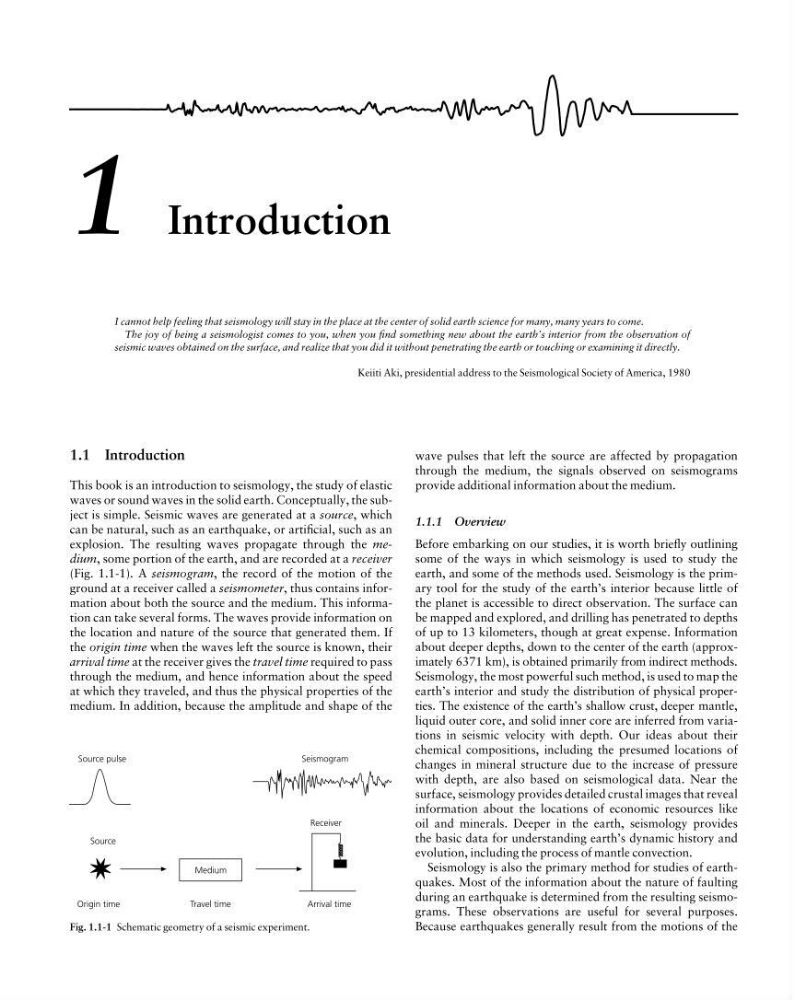
explosion. The resulting waves propagate through the medium, some portion of the earth, and are recorded at a receiver
(Fig. 1.1-1). A seismogram, the record of the motion of the
ground at a receiver called a seismometer, thus contains information about both the source and the medium. This information can take several forms. The waves provide information on
the location and nature of the source that generated them. If
the origin time when the waves left the source is known, their
arrival time at the receiver gives the travel time required to pass
through the medium, and hence information about the speed
at which they traveled, and thus the physical properties of the
medium. In addition, because the amplitude and shape of the
wave pulses that left the source are affected by propagation
through the medium, the signals observed on seismograms
provide additional information about the medium.
1.1.1 Overview
Before embarking on our studies, it is worth briefly outlining
some of the ways in which seismology is used to study the
earth, and some of the methods used. Seismology is the primary tool for the study of the earth’s interior because little of
the planet is accessible to direct observation. The surface can
be mapped and explored, and drilling has penetrated to depths
of up to 13 kilometers, though at great expense. Information
about deeper depths, down to the center of the earth (approximately 6371 km), is obtained primarily from indirect methods.
Seismology, the most powerful such method, is used to map the
earth’s interior and study the distribution of physical properties. The existence of the earth’s shallow crust, deeper mantle,
liquid outer core, and solid inner core are inferred from variations in seismic velocity with depth. Our ideas about their
chemical compositions, including the presumed locations of
changes in mineral structure due to the increase of pressure
with depth, are also based on seismological data. Near the
surface, seismology provides detailed crustal images that reveal
information about the locations of economic resources like
oil and minerals. Deeper in the earth, seismology provides
the basic data for understanding earth’s dynamic history and
evolution, including the process of mantle convection.
Seismology is also the primary method for studies of earthquakes. Most of the information about the nature of faulting
during an earthquake is determined from the resulting seismograms. These observations are useful for several purposes.
Because earthquakes generally result from the motions of the
1 Introduction
I cannot help feeling that seismology will stay in the place at the center of solid earth science for many, many years to come.
The joy of being a seismologist comes to you, when you find something new about the earth’s interior from the observation of
seismic waves obtained on the surface, and realize that you did it without penetrating the earth or touching or examining it directly.
Keiiti Aki, presidential address to the Seismological Society of America, 1980
Fig. 1.1-1 Schematic geometry of a seismic experiment.
Source pulse
Source
Origin time
Travel time
Arrival time
Receiver
Seismogram
Medium
This book is an introduction to seismology, the study of elastic
waves or sound waves in the solid earth. Conceptually, the subject is simple. Seismic waves are generated at a source, which
can be natural, such as an earthquake, or artificial, such as an
explosion. The resulting waves propagate through the medium, some portion of the earth, and are recorded at a receiver
(Fig. 1.1-1). A seismogram, the record of the motion of the
ground at a receiver called a seismometer, thus contains information about both the source and the medium. This information can take several forms. The waves provide information on
the location and nature of the source that generated them. If
the origin time when the waves left the source is known, their
arrival time at the receiver gives the travel time required to pass
through the medium, and hence information about the speed
at which they traveled, and thus the physical properties of the
medium. In addition, because the amplitude and shape of the
wave pulses that left the source are affected by propagation
through the medium, the signals observed on seismograms
provide additional information about the medium.
1.1.1 Overview
Before embarking on our studies, it is worth briefly outlining
some of the ways in which seismology is used to study the
earth, and some of the methods used. Seismology is the primary tool for the study of the earth’s interior because little of
the planet is accessible to direct observation. The surface can
be mapped and explored, and drilling has penetrated to depths
of up to 13 kilometers, though at great expense. Information
about deeper depths, down to the center of the earth (approximately 6371 km), is obtained primarily from indirect methods.
Seismology, the most powerful such method, is used to map the
earth’s interior and study the distribution of physical properties. The existence of the earth’s shallow crust, deeper mantle,
liquid outer core, and solid inner core are inferred from variations in seismic velocity with depth. Our ideas about their
chemical compositions, including the presumed locations of
changes in mineral structure due to the increase of pressure
with depth, are also based on seismological data. Near the
surface, seismology provides detailed crustal images that reveal
information about the locations of economic resources like
oil and minerals. Deeper in the earth, seismology provides
the basic data for understanding earth’s dynamic history and
evolution, including the process of mantle convection.
Seismology is also the primary method for studies of earthquakes. Most of the information about the nature of faulting
during an earthquake is determined from the resulting seismograms. These observations are useful for several purposes.
Because earthquakes generally result from the motions of the
1 Introduction
I cannot help feeling that seismology will stay in the place at the center of solid earth science for many, many years to come.
The joy of being a seismologist comes to you, when you find something new about the earth’s interior from the observation of
seismic waves obtained on the surface, and realize that you did it without penetrating the earth or touching or examining it directly.
Keiiti Aki, presidential address to the Seismological Society of America, 1980
Fig. 1.1-1 Schematic geometry of a seismic experiment.
Source pulse
Source
Origin time
Travel time
Arrival time
Receiver
Seismogram
Medium