

5 Elements Sensitive to Red/Ox Conditions …
73
ultramafic rocks, the last contain appreciable Cr, Ni and Mg (SGS Minerals Services
2005). At last, the soil geochemistry, mining activity, and the emission from ferrochromium metallurgy may explain high Ni levels recorded at specific points relatively
high Ni background level in moss samples of Albania.
5.3 Cobalt, Co
Cobalt is a naturally-occurring trace element widely dispersed in the environment
in low concentrations. It may enter the environment from both natural and anthropogenic sources. Co may enter air from windblown dust, seawater spray, volcanic
eruptions, forest fires and rock containing cobalt. Soils near to the ore deposits implies
a particular rather than a common source, phosphate rocks, or ore smelting facilities,
soils contaminated by airport traffic, highway traffic, or other industrial pollution
may contain high concentrations of cobalt (ATSDR 2004). Small amounts of cobalt
may be released into the atmosphere from coal-fired power plants and incinerators,
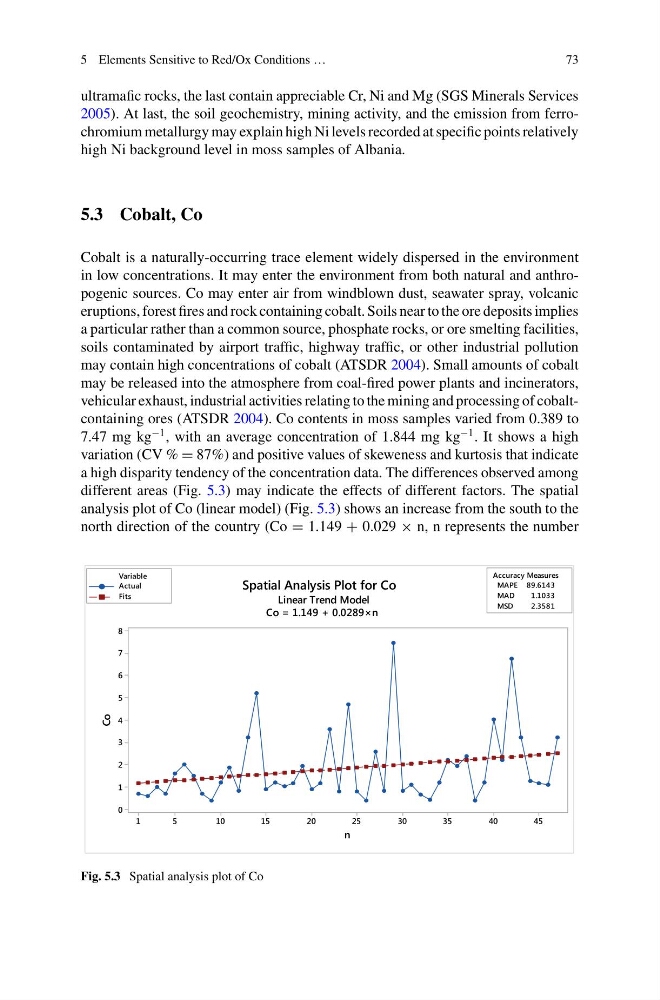
vehicular exhaust, industrial activities relating to the mining and processing of cobaltcontaining ores (ATSDR 2004). Co contents in moss samples varied from 0.389 to
7.47 mg kg
−1 , with an average concentration of 1.844 mg kg
−1 . It shows a high
variation (CV % = 87%) and positive values of skeweness and kurtosis that indicate
a high disparity tendency of the concentration data. The differences observed among
different areas (Fig. 5.3) may indicate the effects of different factors. The spatial
analysis plot of Co (linear model) (Fig. 5.3) shows an increase from the south to the
north direction of the country (Co = 1.149 + 0.029 × n, n represents the number
45
40
35
30
25
20
15
10
5
1
8
7
6
5
4
3
2
1
0
MAPE 89.6143
MAD
1.1033
MSD
2.3581
Accuracy Measures
n
Co
Actual
Fits
Variable
Spatial Analysis Plot for Co
Linear Trend Model
Co = 1.149 + 0.0289×n
Fig. 5.3 Spatial analysis plot of Co
73
ultramafic rocks, the last contain appreciable Cr, Ni and Mg (SGS Minerals Services
2005). At last, the soil geochemistry, mining activity, and the emission from ferrochromium metallurgy may explain high Ni levels recorded at specific points relatively
high Ni background level in moss samples of Albania.
5.3 Cobalt, Co
Cobalt is a naturally-occurring trace element widely dispersed in the environment
in low concentrations. It may enter the environment from both natural and anthropogenic sources. Co may enter air from windblown dust, seawater spray, volcanic
eruptions, forest fires and rock containing cobalt. Soils near to the ore deposits implies
a particular rather than a common source, phosphate rocks, or ore smelting facilities,
soils contaminated by airport traffic, highway traffic, or other industrial pollution
may contain high concentrations of cobalt (ATSDR 2004). Small amounts of cobalt
may be released into the atmosphere from coal-fired power plants and incinerators,
vehicular exhaust, industrial activities relating to the mining and processing of cobaltcontaining ores (ATSDR 2004). Co contents in moss samples varied from 0.389 to
7.47 mg kg
−1 , with an average concentration of 1.844 mg kg
−1 . It shows a high
variation (CV % = 87%) and positive values of skeweness and kurtosis that indicate
a high disparity tendency of the concentration data. The differences observed among
different areas (Fig. 5.3) may indicate the effects of different factors. The spatial
analysis plot of Co (linear model) (Fig. 5.3) shows an increase from the south to the
north direction of the country (Co = 1.149 + 0.029 × n, n represents the number
45
40
35
30
25
20
15
10
5
1
8
7
6
5
4
3
2
1
0
MAPE 89.6143
MAD
1.1033
MSD
2.3581
Accuracy Measures
n
Co
Actual
Fits
Variable
Spatial Analysis Plot for Co
Linear Trend Model
Co = 1.149 + 0.0289×n
Fig. 5.3 Spatial analysis plot of Co