

72
P. Lazo et al.
45
40
35
30
25
20
15
10
5
1
140
120
100
80
60
40
20
0
MAPE 169.208
MAD
10.648
MSD
379.878
Accuracy Measures
n
Ni
Actual
Fits
Variable
Spatial Analysis Plot for Ni
Linear Trend Model
Ni = -1.61 + 0.618×n
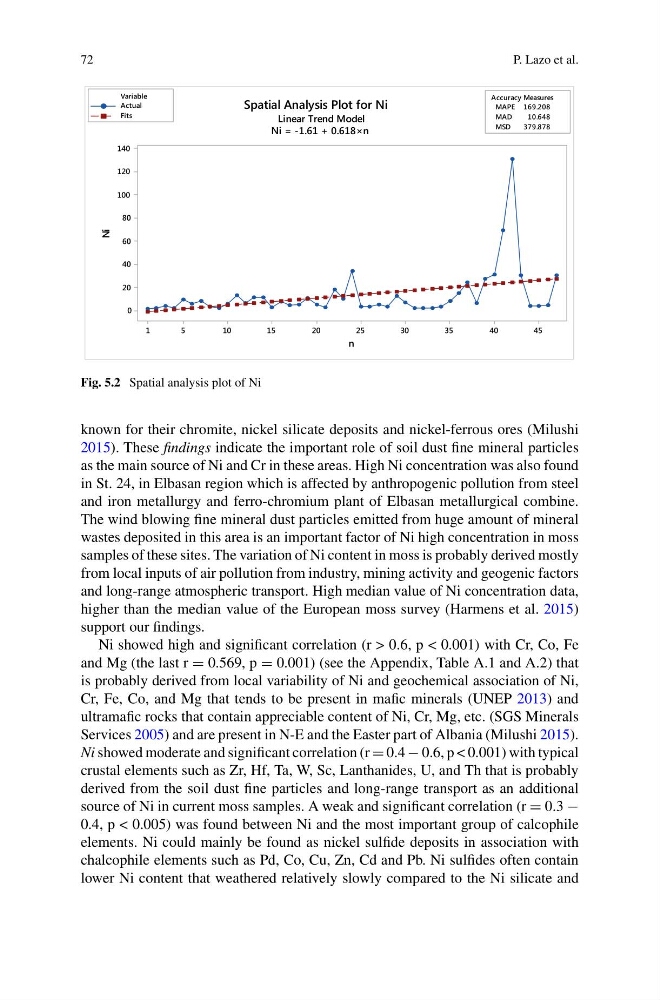
Fig. 5.2 Spatial analysis plot of Ni
known for their chromite, nickel silicate deposits and nickel-ferrous ores (Milushi
2015). These findings indicate the important role of soil dust fine mineral particles
as the main source of Ni and Cr in these areas. High Ni concentration was also found
in St. 24, in Elbasan region which is affected by anthropogenic pollution from steel
and iron metallurgy and ferro-chromium plant of Elbasan metallurgical combine.
The wind blowing fine mineral dust particles emitted from huge amount of mineral
wastes deposited in this area is an important factor of Ni high concentration in moss
samples of these sites. The variation of Ni content in moss is probably derived mostly
from local inputs of air pollution from industry, mining activity and geogenic factors
and long-range atmospheric transport. High median value of Ni concentration data,
higher than the median value of the European moss survey (Harmens et al. 2015)
support our findings.
Ni showed high and significant correlation (r > 0.6, p < 0.001) with Cr, Co, Fe
and Mg (the last r = 0.569, p = 0.001) (see the Appendix, Table A.1 and A.2) that
is probably derived from local variability of Ni and geochemical association of Ni,
Cr, Fe, Co, and Mg that tends to be present in mafic minerals (UNEP 2013) and
ultramafic rocks that contain appreciable content of Ni, Cr, Mg, etc. (SGS Minerals
Services 2005) and are present in N-E and the Easter part of Albania (Milushi 2015).
Ni showed moderate and significant correlation (r = 0.4 − 0.6, p < 0.001) with typical
crustal elements such as Zr, Hf, Ta, W, Sc, Lanthanides, U, and Th that is probably
derived from the soil dust fine particles and long-range transport as an additional
source of Ni in current moss samples. A weak and significant correlation (r = 0.3 −
0.4, p < 0.005) was found between Ni and the most important group of calcophile
elements. Ni could mainly be found as nickel sulfide deposits in association with
chalcophile elements such as Pd, Co, Cu, Zn, Cd and Pb. Ni sulfides often contain
lower Ni content that weathered relatively slowly compared to the Ni silicate and
P. Lazo et al.
45
40
35
30
25
20
15
10
5
1
140
120
100
80
60
40
20
0
MAPE 169.208
MAD
10.648
MSD
379.878
Accuracy Measures
n
Ni
Actual
Fits
Variable
Spatial Analysis Plot for Ni
Linear Trend Model
Ni = -1.61 + 0.618×n
Fig. 5.2 Spatial analysis plot of Ni
known for their chromite, nickel silicate deposits and nickel-ferrous ores (Milushi
2015). These findings indicate the important role of soil dust fine mineral particles
as the main source of Ni and Cr in these areas. High Ni concentration was also found
in St. 24, in Elbasan region which is affected by anthropogenic pollution from steel
and iron metallurgy and ferro-chromium plant of Elbasan metallurgical combine.
The wind blowing fine mineral dust particles emitted from huge amount of mineral
wastes deposited in this area is an important factor of Ni high concentration in moss
samples of these sites. The variation of Ni content in moss is probably derived mostly
from local inputs of air pollution from industry, mining activity and geogenic factors
and long-range atmospheric transport. High median value of Ni concentration data,
higher than the median value of the European moss survey (Harmens et al. 2015)
support our findings.
Ni showed high and significant correlation (r > 0.6, p < 0.001) with Cr, Co, Fe
and Mg (the last r = 0.569, p = 0.001) (see the Appendix, Table A.1 and A.2) that
is probably derived from local variability of Ni and geochemical association of Ni,
Cr, Fe, Co, and Mg that tends to be present in mafic minerals (UNEP 2013) and
ultramafic rocks that contain appreciable content of Ni, Cr, Mg, etc. (SGS Minerals
Services 2005) and are present in N-E and the Easter part of Albania (Milushi 2015).
Ni showed moderate and significant correlation (r = 0.4 − 0.6, p < 0.001) with typical
crustal elements such as Zr, Hf, Ta, W, Sc, Lanthanides, U, and Th that is probably
derived from the soil dust fine particles and long-range transport as an additional
source of Ni in current moss samples. A weak and significant correlation (r = 0.3 −
0.4, p < 0.005) was found between Ni and the most important group of calcophile
elements. Ni could mainly be found as nickel sulfide deposits in association with
chalcophile elements such as Pd, Co, Cu, Zn, Cd and Pb. Ni sulfides often contain
lower Ni content that weathered relatively slowly compared to the Ni silicate and