

58
P. Lazo et al.
45
40
35
30
25
20
15
10
5
1
12
10
8
6
4
2
0
MAPE 47.4119
MAD
1.4433
MSD
3.6184
Accuracy Measures
n
V
Actual
Fits
Variable
Spatial Analysis Plot for V
Linear Trend Model
V = 3.841 - 0.005×n
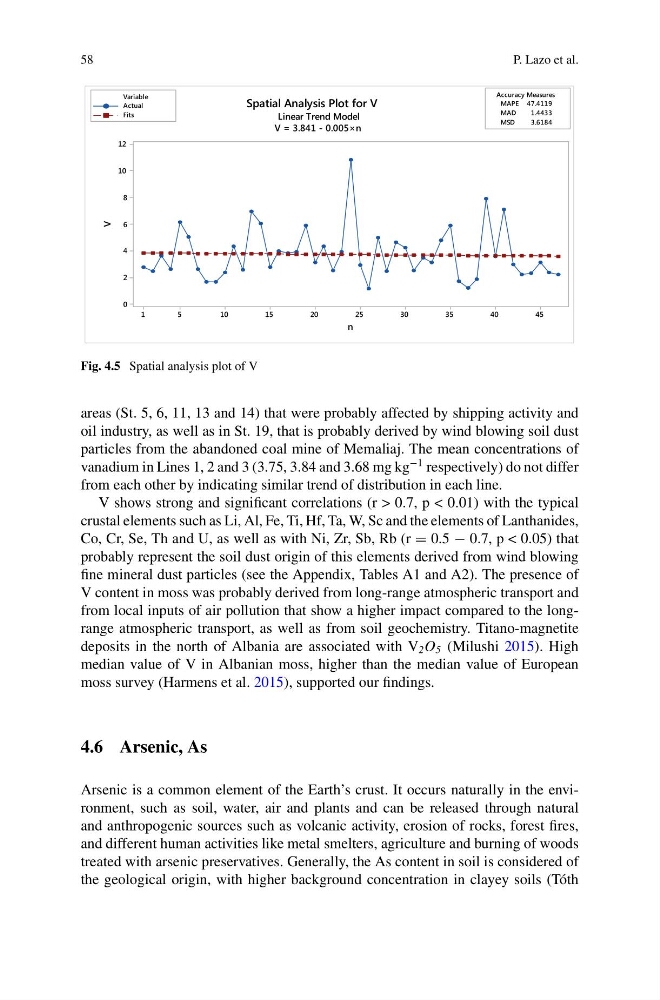
Fig. 4.5 Spatial analysis plot of V
areas (St. 5, 6, 11, 13 and 14) that were probably affected by shipping activity and
oil industry, as well as in St. 19, that is probably derived by wind blowing soil dust
particles from the abandoned coal mine of Memaliaj. The mean concentrations of
vanadium in Lines 1, 2 and 3 (3.75, 3.84 and 3.68 mg kg
−1 respectively) do not differ
from each other by indicating similar trend of distribution in each line.
V shows strong and significant correlations (r > 0.7, p < 0.01) with the typical
crustal elements such as Li, Al, Fe, Ti, Hf, Ta, W, Sc and the elements of Lanthanides,
Co, Cr, Se, Th and U, as well as with Ni, Zr, Sb, Rb (r = 0.5 − 0.7, p < 0.05) that
probably represent the soil dust origin of this elements derived from wind blowing
fine mineral dust particles (see the Appendix, Tables A1 and A2). The presence of
V content in moss was probably derived from long-range atmospheric transport and
from local inputs of air pollution that show a higher impact compared to the longrange atmospheric transport, as well as from soil geochemistry. Titano-magnetite
deposits in the north of Albania are associated with V 2 O 5 (Milushi 2015). High
median value of V in Albanian moss, higher than the median value of European
moss survey (Harmens et al. 2015), supported our findings.
4.6 Arsenic, As
Arsenic is a common element of the Earth’s crust. It occurs naturally in the environment, such as soil, water, air and plants and can be released through natural
and anthropogenic sources such as volcanic activity, erosion of rocks, forest fires,
and different human activities like metal smelters, agriculture and burning of woods
treated with arsenic preservatives. Generally, the As content in soil is considered of
the geological origin, with higher background concentration in clayey soils (Tóth
P. Lazo et al.
45
40
35
30
25
20
15
10
5
1
12
10
8
6
4
2
0
MAPE 47.4119
MAD
1.4433
MSD
3.6184
Accuracy Measures
n
V
Actual
Fits
Variable
Spatial Analysis Plot for V
Linear Trend Model
V = 3.841 - 0.005×n
Fig. 4.5 Spatial analysis plot of V
areas (St. 5, 6, 11, 13 and 14) that were probably affected by shipping activity and
oil industry, as well as in St. 19, that is probably derived by wind blowing soil dust
particles from the abandoned coal mine of Memaliaj. The mean concentrations of
vanadium in Lines 1, 2 and 3 (3.75, 3.84 and 3.68 mg kg
−1 respectively) do not differ
from each other by indicating similar trend of distribution in each line.
V shows strong and significant correlations (r > 0.7, p < 0.01) with the typical
crustal elements such as Li, Al, Fe, Ti, Hf, Ta, W, Sc and the elements of Lanthanides,
Co, Cr, Se, Th and U, as well as with Ni, Zr, Sb, Rb (r = 0.5 − 0.7, p < 0.05) that
probably represent the soil dust origin of this elements derived from wind blowing
fine mineral dust particles (see the Appendix, Tables A1 and A2). The presence of
V content in moss was probably derived from long-range atmospheric transport and
from local inputs of air pollution that show a higher impact compared to the longrange atmospheric transport, as well as from soil geochemistry. Titano-magnetite
deposits in the north of Albania are associated with V 2 O 5 (Milushi 2015). High
median value of V in Albanian moss, higher than the median value of European
moss survey (Harmens et al. 2015), supported our findings.
4.6 Arsenic, As
Arsenic is a common element of the Earth’s crust. It occurs naturally in the environment, such as soil, water, air and plants and can be released through natural
and anthropogenic sources such as volcanic activity, erosion of rocks, forest fires,
and different human activities like metal smelters, agriculture and burning of woods
treated with arsenic preservatives. Generally, the As content in soil is considered of
the geological origin, with higher background concentration in clayey soils (Tóth