

34
P. Lazo et al.
45
40
35
30
25
20
15
10
5
4
3
2
1
0
MAPE 54.0562
MAD
0.5726
MSD
0.6142
Accuracy Measures
n
Li
Actual
Fits
Variable
Spatial Analysis Plot for Li
Linear Trend Model
Li = 1.509 - 0.00165×n
1
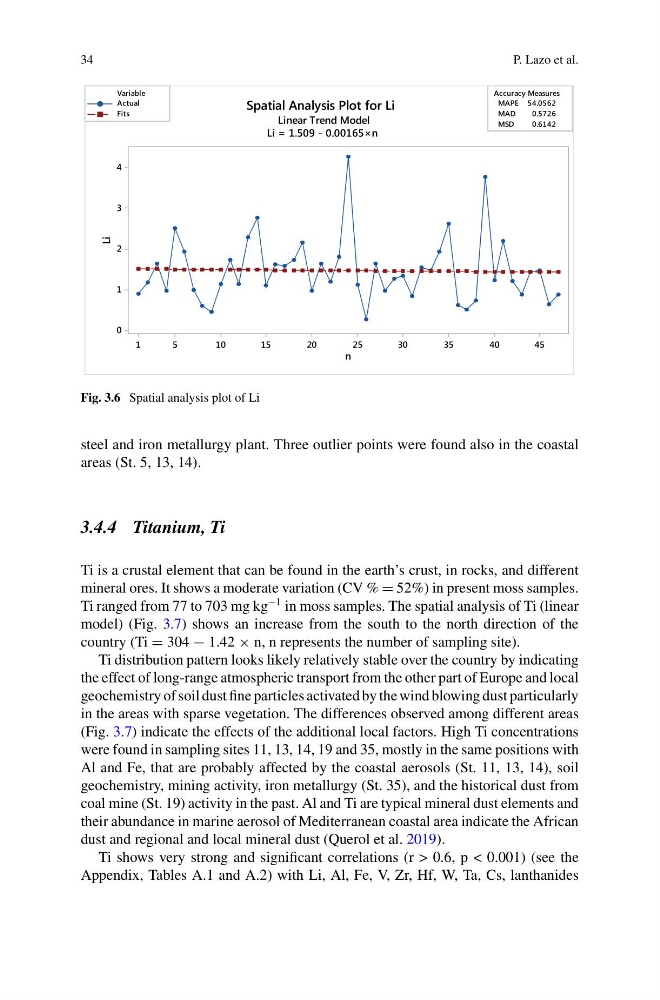
Fig. 3.6 Spatial analysis plot of Li
steel and iron metallurgy plant. Three outlier points were found also in the coastal
areas (St. 5, 13, 14).
3.4.4 Titanium, Ti
Ti is a crustal element that can be found in the earth’s crust, in rocks, and different
mineral ores. It shows a moderate variation (CV % = 52%) in present moss samples.
Ti ranged from 77 to 703 mg kg
−1 in moss samples. The spatial analysis of Ti (linear
model) (Fig. 3.7) shows an increase from the south to the north direction of the
country (Ti = 304 − 1.42 × n, n represents the number of sampling site).
Ti distribution pattern looks likely relatively stable over the country by indicating
the effect of long-range atmospheric transport from the other part of Europe and local
geochemistry of soil dust fine particles activated by the wind blowing dust particularly
in the areas with sparse vegetation. The differences observed among different areas
(Fig. 3.7) indicate the effects of the additional local factors. High Ti concentrations
were found in sampling sites 11, 13, 14, 19 and 35, mostly in the same positions with
Al and Fe, that are probably affected by the coastal aerosols (St. 11, 13, 14), soil
geochemistry, mining activity, iron metallurgy (St. 35), and the historical dust from
coal mine (St. 19) activity in the past. Al and Ti are typical mineral dust elements and
their abundance in marine aerosol of Mediterranean coastal area indicate the African
dust and regional and local mineral dust (Querol et al. 2019).
Ti shows very strong and significant correlations (r > 0.6, p < 0.001) (see the
Appendix, Tables A.1 and A.2) with Li, Al, Fe, V, Zr, Hf, W, Ta, Cs, lanthanides
P. Lazo et al.
45
40
35
30
25
20
15
10
5
4
3
2
1
0
MAPE 54.0562
MAD
0.5726
MSD
0.6142
Accuracy Measures
n
Li
Actual
Fits
Variable
Spatial Analysis Plot for Li
Linear Trend Model
Li = 1.509 - 0.00165×n
1
Fig. 3.6 Spatial analysis plot of Li
steel and iron metallurgy plant. Three outlier points were found also in the coastal
areas (St. 5, 13, 14).
3.4.4 Titanium, Ti
Ti is a crustal element that can be found in the earth’s crust, in rocks, and different
mineral ores. It shows a moderate variation (CV % = 52%) in present moss samples.
Ti ranged from 77 to 703 mg kg
−1 in moss samples. The spatial analysis of Ti (linear
model) (Fig. 3.7) shows an increase from the south to the north direction of the
country (Ti = 304 − 1.42 × n, n represents the number of sampling site).
Ti distribution pattern looks likely relatively stable over the country by indicating
the effect of long-range atmospheric transport from the other part of Europe and local
geochemistry of soil dust fine particles activated by the wind blowing dust particularly
in the areas with sparse vegetation. The differences observed among different areas
(Fig. 3.7) indicate the effects of the additional local factors. High Ti concentrations
were found in sampling sites 11, 13, 14, 19 and 35, mostly in the same positions with
Al and Fe, that are probably affected by the coastal aerosols (St. 11, 13, 14), soil
geochemistry, mining activity, iron metallurgy (St. 35), and the historical dust from
coal mine (St. 19) activity in the past. Al and Ti are typical mineral dust elements and
their abundance in marine aerosol of Mediterranean coastal area indicate the African
dust and regional and local mineral dust (Querol et al. 2019).
Ti shows very strong and significant correlations (r > 0.6, p < 0.001) (see the
Appendix, Tables A.1 and A.2) with Li, Al, Fe, V, Zr, Hf, W, Ta, Cs, lanthanides