

69
also isolated. Among the samples of the L type, sample 18 was particularly interesting
in terms of the phytochemical profile of its roots, with the major constituent being
compound 359. Also, there were several norsesquiterpenoids (98, 132, 133, 136, and
159) present in this sample. The biosynthesis pathway is postulated to start from fukinone (4) → 20 → 98 → 100 → 136 → 133 → 132 [28].
Sample 19 produced 6-hydroxyeuryopsyn (248), cacalol (316), and 6β-(2methylpropanoyloxy)furanoerephil-1(10)-en-9-one (280) and thus was grouped to
the H/C/N type [45]. A typical compound of the N type was neoadenostylone (283),
for which the carbonyl group at C-9 is presumably formed by oxidation from 248
and its derivatives (samples 20 and 22) [45, 76]. The C-9 position is doubly allylic
both from the furan and the double bond at C-1/C-10, and thus this position is readily oxidized. Sample 21 also produced 6-hydroxyeuryopsyn (248) and cacalol (316)
as major constituents as well as their related compounds, 251, 253, 257, 288, 289,
317, 322, 323, 335, 434, and 448. Sample 21 was assigned to the H/C type as well.
6-Acetoxyeuryopsyn (251) and neoadenostylone (283) were major constituents of
sample 23 (H/N type).
Sample 24 (V type) produced five 1(10)-en-2-one type compounds (455, 457,
530, 533, and 534), four 1(10),8-diene type compounds (463, 459, 461, and 462),
and four 1(10),8-dien-12-ol type compounds (569, 566, 567, and 568) as well as
1(10)-ene-2,9-dione 277. The 1(10)-en-2-one type bakkanes, virgaurenospirolides
A (640) and C (638), were also produced. It is interesting to note that virgaurenoanhydride A (641) was isolated from this sample, since it has an anhydride partial
structure instead of a lactone moiety in ring C of a bakkane skeleton. This type of
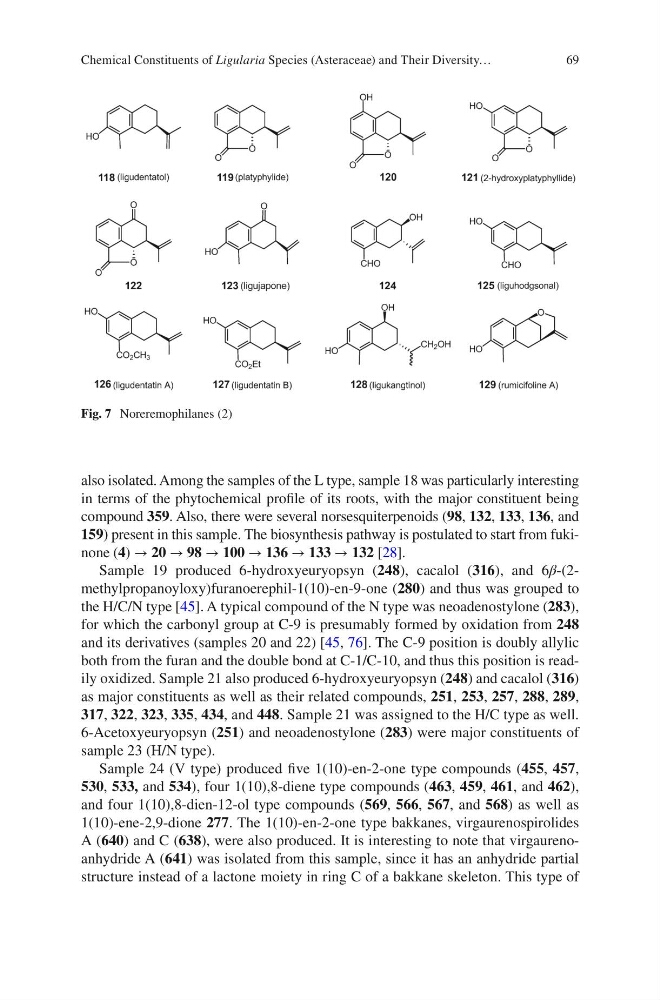
Fig. 7 Noreremophilanes (2)
Chemical Constituents of Ligularia Species (Asteraceae) and Their Diversity…
also isolated. Among the samples of the L type, sample 18 was particularly interesting
in terms of the phytochemical profile of its roots, with the major constituent being
compound 359. Also, there were several norsesquiterpenoids (98, 132, 133, 136, and
159) present in this sample. The biosynthesis pathway is postulated to start from fukinone (4) → 20 → 98 → 100 → 136 → 133 → 132 [28].
Sample 19 produced 6-hydroxyeuryopsyn (248), cacalol (316), and 6β-(2methylpropanoyloxy)furanoerephil-1(10)-en-9-one (280) and thus was grouped to
the H/C/N type [45]. A typical compound of the N type was neoadenostylone (283),
for which the carbonyl group at C-9 is presumably formed by oxidation from 248
and its derivatives (samples 20 and 22) [45, 76]. The C-9 position is doubly allylic
both from the furan and the double bond at C-1/C-10, and thus this position is readily oxidized. Sample 21 also produced 6-hydroxyeuryopsyn (248) and cacalol (316)
as major constituents as well as their related compounds, 251, 253, 257, 288, 289,
317, 322, 323, 335, 434, and 448. Sample 21 was assigned to the H/C type as well.
6-Acetoxyeuryopsyn (251) and neoadenostylone (283) were major constituents of
sample 23 (H/N type).
Sample 24 (V type) produced five 1(10)-en-2-one type compounds (455, 457,
530, 533, and 534), four 1(10),8-diene type compounds (463, 459, 461, and 462),
and four 1(10),8-dien-12-ol type compounds (569, 566, 567, and 568) as well as
1(10)-ene-2,9-dione 277. The 1(10)-en-2-one type bakkanes, virgaurenospirolides
A (640) and C (638), were also produced. It is interesting to note that virgaurenoanhydride A (641) was isolated from this sample, since it has an anhydride partial
structure instead of a lactone moiety in ring C of a bakkane skeleton. This type of
Fig. 7 Noreremophilanes (2)
Chemical Constituents of Ligularia Species (Asteraceae) and Their Diversity…