

60
furanoeremophilanes. The first one (L type) showed several pink spots identified as
ligularol (= petasalbin) (161) and its derivatives; the second (V type), one or two
spots with yellow color identified as virgaurenones A (274) and B (273); the third
one (C type), a blue spot, with the coloring developing in 10–24 h, identified as
cacalol (316); the fourth (H type), a purple spot, identified as 6-hydroxyeuryopsin
(248); and the last one (N type), a rapidly developed blue spot, identified as neoadenostylone (283). Each sample examined showed one or more TLC spots of these
types. Chemical studies revealed that there were at least five chemotypes in L. virgaurea, although the companion genetic studies indicated the presence of three different types (Sect. 4). The number of samples belonging to the L and V types is
particularly large, so that they are the major ones that occur.
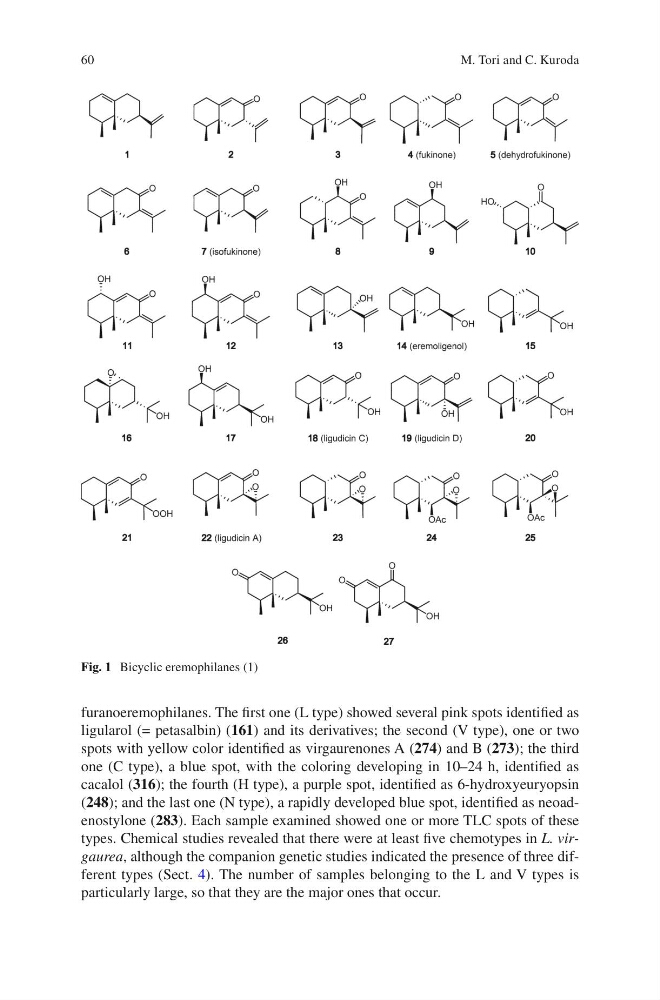
Fig. 1 Bicyclic eremophilanes (1)
M. Tori and C. Kuroda
furanoeremophilanes. The first one (L type) showed several pink spots identified as
ligularol (= petasalbin) (161) and its derivatives; the second (V type), one or two
spots with yellow color identified as virgaurenones A (274) and B (273); the third
one (C type), a blue spot, with the coloring developing in 10–24 h, identified as
cacalol (316); the fourth (H type), a purple spot, identified as 6-hydroxyeuryopsin
(248); and the last one (N type), a rapidly developed blue spot, identified as neoadenostylone (283). Each sample examined showed one or more TLC spots of these
types. Chemical studies revealed that there were at least five chemotypes in L. virgaurea, although the companion genetic studies indicated the presence of three different types (Sect. 4). The number of samples belonging to the L and V types is
particularly large, so that they are the major ones that occur.
Fig. 1 Bicyclic eremophilanes (1)
M. Tori and C. Kuroda