

226
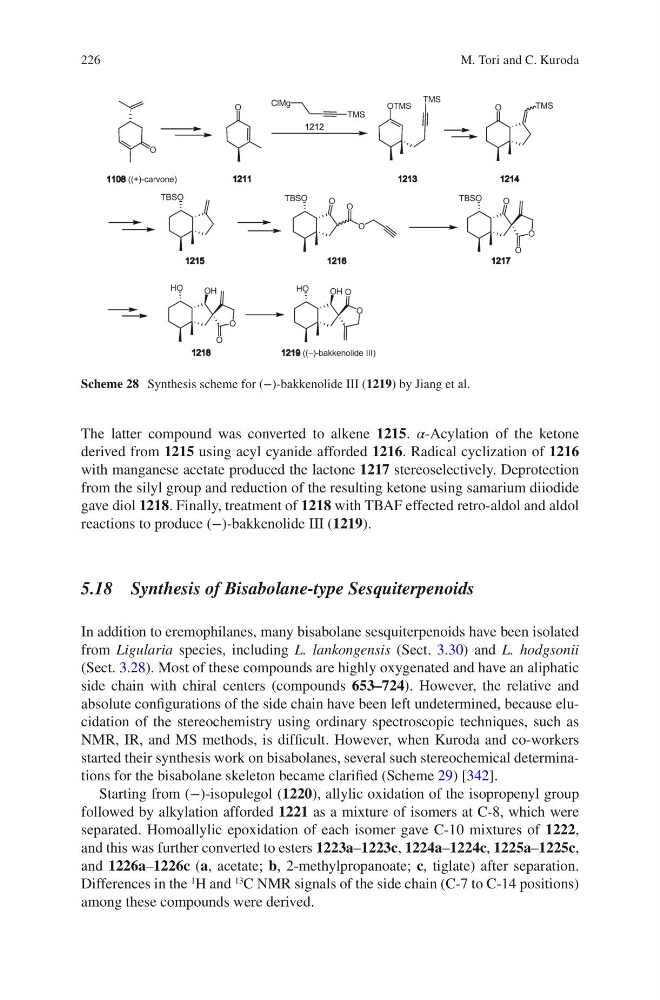
The latter compound was converted to alkene 1215. α-Acylation of the ketone
derived from 1215 using acyl cyanide afforded 1216. Radical cyclization of 1216
with manganese acetate produced the lactone 1217 stereoselectively. Deprotection
from the silyl group and reduction of the resulting ketone using samarium diiodide
gave diol 1218. Finally, treatment of 1218 with TBAF effected retro-aldol and aldol
reactions to produce (−)-bakkenolide III (1219).
5.18 Synthesis of Bisabolane-type Sesquiterpenoids
In addition to eremophilanes, many bisabolane sesquiterpenoids have been isolated
from Ligularia species, including L. lankongensis (Sect. 3.30) and L. hodgsonii
(Sect. 3.28). Most of these compounds are highly oxygenated and have an aliphatic
side chain with chiral centers (compounds 653–724). However, the relative and
absolute configurations of the side chain have been left undetermined, because elucidation of the stereochemistry using ordinary spectroscopic techniques, such as
NMR, IR, and MS methods, is difficult. However, when Kuroda and co-workers
started their synthesis work on bisabolanes, several such stereochemical determinations for the bisabolane skeleton became clarified (Scheme 29) [342].
Starting from (−)-isopulegol (1220), allylic oxidation of the isopropenyl group
followed by alkylation afforded 1221 as a mixture of isomers at C-8, which were
separated. Homoallylic epoxidation of each isomer gave C-10 mixtures of 1222,
and this was further converted to esters 1223a–1223c, 1224a–1224c, 1225a–1225c,
and 1226a–1226c (a, acetate; b, 2-methylpropanoate; c, tiglate) after separation.
Differences in the
1
H and
13
C NMR signals of the side chain (C-7 to C-14 positions)
among these compounds were derived.
Scheme 28 Synthesis scheme for (−)-bakkenolide III (1219) by Jiang et al.
M. Tori and C. Kuroda
The latter compound was converted to alkene 1215. α-Acylation of the ketone
derived from 1215 using acyl cyanide afforded 1216. Radical cyclization of 1216
with manganese acetate produced the lactone 1217 stereoselectively. Deprotection
from the silyl group and reduction of the resulting ketone using samarium diiodide
gave diol 1218. Finally, treatment of 1218 with TBAF effected retro-aldol and aldol
reactions to produce (−)-bakkenolide III (1219).
5.18 Synthesis of Bisabolane-type Sesquiterpenoids
In addition to eremophilanes, many bisabolane sesquiterpenoids have been isolated
from Ligularia species, including L. lankongensis (Sect. 3.30) and L. hodgsonii
(Sect. 3.28). Most of these compounds are highly oxygenated and have an aliphatic
side chain with chiral centers (compounds 653–724). However, the relative and
absolute configurations of the side chain have been left undetermined, because elucidation of the stereochemistry using ordinary spectroscopic techniques, such as
NMR, IR, and MS methods, is difficult. However, when Kuroda and co-workers
started their synthesis work on bisabolanes, several such stereochemical determinations for the bisabolane skeleton became clarified (Scheme 29) [342].
Starting from (−)-isopulegol (1220), allylic oxidation of the isopropenyl group
followed by alkylation afforded 1221 as a mixture of isomers at C-8, which were
separated. Homoallylic epoxidation of each isomer gave C-10 mixtures of 1222,
and this was further converted to esters 1223a–1223c, 1224a–1224c, 1225a–1225c,
and 1226a–1226c (a, acetate; b, 2-methylpropanoate; c, tiglate) after separation.
Differences in the
1
H and
13
C NMR signals of the side chain (C-7 to C-14 positions)
among these compounds were derived.
Scheme 28 Synthesis scheme for (−)-bakkenolide III (1219) by Jiang et al.
M. Tori and C. Kuroda