

225
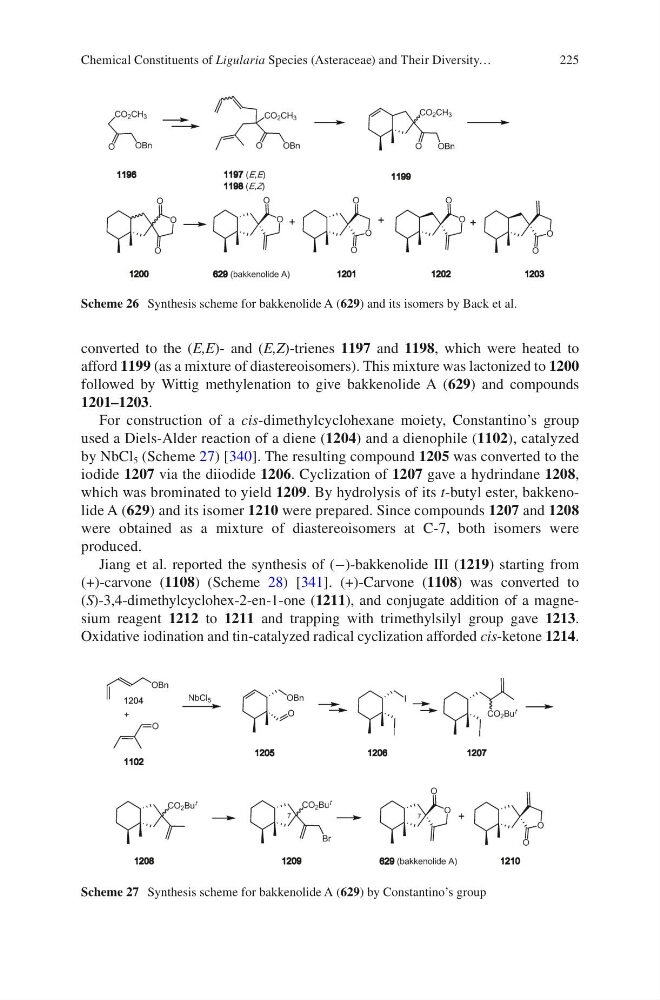
converted to the (E,E)- and (E,Z)-trienes 1197 and 1198, which were heated to
afford 1199 (as a mixture of diastereoisomers). This mixture was lactonized to 1200
followed by Wittig methylenation to give bakkenolide A (629) and compounds
1201–1203.
For construction of a cis-dimethylcyclohexane moiety, Constantino’s group
used a Diels-Alder reaction of a diene (1204) and a dienophile (1102), catalyzed
by NbCl 5 (Scheme 27) [340]. The resulting compound 1205 was converted to the
iodide 1207 via the diiodide 1206. Cyclization of 1207 gave a hydrindane 1208,
which was brominated to yield 1209. By hydrolysis of its t-butyl ester, bakkenolide A (629) and its isomer 1210 were prepared. Since compounds 1207 and 1208
were obtained as a mixture of diastereoisomers at C-7, both isomers were
produced.
Jiang et al. reported the synthesis of (−)-bakkenolide III (1219) starting from
(+)-carvone (1108) (Scheme 28) [341]. (+)-Carvone (1108) was converted to
(S)-3,4-dimethylcyclohex-2-en-1-one (1211), and conjugate addition of a magnesium reagent 1212 to 1211 and trapping with trimethylsilyl group gave 1213.
Oxidative iodination and tin-catalyzed radical cyclization afforded cis-ketone 1214.
Scheme 26 Synthesis scheme for bakkenolide A (629) and its isomers by Back et al.
Scheme 27 Synthesis scheme for bakkenolide A (629) by Constantino’s group
Chemical Constituents of Ligularia Species (Asteraceae) and Their Diversity…
converted to the (E,E)- and (E,Z)-trienes 1197 and 1198, which were heated to
afford 1199 (as a mixture of diastereoisomers). This mixture was lactonized to 1200
followed by Wittig methylenation to give bakkenolide A (629) and compounds
1201–1203.
For construction of a cis-dimethylcyclohexane moiety, Constantino’s group
used a Diels-Alder reaction of a diene (1204) and a dienophile (1102), catalyzed
by NbCl 5 (Scheme 27) [340]. The resulting compound 1205 was converted to the
iodide 1207 via the diiodide 1206. Cyclization of 1207 gave a hydrindane 1208,
which was brominated to yield 1209. By hydrolysis of its t-butyl ester, bakkenolide A (629) and its isomer 1210 were prepared. Since compounds 1207 and 1208
were obtained as a mixture of diastereoisomers at C-7, both isomers were
produced.
Jiang et al. reported the synthesis of (−)-bakkenolide III (1219) starting from
(+)-carvone (1108) (Scheme 28) [341]. (+)-Carvone (1108) was converted to
(S)-3,4-dimethylcyclohex-2-en-1-one (1211), and conjugate addition of a magnesium reagent 1212 to 1211 and trapping with trimethylsilyl group gave 1213.
Oxidative iodination and tin-catalyzed radical cyclization afforded cis-ketone 1214.
Scheme 26 Synthesis scheme for bakkenolide A (629) and its isomers by Back et al.
Scheme 27 Synthesis scheme for bakkenolide A (629) by Constantino’s group
Chemical Constituents of Ligularia Species (Asteraceae) and Their Diversity…