

211
5.2 Synthesis of Tetrahydroligularenolide Using Biogenetic
Type Rearrangement
Before the contributions of Yamakawa and Satoh were made, in 1972 Kitagawa’s
group published the first successful biogenetic-type rearrangement from a eudesmane to an eremophilane skeleton (Scheme 4) [315, 316]. When epoxide 1065,
prepared from dihydroalantolactone (1064), was treated with formic acid in acetone, four products (1066, 1067, 1068, and 1069) were obtained, of which three
were rearranged compounds with an eremophilane skeleton. Compound 1068 was
used for the synthesis of tetrahydroligularenolide (1071) via 1070.
O
O
O
EtO
O
O
O
O
O
168 (ligularone)
O
HO
1059 (furanofukinol)
HO
O
HO
161 (ligularol)
1051
1058
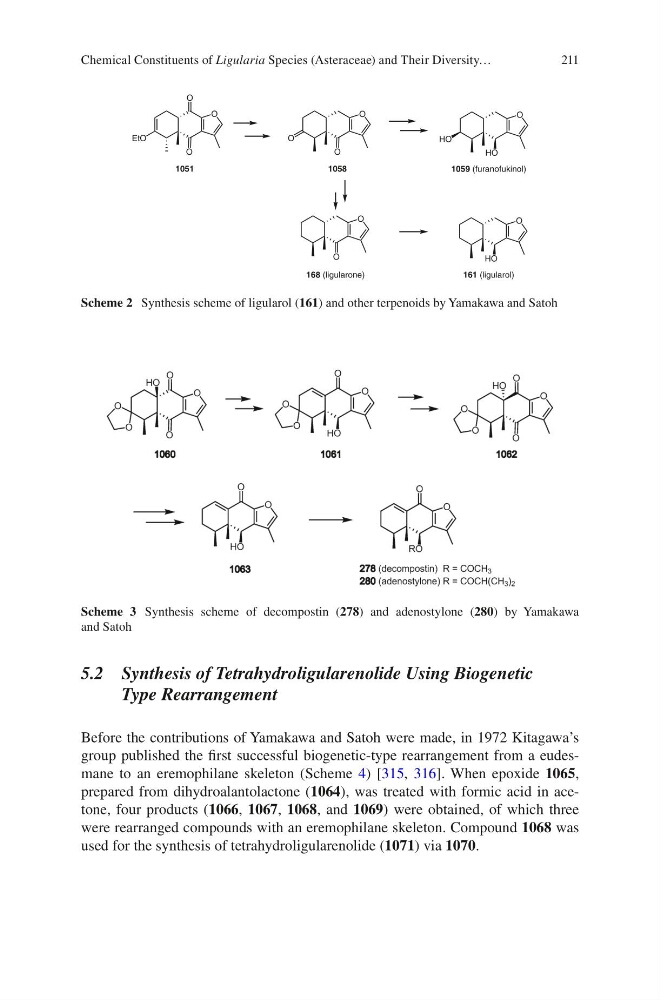
Scheme 2 Synthesis scheme of ligularol (161) and other terpenoids by Yamakawa and Satoh
Scheme 3 Synthesis scheme of decompostin (278) and adenostylone (280) by Yamakawa
and Satoh
Chemical Constituents of Ligularia Species (Asteraceae) and Their Diversity…
5.2 Synthesis of Tetrahydroligularenolide Using Biogenetic
Type Rearrangement
Before the contributions of Yamakawa and Satoh were made, in 1972 Kitagawa’s
group published the first successful biogenetic-type rearrangement from a eudesmane to an eremophilane skeleton (Scheme 4) [315, 316]. When epoxide 1065,
prepared from dihydroalantolactone (1064), was treated with formic acid in acetone, four products (1066, 1067, 1068, and 1069) were obtained, of which three
were rearranged compounds with an eremophilane skeleton. Compound 1068 was
used for the synthesis of tetrahydroligularenolide (1071) via 1070.
O
O
O
EtO
O
O
O
O
O
168 (ligularone)
O
HO
1059 (furanofukinol)
HO
O
HO
161 (ligularol)
1051
1058
Scheme 2 Synthesis scheme of ligularol (161) and other terpenoids by Yamakawa and Satoh
Scheme 3 Synthesis scheme of decompostin (278) and adenostylone (280) by Yamakawa
and Satoh
Chemical Constituents of Ligularia Species (Asteraceae) and Their Diversity…