

194
3.37 Hybrid Ligularia Species
Natural hybridization is an important step in plant diversification and evolution
[304–306]. During the course of our searching in the field, we were able to collect
several hybrid Ligularia species. The phytochemical profiles of these hybrids were
found to be diverse, depending on the individual sample examined (Table 45). A
number of furanoeremophilanes were obtained from hybrids of furanoeremophilaneproducing species. For example, from seven samples of hybrids between L. cyathiceps and L. subspicata (samples 1–7), 23 furanoeremophilanes were isolated. The
isolated compounds were 160, ligularol (161), 163, 165, 167, subspicatol A (170),
subspicatins A (171), B (172), C (173), O1 (175), O2 (176), 177, 181, 182, 185,
tetradymol (225), 226, 229, 230, 231, 232, 235, and 306. Seven eremophilan- 12,8olides (344, eremopetasitenin A8 (517), subspicatins M (519), N (520), eremopetasitenins B6 (525), B5 (527), subspicatin F (540)) were also obtained. Other
isolated compounds were fukinone (4), norsubspicatin A (130), bakkenolide A
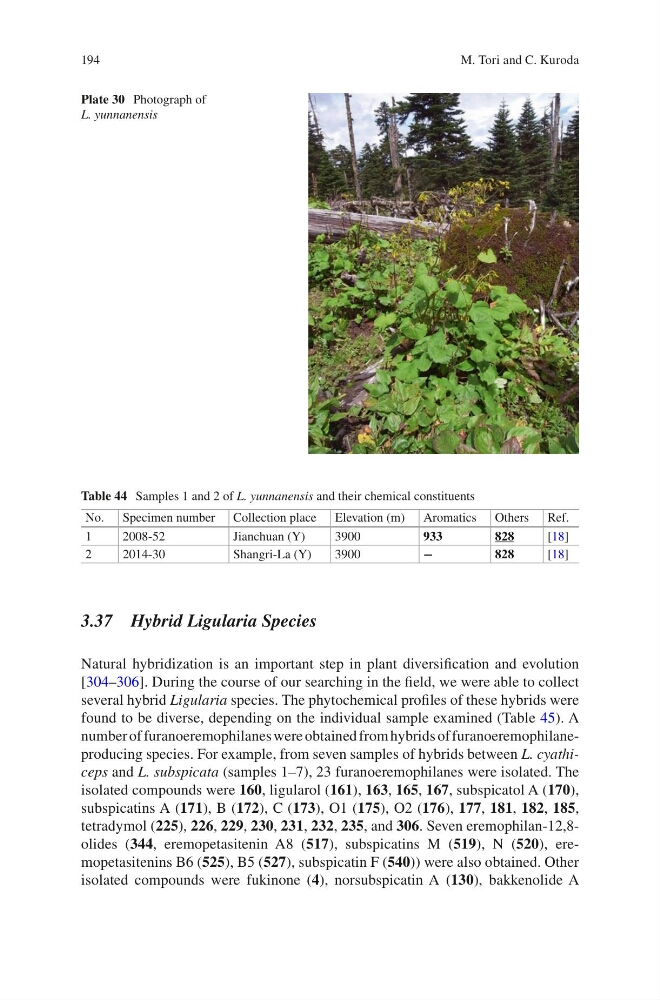
Plate 30 Photograph of
L. yunnanensis
Table 44 Samples 1 and 2 of L. yunnanensis and their chemical constituents
No. Specimen number Collection place Elevation (m) Aromatics Others Ref.
1
2008-52
Jianchuan (Y)
3900
933
828
[18]
2
2014-30
Shangri-La (Y)
3900
−
828
[18]
M. Tori and C. Kuroda
3.37 Hybrid Ligularia Species
Natural hybridization is an important step in plant diversification and evolution
[304–306]. During the course of our searching in the field, we were able to collect
several hybrid Ligularia species. The phytochemical profiles of these hybrids were
found to be diverse, depending on the individual sample examined (Table 45). A
number of furanoeremophilanes were obtained from hybrids of furanoeremophilaneproducing species. For example, from seven samples of hybrids between L. cyathiceps and L. subspicata (samples 1–7), 23 furanoeremophilanes were isolated. The
isolated compounds were 160, ligularol (161), 163, 165, 167, subspicatol A (170),
subspicatins A (171), B (172), C (173), O1 (175), O2 (176), 177, 181, 182, 185,
tetradymol (225), 226, 229, 230, 231, 232, 235, and 306. Seven eremophilan- 12,8olides (344, eremopetasitenin A8 (517), subspicatins M (519), N (520), eremopetasitenins B6 (525), B5 (527), subspicatin F (540)) were also obtained. Other
isolated compounds were fukinone (4), norsubspicatin A (130), bakkenolide A
Plate 30 Photograph of
L. yunnanensis
Table 44 Samples 1 and 2 of L. yunnanensis and their chemical constituents
No. Specimen number Collection place Elevation (m) Aromatics Others Ref.
1
2008-52
Jianchuan (Y)
3900
933
828
[18]
2
2014-30
Shangri-La (Y)
3900
−
828
[18]
M. Tori and C. Kuroda