

193
866 and 870 were isolated from L. muliensis (samples 9, 10) [86, 180, 209, 214].
Next, we compared the chemical composition of the former L. tsangchanensis with
that of L. muliensis. Cacalol derivatives from both species were isolated, namely,
cacalol (316), 322, 323, and 600 from sample 8 (former L. muliensis) and 316, 318,
319, 322, 323, 335 (farfugin A), 547 (cacalolide), 548 (epicacalolide), and 570 from
samples 5 and 6 (L. tsangchanensis) [25]. From these results, it was confirmed that
these two former individual species are identical in chemical composition. In addition, from sample 7 (a hybrid sample with L. vellerea) (vide infra), furanoeremophilanes 163, 164, and 180 were isolated together with an eremophila-1(10),11-diene
(1) [25]. Compound 180 may be a precursor of cacalol.
3.36 Ligularia yunnanensis (Franchet) C. C. Chang
Ligularia yunnanensis is taxonomically close to L. duciformis. We analyzed two
samples collected in Jianchuan and Shangri-La Counties, Yunnan Province (Plate
30, Table 44). Only a phenylpropanoid docosyl ferulate (933) and lupeol (828) were
isolated from these samples [18].
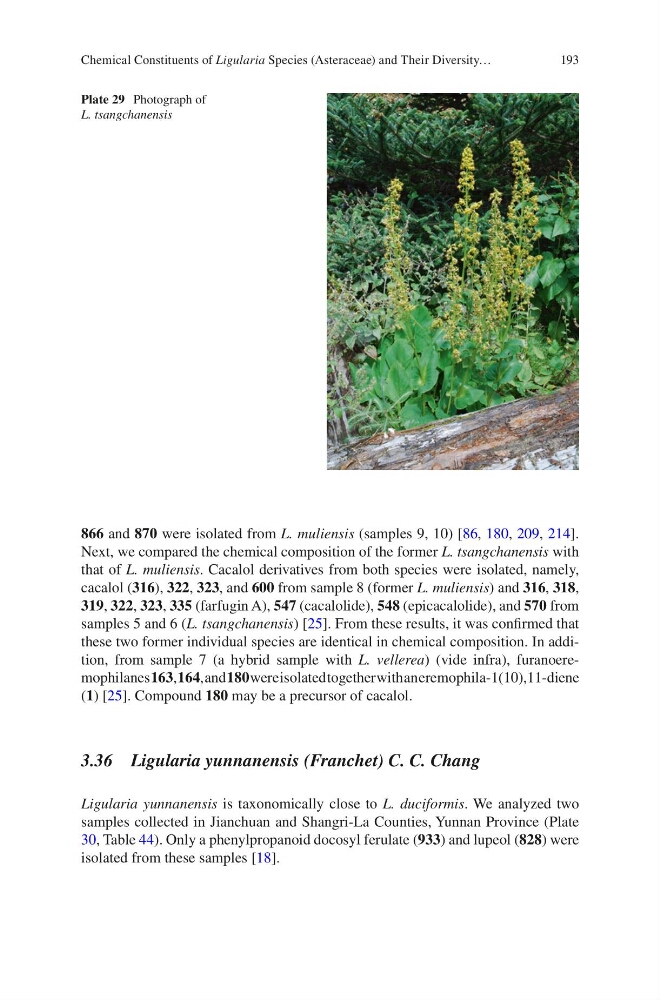
Plate 29 Photograph of
L. tsangchanensis
Chemical Constituents of Ligularia Species (Asteraceae) and Their Diversity…
866 and 870 were isolated from L. muliensis (samples 9, 10) [86, 180, 209, 214].
Next, we compared the chemical composition of the former L. tsangchanensis with
that of L. muliensis. Cacalol derivatives from both species were isolated, namely,
cacalol (316), 322, 323, and 600 from sample 8 (former L. muliensis) and 316, 318,
319, 322, 323, 335 (farfugin A), 547 (cacalolide), 548 (epicacalolide), and 570 from
samples 5 and 6 (L. tsangchanensis) [25]. From these results, it was confirmed that
these two former individual species are identical in chemical composition. In addition, from sample 7 (a hybrid sample with L. vellerea) (vide infra), furanoeremophilanes 163, 164, and 180 were isolated together with an eremophila-1(10),11-diene
(1) [25]. Compound 180 may be a precursor of cacalol.
3.36 Ligularia yunnanensis (Franchet) C. C. Chang
Ligularia yunnanensis is taxonomically close to L. duciformis. We analyzed two
samples collected in Jianchuan and Shangri-La Counties, Yunnan Province (Plate
30, Table 44). Only a phenylpropanoid docosyl ferulate (933) and lupeol (828) were
isolated from these samples [18].
Plate 29 Photograph of
L. tsangchanensis
Chemical Constituents of Ligularia Species (Asteraceae) and Their Diversity…