

156
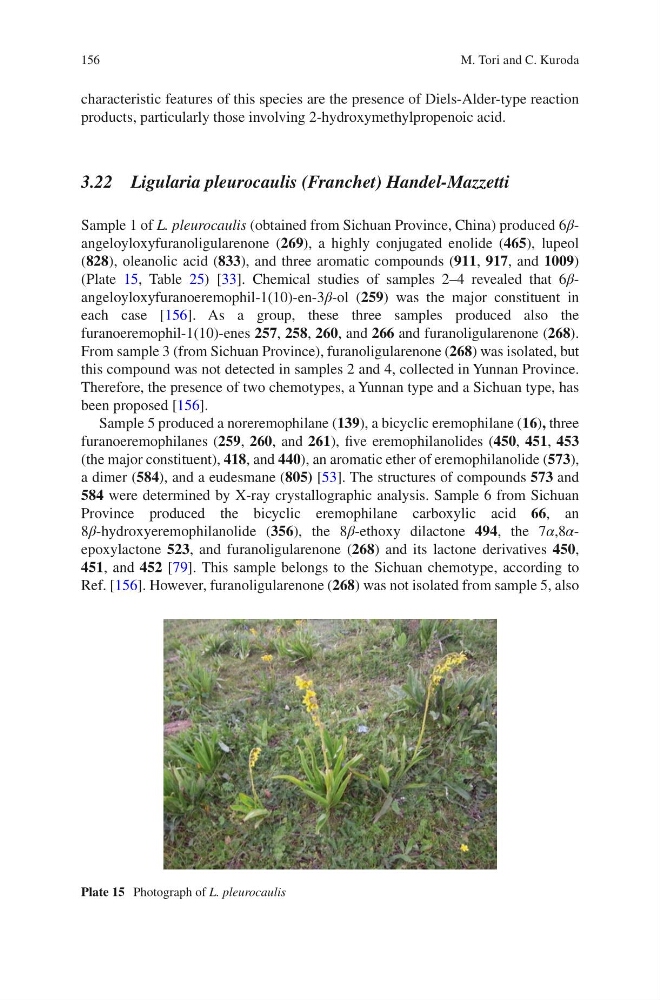
Plate 15 Photograph of L. pleurocaulis
characteristic features of this species are the presence of Diels-Alder-type reaction
products, particularly those involving 2-hydroxymethylpropenoic acid.
3.22 Ligularia pleurocaulis (Franchet) Handel-Mazzetti
Sample 1 of L. pleurocaulis (obtained from Sichuan Province, China) produced 6βangeloyloxyfuranoligularenone (269), a highly conjugated enolide (465), lupeol
(828), oleanolic acid (833), and three aromatic compounds (911, 917, and 1009)
(Plate 15, Table 25) [33]. Chemical studies of samples 2–4 revealed that 6βangeloyloxyfuranoeremophil- 1(10)-en-3β-ol (259) was the major constituent in
each case [156]. As a group, these three samples produced also the
furanoeremophil- 1(10)-enes 257, 258, 260, and 266 and furanoligularenone (268).
From sample 3 (from Sichuan Province), furanoligularenone (268) was isolated, but
this compound was not detected in samples 2 and 4, collected in Yunnan Province.
Therefore, the presence of two chemotypes, a Yunnan type and a Sichuan type, has
been proposed [156].
Sample 5 produced a noreremophilane (139), a bicyclic eremophilane (16), three
furanoeremophilanes (259, 260, and 261), five eremophilanolides (450, 451, 453
(the major constituent), 418, and 440), an aromatic ether of eremophilanolide (573),
a dimer (584), and a eudesmane (805) [53]. The structures of compounds 573 and
584 were determined by X-ray crystallographic analysis. Sample 6 from Sichuan
Province produced the bicyclic eremophilane carboxylic acid 66, an
8β-hydroxyeremophilanolide (356), the 8β-ethoxy dilactone 494, the 7α,8αepoxylactone 523, and furanoligularenone (268) and its lactone derivatives 450,
451, and 452 [79]. This sample belongs to the Sichuan chemotype, according to
Ref. [156]. However, furanoligularenone (268) was not isolated from sample 5, also
M. Tori and C. Kuroda
Plate 15 Photograph of L. pleurocaulis
characteristic features of this species are the presence of Diels-Alder-type reaction
products, particularly those involving 2-hydroxymethylpropenoic acid.
3.22 Ligularia pleurocaulis (Franchet) Handel-Mazzetti
Sample 1 of L. pleurocaulis (obtained from Sichuan Province, China) produced 6βangeloyloxyfuranoligularenone (269), a highly conjugated enolide (465), lupeol
(828), oleanolic acid (833), and three aromatic compounds (911, 917, and 1009)
(Plate 15, Table 25) [33]. Chemical studies of samples 2–4 revealed that 6βangeloyloxyfuranoeremophil- 1(10)-en-3β-ol (259) was the major constituent in
each case [156]. As a group, these three samples produced also the
furanoeremophil- 1(10)-enes 257, 258, 260, and 266 and furanoligularenone (268).
From sample 3 (from Sichuan Province), furanoligularenone (268) was isolated, but
this compound was not detected in samples 2 and 4, collected in Yunnan Province.
Therefore, the presence of two chemotypes, a Yunnan type and a Sichuan type, has
been proposed [156].
Sample 5 produced a noreremophilane (139), a bicyclic eremophilane (16), three
furanoeremophilanes (259, 260, and 261), five eremophilanolides (450, 451, 453
(the major constituent), 418, and 440), an aromatic ether of eremophilanolide (573),
a dimer (584), and a eudesmane (805) [53]. The structures of compounds 573 and
584 were determined by X-ray crystallographic analysis. Sample 6 from Sichuan
Province produced the bicyclic eremophilane carboxylic acid 66, an
8β-hydroxyeremophilanolide (356), the 8β-ethoxy dilactone 494, the 7α,8αepoxylactone 523, and furanoligularenone (268) and its lactone derivatives 450,
451, and 452 [79]. This sample belongs to the Sichuan chemotype, according to
Ref. [156]. However, furanoligularenone (268) was not isolated from sample 5, also
M. Tori and C. Kuroda