

155
epimeric at C-8. Four tricyclic eremophilanolides (484, 485, 486, and 487) were isolated
from sample 7 collected in Qinghai Province [203]. All these isolated compounds had
1β,10β-epoxide and 3β-tigloyloxy substituents. Sample 8 seems to have been produced
from the same extracts as sample 7, and liguhodgsonal (125), 486 (analyzed by X-ray
structural analysis), and 918 were isolated [106]. Sample 9 was collected in Qinghai
Province and produced bakkenolide A (629), 315, 333, lupeol (828), and 1008, as well as
three acids (923, 926, and 930) [167]. Compound 333 has an interesting structure, with a
dihydrofuran moiety rearranged to C-6. Sample 10 (Gansu Province) produced five
dimeric compounds, ligulasagitins A–E (625, 597, 600, 626, and 627) [221]. Ligulasagitins
B (597) and C (600) exhibited structures arising from an intramolecular Diels-Alder reaction with 2- hydroxymethylpropenoic acid. The structure of 597 was established by X-ray
analysis. The relative configurations of the three dimers 625, 626, and 627 at C-11 and
C-12 were determined as cis (H 3 -13/H-12), but the absolute configurations were not
ascertained.
Four Diels-Alder-type dimers (596, 601, 602, and 603) were isolated from sample 11 collected in Gansu Province [218]. The structure of 601 was established by
X-ray crystallographic analysis of its acetate. Sample 12 (Gansu Province) produced four noreremophilanes (95, 96, 105, and 109), a bicyclic diol (29), a 10-OH
furan (240), a 10-OH lactone (416), and a triterpenoid (839) [59]. Sample 13 from
Gansu Province produced two Diels-Alder-type derivatives, sagittacins A and B
(598 and 599), five eremophilanolides (398, 467, 473, sagittacin D (480), and sagittacin C (481)), and six bicyclic eremophilanes (30 (both isomers), 95, 101, 106, and
108) [61]. The structure of sagittacin A (598) was established by X-ray diffraction
analysis. However, there is some doubt about the stereochemistry of sagittacin D
(480), as published by Chen et al. in 2014 [61]. The configuration at C-8 was
assigned originally as C-8β-OH, but our analysis of the NOESY data presented has
indicated that C-8 should be α-OH, or otherwise the NOE data cannot be explained.
We have concluded that the structure of compound 480 should be revised as having
an 8α-hydroxy group, as depicted in Fig. 29. The ECD spectrum of sagittacin C
(481) was calculated in order to establish its absolute configuration, as depicted in
the formula. Recently, Li et al. isolated two dimers (ligusaginoids A and B; 609 and
610) and two trimers (ligusaginoids C and D; 623 and 624) (sample 14) [222]. The
structure of ligusaginoid A (609) was supported by X-ray structural analysis. The
measurement of ECD spectra was used for the determination of the absolute configurations of four dimeric and trimeric compounds. From L. sagitta, many 1β,10βepoxy tricyclic eremophilanes (having oxidation at C-1) and those bearing
6β-(2-hydroxymethyl)propenoyloxy substituents have been isolated. The
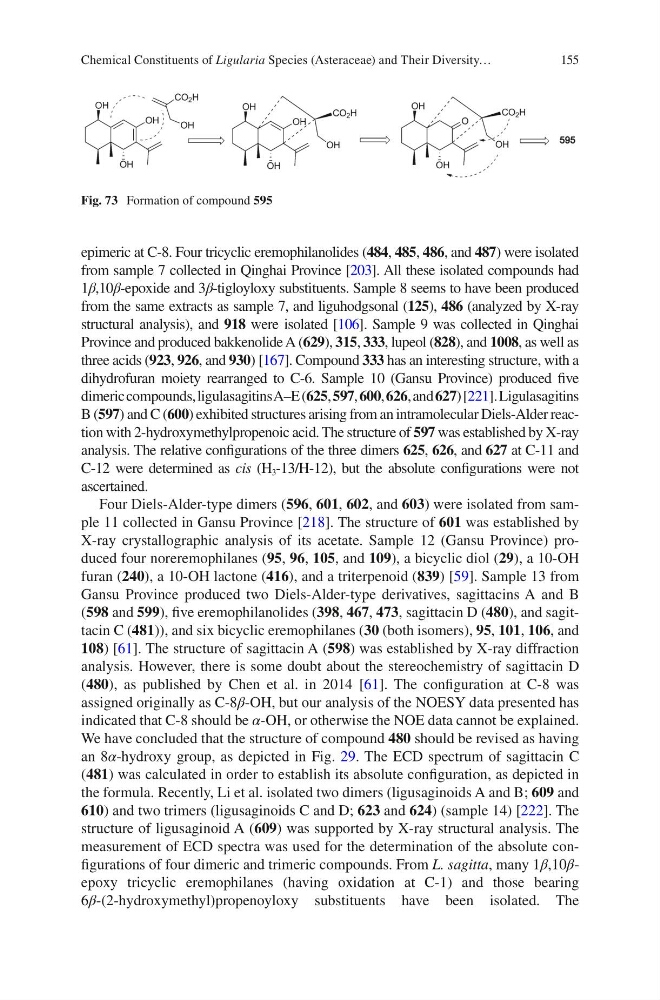
Fig. 73 Formation of compound 595
Chemical Constituents of Ligularia Species (Asteraceae) and Their Diversity…
epimeric at C-8. Four tricyclic eremophilanolides (484, 485, 486, and 487) were isolated
from sample 7 collected in Qinghai Province [203]. All these isolated compounds had
1β,10β-epoxide and 3β-tigloyloxy substituents. Sample 8 seems to have been produced
from the same extracts as sample 7, and liguhodgsonal (125), 486 (analyzed by X-ray
structural analysis), and 918 were isolated [106]. Sample 9 was collected in Qinghai
Province and produced bakkenolide A (629), 315, 333, lupeol (828), and 1008, as well as
three acids (923, 926, and 930) [167]. Compound 333 has an interesting structure, with a
dihydrofuran moiety rearranged to C-6. Sample 10 (Gansu Province) produced five
dimeric compounds, ligulasagitins A–E (625, 597, 600, 626, and 627) [221]. Ligulasagitins
B (597) and C (600) exhibited structures arising from an intramolecular Diels-Alder reaction with 2- hydroxymethylpropenoic acid. The structure of 597 was established by X-ray
analysis. The relative configurations of the three dimers 625, 626, and 627 at C-11 and
C-12 were determined as cis (H 3 -13/H-12), but the absolute configurations were not
ascertained.
Four Diels-Alder-type dimers (596, 601, 602, and 603) were isolated from sample 11 collected in Gansu Province [218]. The structure of 601 was established by
X-ray crystallographic analysis of its acetate. Sample 12 (Gansu Province) produced four noreremophilanes (95, 96, 105, and 109), a bicyclic diol (29), a 10-OH
furan (240), a 10-OH lactone (416), and a triterpenoid (839) [59]. Sample 13 from
Gansu Province produced two Diels-Alder-type derivatives, sagittacins A and B
(598 and 599), five eremophilanolides (398, 467, 473, sagittacin D (480), and sagittacin C (481)), and six bicyclic eremophilanes (30 (both isomers), 95, 101, 106, and
108) [61]. The structure of sagittacin A (598) was established by X-ray diffraction
analysis. However, there is some doubt about the stereochemistry of sagittacin D
(480), as published by Chen et al. in 2014 [61]. The configuration at C-8 was
assigned originally as C-8β-OH, but our analysis of the NOESY data presented has
indicated that C-8 should be α-OH, or otherwise the NOE data cannot be explained.
We have concluded that the structure of compound 480 should be revised as having
an 8α-hydroxy group, as depicted in Fig. 29. The ECD spectrum of sagittacin C
(481) was calculated in order to establish its absolute configuration, as depicted in
the formula. Recently, Li et al. isolated two dimers (ligusaginoids A and B; 609 and
610) and two trimers (ligusaginoids C and D; 623 and 624) (sample 14) [222]. The
structure of ligusaginoid A (609) was supported by X-ray structural analysis. The
measurement of ECD spectra was used for the determination of the absolute configurations of four dimeric and trimeric compounds. From L. sagitta, many 1β,10βepoxy tricyclic eremophilanes (having oxidation at C-1) and those bearing
6β-(2-hydroxymethyl)propenoyloxy substituents have been isolated. The
Fig. 73 Formation of compound 595
Chemical Constituents of Ligularia Species (Asteraceae) and Their Diversity…