

Water Footprint in Leather Tanning and Steel Production
151
Definition of goal and
scope
Inventory analysis
Impact assessment
Inventory analysis
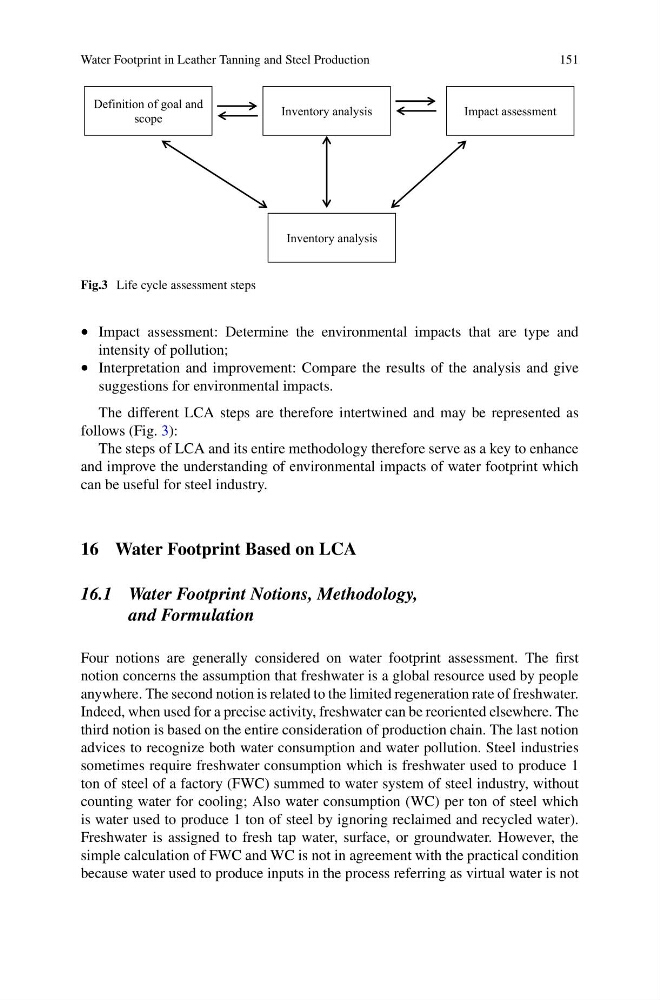
Fig.3 Life cycle assessment steps
• Impact assessment: Determine the environmental impacts that are type and
intensity of pollution;
• Interpretation and improvement: Compare the results of the analysis and give
suggestions for environmental impacts.
The different LCA steps are therefore intertwined and may be represented as
follows (Fig. 3):
The steps of LCA and its entire methodology therefore serve as a key to enhance
and improve the understanding of environmental impacts of water footprint which
can be useful for steel industry.
16 Water Footprint Based on LCA
16.1 Water Footprint Notions, Methodology,
and Formulation
Four notions are generally considered on water footprint assessment. The first
notion concerns the assumption that freshwater is a global resource used by people
anywhere. The second notion is related to the limited regeneration rate of freshwater.
Indeed, when used for a precise activity, freshwater can be reoriented elsewhere. The
third notion is based on the entire consideration of production chain. The last notion
advices to recognize both water consumption and water pollution. Steel industries
sometimes require freshwater consumption which is freshwater used to produce 1
ton of steel of a factory (FWC) summed to water system of steel industry, without
counting water for cooling; Also water consumption (WC) per ton of steel which
is water used to produce 1 ton of steel by ignoring reclaimed and recycled water).
Freshwater is assigned to fresh tap water, surface, or groundwater. However, the
simple calculation of FWC and WC is not in agreement with the practical condition
because water used to produce inputs in the process referring as virtual water is not
151
Definition of goal and
scope
Inventory analysis
Impact assessment
Inventory analysis
Fig.3 Life cycle assessment steps
• Impact assessment: Determine the environmental impacts that are type and
intensity of pollution;
• Interpretation and improvement: Compare the results of the analysis and give
suggestions for environmental impacts.
The different LCA steps are therefore intertwined and may be represented as
follows (Fig. 3):
The steps of LCA and its entire methodology therefore serve as a key to enhance
and improve the understanding of environmental impacts of water footprint which
can be useful for steel industry.
16 Water Footprint Based on LCA
16.1 Water Footprint Notions, Methodology,
and Formulation
Four notions are generally considered on water footprint assessment. The first
notion concerns the assumption that freshwater is a global resource used by people
anywhere. The second notion is related to the limited regeneration rate of freshwater.
Indeed, when used for a precise activity, freshwater can be reoriented elsewhere. The
third notion is based on the entire consideration of production chain. The last notion
advices to recognize both water consumption and water pollution. Steel industries
sometimes require freshwater consumption which is freshwater used to produce 1
ton of steel of a factory (FWC) summed to water system of steel industry, without
counting water for cooling; Also water consumption (WC) per ton of steel which
is water used to produce 1 ton of steel by ignoring reclaimed and recycled water).
Freshwater is assigned to fresh tap water, surface, or groundwater. However, the
simple calculation of FWC and WC is not in agreement with the practical condition
because water used to produce inputs in the process referring as virtual water is not