

From Field to Bottle: Water Footprint Estimation …
107
winter provides a period of rest for the vine [55]. In some areas that are warm yearround, such as Brazil, it may be possible to obtain up to 5 harvests over a two-year
period, however, this will cause the lifespan of the vine to decrease accordingly [25].
The winery is the centre of the vinification stage. The harvested grapes are brought
to the winery as quickly as possible for processing, making the vinification stage
seasonal in nature. The harvested grapes are destemmed and crushed to produce the
must, which is the mixture of grape juice, skins and/or stems that are directed to the
fermentation step. In the case of white wines, skins are removed prior to fermentation,
either during crushing or after a short contact period with the juice. Because the berry
pulp is essentially colourless, the skins of black grapes are left in the must for the
production of red wines, since it is the leaching of these coloured compounds from
the skins that produce red wine’s distinctive colour. Prior to fermentation, the must
may undergo several processing steps, including treatment with SO 2 , which acts as
a disinfectant and antioxidant, as well as acidification or deacidification, as needed.
Sucrose may be added, a process called chaptalization, however some regions, such
as California, Italy, Greece and Spain, prohibit the addition of sugar to the must [62].
Because of the high water content of the grape berry pulp, water is not generally
added as an ingredient during vinification and, like chaptalization, its addition is
often prohibited; despite this, it is occasionally permitted if the sugar concentration
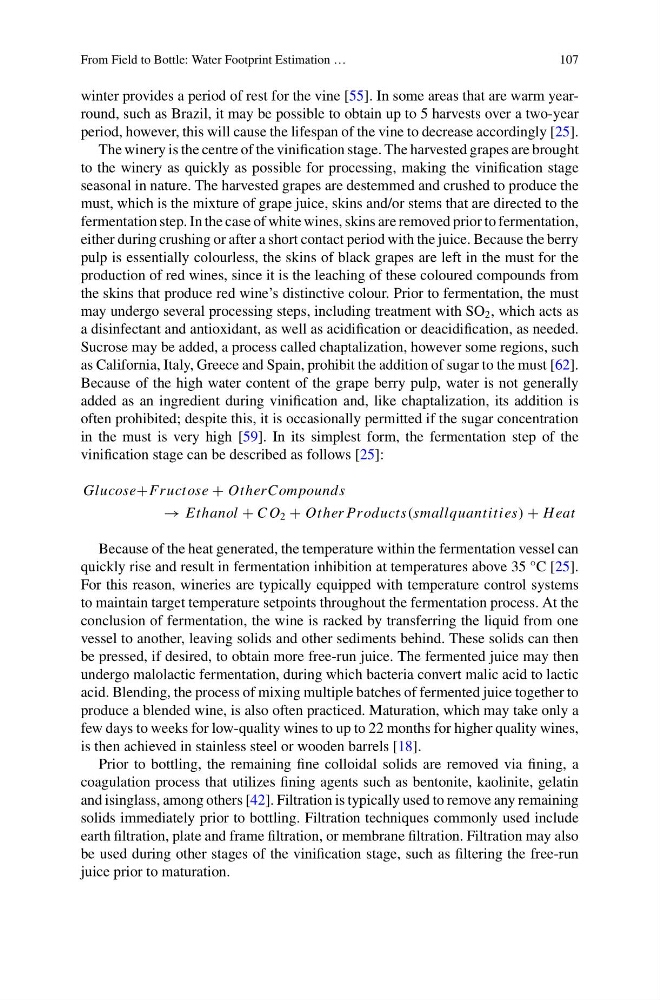
in the must is very high [59]. In its simplest form, the fermentation step of the
vinification stage can be described as follows [25]:
Glucose+Fructose + OtherCompounds
→ Ethanol + C O 2 + Other Products(smallquantities) + Heat
Because of the heat generated, the temperature within the fermentation vessel can
quickly rise and result in fermentation inhibition at temperatures above 35 °C [25].
For this reason, wineries are typically equipped with temperature control systems
to maintain target temperature setpoints throughout the fermentation process. At the
conclusion of fermentation, the wine is racked by transferring the liquid from one
vessel to another, leaving solids and other sediments behind. These solids can then
be pressed, if desired, to obtain more free-run juice. The fermented juice may then
undergo malolactic fermentation, during which bacteria convert malic acid to lactic
acid. Blending, the process of mixing multiple batches of fermented juice together to
produce a blended wine, is also often practiced. Maturation, which may take only a
few days to weeks for low-quality wines to up to 22 months for higher quality wines,
is then achieved in stainless steel or wooden barrels [18].
Prior to bottling, the remaining fine colloidal solids are removed via fining, a
coagulation process that utilizes fining agents such as bentonite, kaolinite, gelatin
and isinglass, among others [42]. Filtration is typically used to remove any remaining
solids immediately prior to bottling. Filtration techniques commonly used include
earth filtration, plate and frame filtration, or membrane filtration. Filtration may also
be used during other stages of the vinification stage, such as filtering the free-run
juice prior to maturation.
107
winter provides a period of rest for the vine [55]. In some areas that are warm yearround, such as Brazil, it may be possible to obtain up to 5 harvests over a two-year
period, however, this will cause the lifespan of the vine to decrease accordingly [25].
The winery is the centre of the vinification stage. The harvested grapes are brought
to the winery as quickly as possible for processing, making the vinification stage
seasonal in nature. The harvested grapes are destemmed and crushed to produce the
must, which is the mixture of grape juice, skins and/or stems that are directed to the
fermentation step. In the case of white wines, skins are removed prior to fermentation,
either during crushing or after a short contact period with the juice. Because the berry
pulp is essentially colourless, the skins of black grapes are left in the must for the
production of red wines, since it is the leaching of these coloured compounds from
the skins that produce red wine’s distinctive colour. Prior to fermentation, the must
may undergo several processing steps, including treatment with SO 2 , which acts as
a disinfectant and antioxidant, as well as acidification or deacidification, as needed.
Sucrose may be added, a process called chaptalization, however some regions, such
as California, Italy, Greece and Spain, prohibit the addition of sugar to the must [62].
Because of the high water content of the grape berry pulp, water is not generally
added as an ingredient during vinification and, like chaptalization, its addition is
often prohibited; despite this, it is occasionally permitted if the sugar concentration
in the must is very high [59]. In its simplest form, the fermentation step of the
vinification stage can be described as follows [25]:
Glucose+Fructose + OtherCompounds
→ Ethanol + C O 2 + Other Products(smallquantities) + Heat
Because of the heat generated, the temperature within the fermentation vessel can
quickly rise and result in fermentation inhibition at temperatures above 35 °C [25].
For this reason, wineries are typically equipped with temperature control systems
to maintain target temperature setpoints throughout the fermentation process. At the
conclusion of fermentation, the wine is racked by transferring the liquid from one
vessel to another, leaving solids and other sediments behind. These solids can then
be pressed, if desired, to obtain more free-run juice. The fermented juice may then
undergo malolactic fermentation, during which bacteria convert malic acid to lactic
acid. Blending, the process of mixing multiple batches of fermented juice together to
produce a blended wine, is also often practiced. Maturation, which may take only a
few days to weeks for low-quality wines to up to 22 months for higher quality wines,
is then achieved in stainless steel or wooden barrels [18].
Prior to bottling, the remaining fine colloidal solids are removed via fining, a
coagulation process that utilizes fining agents such as bentonite, kaolinite, gelatin
and isinglass, among others [42]. Filtration is typically used to remove any remaining
solids immediately prior to bottling. Filtration techniques commonly used include
earth filtration, plate and frame filtration, or membrane filtration. Filtration may also
be used during other stages of the vinification stage, such as filtering the free-run
juice prior to maturation.